Yogurt and lavender bar
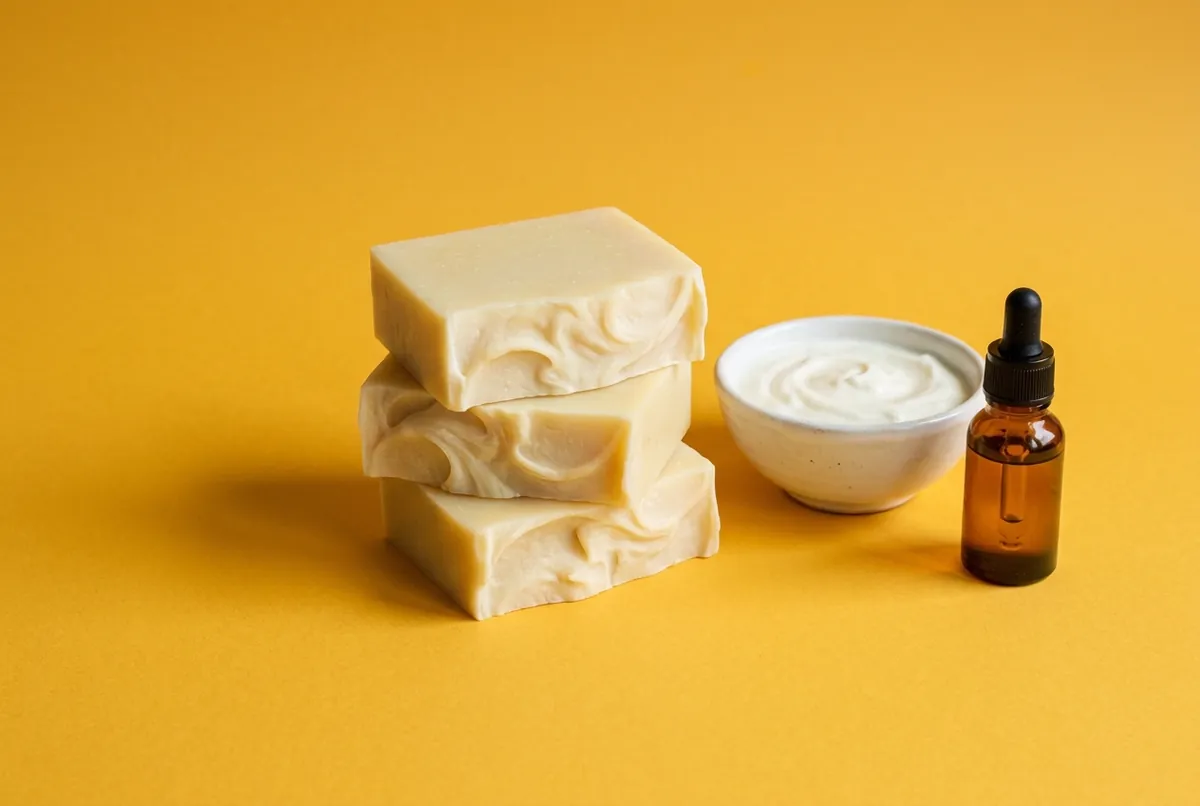
An olive-rich bar with plain yogurt stirred in at trace and a lavender and clary sage scent. The yogurt never meets the fresh lye, so there is nothing to freeze: the easiest way into milk soap.
- Skill
- Beginner
- Method
- Cold process
- Batch
- 1000 g of oils about 1488 g of batter
- Hands-on
- 45 min
- Cure
- 6 weeks
- Gel phase
- No keep it cool
What you need
For 1000 g of oils, which fills a 1.5 litre loaf mould. Weigh everything, liquids included.
| Olive Oil · 50.0 % | 500 g | 17.64 oz |
| Coconut Oil · 25.0 % | 250 g | 8.82 oz |
| Cocoa Butter · 10.0 % | 100 g | 3.53 oz |
| Shea Butter · 10.0 % | 100 g | 3.53 oz |
| Castor Oil · 5.0 % | 50 g | 1.76 oz |
| Sodium hydroxide (NaOH) · the lye, 100 % pure | 139.3 g | 4.91 oz |
| Distilled water · for a 36 % lye solution | 244.1 g | 8.61 oz |
| Plain whole-milk yogurt · unsweetened, at room temperature; stirred in at light trace | 75 g | 2.65 oz |
| Lavender essential oil · 2.5 % of the oils, at trace | 25 g | 0.88 oz |
| Clary sage essential oil · 0.5 % of the oils, at trace | 5 g | 0.18 oz |
- Superfat
- 5 %
- Temperatures
- Lye solution and oils at 30 to 35 °C (86 to 95 °F)
Method
-
Make the lye solution
Put on goggles, gloves and long sleeves and work where the air moves. Sprinkle the sodium hydroxide into the cold distilled water, never the water onto the lye, stir until it clears, and let it cool to 30 to 35 °C (86 to 95 °F). -
Bring the yogurt to room temperature
Weigh the yogurt into a small bowl, stir it smooth and leave it on the bench while you work, so it is not fridge-cold when it goes in. -
Melt the oils
Melt the coconut oil, cocoa butter and shea butter gently, stir in the olive and castor oils, and let them cool to 30 to 35 °C (86 to 95 °F). -
Weigh the scent and line the mould
Weigh the lavender and clary sage essential oils into a small glass and line the mould. -
Blend to light trace
Pour the lye solution into the oils through a sieve and stick blend in short bursts, stirring between them, until the batter looks like thin custard. -
Add the yogurt
Whisk a ladle of batter into the yogurt to loosen it, pour it back into the pot and stick blend for a few seconds, until no white streaks or lumps are left. -
Add the essential oils
Stir in the lavender and clary sage, then give the batter two or three short bursts with the blender. -
Pour
Pour into the mould, tap it on the bench to release air, and swirl the top with the back of a spoon if you like a textured finish. -
Keep it cool
Leave the mould uncovered and unwrapped in a cool room; in a warm kitchen, put it in the fridge for the first night. Heat can turn the yogurt bright yellow and give it an off smell. -
Unmould and cut
Unmould when the loaf is firm, usually after two to three days for a bar this rich in olive oil, letting it reach room temperature first if it was in the fridge, and cut it into bars. -
Cure
Stand the bars on a rack with air around them for six weeks, turning them now and then.
Tips
- Use ordinary plain, unsweetened yogurt. Greek yogurt carries less water and flavoured yogurt carries sugar, and either one changes the recipe.
- The yogurt brings 66 g of the recipe's water, so the lye dissolves in a little less water than usual, a solution of about 36 %. Let it cool before you use it.
- Olive oil makes a slow, forgiving batter, so there is time to add the yogurt and the scent before it thickens: a good first milk soap.
The oils
| Oil | Share |
|---|---|
| Olive Oil (virgin / refined / olive oil) | 50.0 % |
| Coconut Oil | 25.0 % |
| Cocoa Butter (Theobroma Oil) | 10.0 % |
| Shea Butter | 10.0 % |
| Castor Oil | 5.0 % |
How it is made
| Process | Cold process |
| Alkali | NaOH |
| Superfat | 5 % |
| Water | lye water at 31 % |
| Iodine value | 58 |
| INS | 148 |
Why make it
An olive-rich, conditioning bar, conditioning 57 and cleansing 17 on our scale, and an easy first milk soap, because the yogurt goes in at trace instead of meeting the hot lye. Milk soaps have long been recognised among makers for their gentleness (Casey Makela), and many people choose them for dry skin. The evidence is thin, and one reason is chemistry: yogurt's lactic acid is neutralised by the lye into sodium lactate, so the bar keeps none of yogurt's acidity, and what the milk mostly adds is a creamier lather and a softer feel. Lavender, softened with clary sage, is one of the best-loved scents in soap. Keep the loaf cool while it sets, or the yogurt can turn yellow and smell off.
Sources
- Casey Makela, Making Natural Milk Soap · Storey Publishing, 1999
What tradition, makers' experience and research say about soaps like this, each labelled for what it is. It is not medical advice, and no soap treats a skin condition: if you have one, ask a doctor or pharmacist.
What the numbers say
- Lauric acid 12.3 %
- Myristic acid 4.7 %
- Palmitic acid 12.2 %
- Stearic acid 9.8 %
- Ricinoleic acid 4.4 %
- Oleic acid 44.8 %
- Linoleic acid 7.7 %
- Other 5.1 %
Saturated : unsaturated 42 : 58
Computed from the fatty acids of the fats above. The bands are what the craft has settled on, not chemistry — a bar outside one is not wrong.
From the guides
All guides
Milk soap: goat milk, freezing and keeping it pale
How to make goat milk soap without scorching it: frozen milk, lye added a spoonful at a time, a cool mould, and a full recipe worked through the calculator.

Scenting soap: essential oils and fragrance oils
How much essential or fragrance oil to use in soap, what ounces per pound mean in percent, the IFRA limits for common essential oils, and EU allergen labelling.
Trace: how to tell when soap batter is ready
What trace is, how to read emulsion, light, medium and thick trace, how to spot false trace, and what makes soap batter thicken faster or slower.
Where these proportions come from
Adapted from Faiola's yogurt soap, an olive and coconut oil base with plain yogurt blended in after the lye rather than into it. We added cocoa and shea butter for a firmer bar and set the water so the lye still dissolves in a solution of about 36 % once the yogurt's share is taken out.
Formulation adapted from Soap Crafting by Anne-Marie Faiola (Storey Publishing, 2013). The method and notes are ours.