Almond milk and oat bar
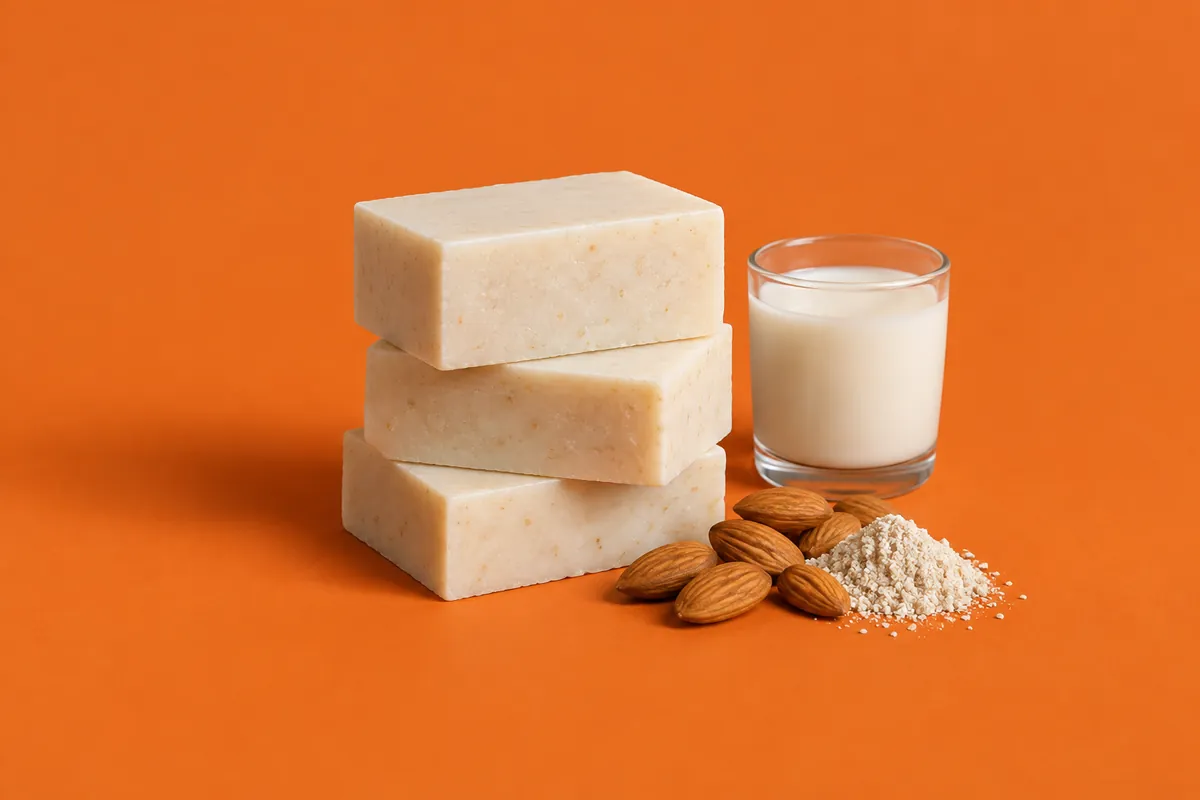
A vegan, palm-free bar with unsweetened almond milk as all of its liquid, sweet almond oil in the blend and a little oat flour. Unscented and mild, and more forgiving than dairy milk, since unsweetened almond milk carries almost no sugar to brown.
- Skill
- Intermediate
- Method
- Cold process
- Batch
- 1000 g of oils about 1445 g of batter
- Hands-on
- 55 min
- Cure
- 6 weeks
- Gel phase
- No keep it cool
What you need
For 1000 g of oils, which fills a 1.5 litre loaf mould. Weigh everything, liquids included.
| Olive Oil · 40.0 % | 400 g | 14.11 oz |
| Coconut Oil · 25.0 % | 250 g | 8.82 oz |
| Cocoa Butter · 15.0 % | 150 g | 5.29 oz |
| Almond Oil · 15.0 % | 150 g | 5.29 oz |
| Castor Oil · 5.0 % | 50 g | 1.76 oz |
| Sodium hydroxide (NaOH) · the lye, 100 % pure | 140.4 g | 4.95 oz |
| Almond milk, unsweetened, frozen in cubes · all of the liquid; the lye goes onto it | 293 g | 10.32 oz |
| Oat flour · 2 tbsp, finely ground oats, stirred into 1 tbsp of the oils first | 11.5 g | 0.41 oz |
- Superfat
- 5 %
- Temperatures
- Keep the almond milk and lye below 30 °C (86 °F) and soap at 27 to 32 °C (81 to 90 °F)
Method
-
Freeze the almond milk
The day before, shake the carton, weigh 292.5 g of almond milk into an ice-cube tray and freeze it solid. -
Get ready
Put on goggles, gloves and long sleeves, work where the air moves, weigh the oils, lye and oat flour, line the mould, clear a shelf in the fridge, and fill a bowl with ice and water for the lye jug to stand in. -
Melt the oils
Melt the coconut oil and cocoa butter gently, stir in the olive, sweet almond and castor oils, and let them cool to 27 to 32 °C (81 to 90 °F). -
Loosen the oat flour
Stir 2 tablespoons of oat flour into 1 tablespoon of the melted oils in a small cup until smooth, so it goes into the batter without lumps. -
Add the lye to the almond milk
Stand the jug of frozen almond milk in the iced water and sprinkle the 140.4 g of sodium hydroxide onto the milk a spoonful at a time, never the milk onto the lye, stirring until each dissolves. Take 10 to 15 minutes and keep it below 30 °C (86 °F); it stays paler than dairy milk, off-white to pale yellow. -
Strain and blend
Pour the almond milk and lye through a stainless steel sieve into the oils and stick blend in short bursts, stirring between them, to light trace. -
Add the oat flour
Stir in the oat flour mixture and blend for a few seconds until it has disappeared into the batter. -
Pour and chill
Pour into the mould, tap it on the bench to release air, smooth the top, and put it uncovered in the fridge for 24 hours. -
Unmould and cut
Let the loaf come back to room temperature before unmoulding, then cut it into bars once firm, usually 24 to 48 hours after pouring. -
Cure
Stand the bars on a rack with air around them for six weeks, turning them now and then.
Tips
- Buy unsweetened almond milk. The sugar in sweetened and flavoured versions scorches in lye just as dairy milk does. The thickeners and added calcium most cartons carry do no harm.
- Almond milk is about 97 % water, so it stands in for the water almost gram for gram; the calculator counts that water and the little fat it brings.
- Oat flour is rolled oats blended to a fine powder. Sieve out any flakes that stay whole if you want a smooth bar.
The oils
| Oil | Share |
|---|---|
| Olive Oil (virgin / refined / olive oil) | 40.0 % |
| Coconut Oil | 25.0 % |
| Cocoa Butter (Theobroma Oil) | 15.0 % |
| Almond Oil (Sweet Almond Oil) | 15.0 % |
| Castor Oil | 5.0 % |
How it is made
| Process | Cold process |
| Alkali | NaOH |
| Superfat | 5 % |
| Water | lye water at 33 % |
| Iodine value | 60 |
| INS | 147 |
Why make it
For anyone who wants the creamy feel people look for in a milk soap without dairy: unsweetened almond milk replaces all the water, and the oils are vegan and palm-free. By our numbers it is a balanced, mild bar, cleansing 17 and conditioning 60, and it has no scent added, in line with dermatologists' advice to use fragrance-free products on dry, sensitive skin. Almond milk is almost all water and brings very little sugar or fat, so its part is mostly a paler bar and the pleasure of the idea; the case for it rests on makers' preference, not evidence. Oat flour adds a soft, barely-there texture. Oats are a recognised skin protectant in leave-on products, though in a rinse-off bar the contact is brief. With almond in it twice over, it is not for anyone with a nut allergy.
Sources
- Dermatologists' top tips for relieving dry skin · American Academy of Dermatology, 2026
- 21 CFR 347.10, Skin protectant active ingredients · US Food and Drug Administration, Code of Federal Regulations
What tradition, makers' experience and research say about soaps like this, each labelled for what it is. It is not medical advice, and no soap treats a skin condition: if you have one, ask a doctor or pharmacist.
What the numbers say
- Lauric acid 12.3 %
- Myristic acid 4.7 %
- Palmitic acid 12.8 %
- Stearic acid 7.3 %
- Ricinoleic acid 4.4 %
- Oleic acid 45.2 %
- Linoleic acid 9.8 %
- Other 5.0 %
Saturated : unsaturated 40 : 60
Computed from the fatty acids of the fats above. The bands are what the craft has settled on, not chemistry — a bar outside one is not wrong.
From the guides
All guides
Milk soap: goat milk, freezing and keeping it pale
How to make goat milk soap without scorching it: frozen milk, lye added a spoonful at a time, a cool mould, and a full recipe worked through the calculator.
Palm-free soap: what takes palm oil's place
What palm oil does in a bar of soap, why makers drop it, and how lard, tallow, shea, cocoa, kokum or stearic acid take its place, with worked palm-free recipes.

Soap additives: salt, sugar, sodium lactate, clays, oats, silk and more
What common soap additives do, how much to use and when they go in: sourced doses for sodium lactate, salt, sugar, honey, citric acid, clays, oats and silk.
Where these proportions come from
Our own vegan, palm-free formulation: olive, coconut and cocoa butter with sweet almond oil at 5 % superfat, unsweetened almond milk frozen as all of the liquid, and oat flour at the usual tablespoon per pound of oils.