Carrot and honey bar
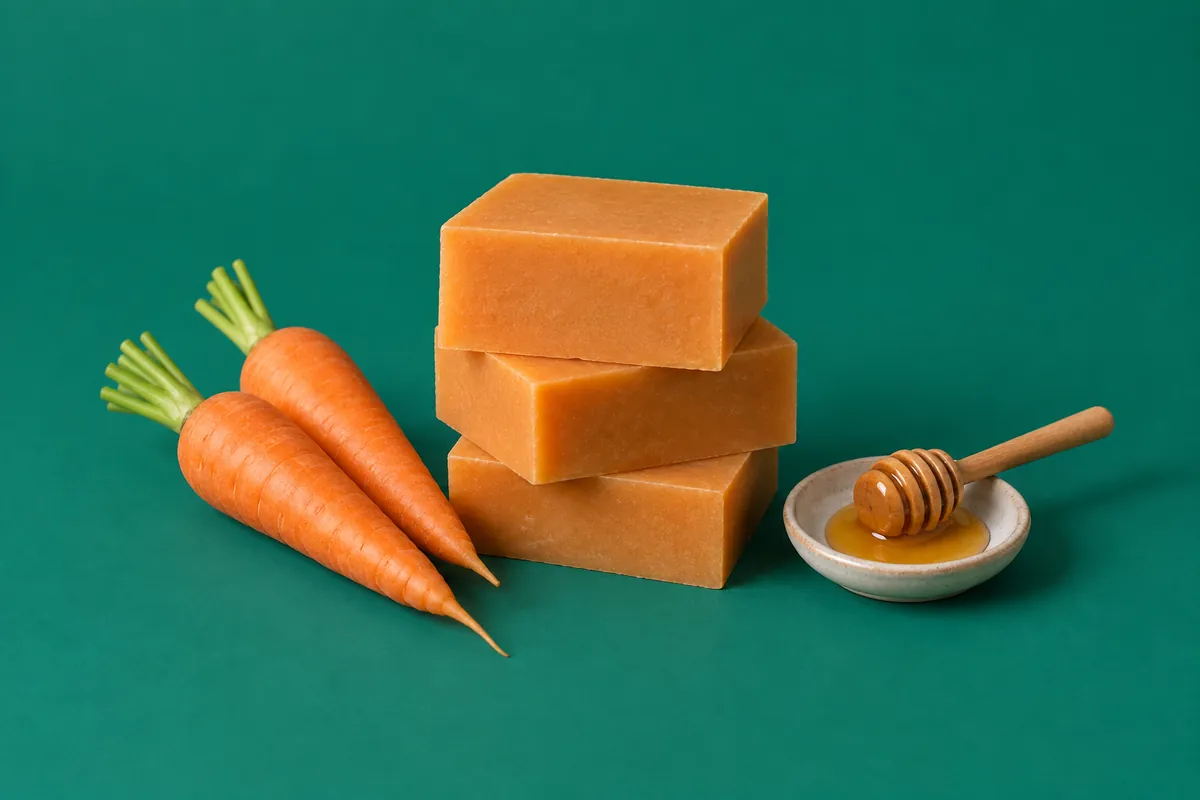
A gentle, olive-rich bar made with fresh carrot juice as half of its liquid and a spoonful of honey for lather. Annatto infused in the olive oil gives it a warm, natural orange that carrot alone never manages; unscented.
- Skill
- Intermediate
- Method
- Cold process
- Batch
- 1000 g of oils about 1462 g of batter
- Hands-on
- 1 h 15 min
- Cure
- 6 weeks
- Gel phase
- No keep it cool
What you need
For 1000 g of oils, which fills a 1.5 litre loaf mould. Weigh everything, liquids included.
| Olive Oil · 45.0 % | 450 g | 15.87 oz |
| Coconut Oil · 20.0 % | 200 g | 7.05 oz |
| Shea Butter · 15.0 % | 150 g | 5.29 oz |
| Cocoa Butter · 10.0 % | 100 g | 3.53 oz |
| Rice Bran Oil · 5.0 % | 50 g | 1.76 oz |
| Castor Oil · 5.0 % | 50 g | 1.76 oz |
| Sodium hydroxide (NaOH) · the lye, 100 % pure | 135.3 g | 4.77 oz |
| Distilled water · for a 34 % lye solution | 130.8 g | 4.61 oz |
| Carrot juice, fresh · half of the liquid; frozen with the water | 154 g | 5.43 oz |
| Honey · 2 tbsp, warmed and stirred into 1 tbsp of the oils | 42 g | 1.48 oz |
| Annatto seed · 4 tsp, infused in 220 g of the olive oil and strained out | 8.4 g | 0.30 oz |
- Superfat
- 6 %
- Temperatures
- Carrot lye kept below 30 °C (86 °F); oils at 32 to 35 °C (90 to 95 °F) when it goes in
Method
-
Infuse the annatto
A day ahead, put 4 teaspoons of annatto seeds and 220 g of the recipe's olive oil in a jar and stand it in a pan of hot water, keeping the oil at about 49 °C (120 °F) and below 54 °C (130 °F), for 1 to 2 hours, until the oil is deep orange. Strain it through fine cloth and top it back up to 220 g with plain olive oil; heat oil only in a water bath, and never leave it unattended. -
Freeze the carrot juice
The day before, stir 154 g of fresh carrot juice and 130.8 g of distilled water together and freeze them in an ice-cube tray. -
Get ready
Put on goggles, gloves and long sleeves, open a window or run the extractor, weigh the oils and lye, line the mould, and make an ice bath the lye jug can stand in. -
Melt the oils
Melt the cocoa butter, shea butter and coconut oil, stir in the annatto oil, the rest of the olive oil and the rice bran and castor oils, and let them cool to 32 to 35 °C (90 to 95 °F). Set a tablespoon of them aside for the honey. -
Add the lye to the frozen juice
Put the cubes in a heat-safe jug standing in the ice bath and sprinkle in the lye a spoonful at a time, stirring until each dissolves; never pour the juice onto the lye. Take 10 to 15 minutes and keep it below 30 °C (86 °F), so the carrot's sugar doesn't scorch. -
Strain and combine
Pour the cold carrot lye through a stainless steel sieve into the oils and stick blend in short bursts to light trace, like thin custard. -
Add the honey
Warm 2 tablespoons of honey until it pours, stir it into the tablespoon of oil you set aside, and blend it in. Honey speeds trace, so have the mould ready. -
Pour
Pour into the mould, tap it on the bench to release air, and smooth the top. -
Keep it cool
Put the mould uncovered in the fridge for the first night: carrot sugar and honey both heat the loaf, and a warm, wrapped one can crack or rise out of the mould. -
Unmould and cut
Let the loaf come back to room temperature, then unmould and cut it once firm, usually after 36 to 48 hours. -
Cure
Cure the bars on a rack with air around them for six weeks, turning them now and then.
Tips
- The orange is the annatto's. Carrot juice on its own gives a pale yellow-orange at best; use fewer seeds for a yellower bar, but not many more, or the lather turns orange too.
- Fresh carrot juice keeps only a day or two in the fridge, so freeze it with the water the day you juice or open it.
- Honey goes in at trace, never into the lye: its sugar would heat the solution towards the point where sugars and lye give off carbon monoxide, above 84 °C (183 °F).
The oils
| Oil | Share |
|---|---|
| Olive Oil (virgin / refined / olive oil) | 45.0 % |
| Coconut Oil | 20.0 % |
| Shea Butter | 15.0 % |
| Cocoa Butter (Theobroma Oil) | 10.0 % |
| Rice Bran Oil | 5.0 % |
| Castor Oil | 5.0 % |
How it is made
| Process | Cold process |
| Alkali | NaOH |
| Superfat | 6 % |
| Water | lye water at 33 % |
| Iodine value | 61 |
| INS | 141 |
Why make it
A gentle, olive-rich bar for dry skin, cleansing 14 and conditioning 59 on our scale, unscented and palm-free. Carrot juice and honey both carry sugars, which soapmakers find lift the lather, and honey is a favourite in soap for exactly that reason. Carrot soaps are often sold on vitamin A and beta-carotene, but a bar spends seconds on the skin before it is rinsed away, and there is no evidence the carrot does anything for skin; the case for it is the warm colour, the story and a slightly fuller lather. The orange here comes mostly from annatto, a seed long used to colour food such as cheese. With no fragrance, it suits people who avoid scent.
Sources
- Pure Soapmaking · Storey Publishing, 2016
What tradition, makers' experience and research say about soaps like this, each labelled for what it is. It is not medical advice, and no soap treats a skin condition: if you have one, ask a doctor or pharmacist.
What the numbers say
- Lauric acid 9.8 %
- Myristic acid 3.8 %
- Palmitic acid 12.2 %
- Stearic acid 11.7 %
- Ricinoleic acid 4.4 %
- Oleic acid 45.5 %
- Linoleic acid 8.9 %
- Other 4.4 %
Saturated : unsaturated 40 : 60
Computed from the fatty acids of the fats above. The bands are what the craft has settled on, not chemistry — a bar outside one is not wrong.
From the guides
All guides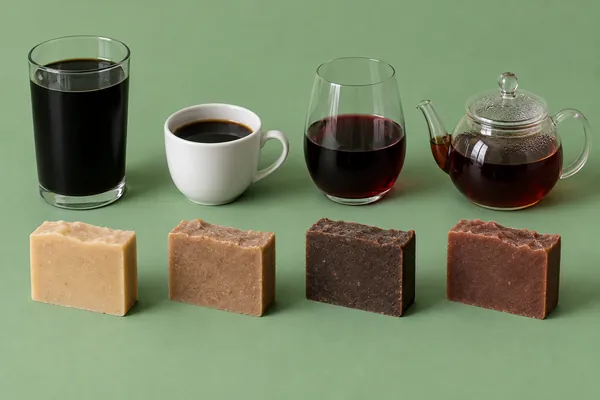
Beer, wine, coffee, tea and juice in soap
Using beer, wine, coffee, tea or juice in place of soap's water: how to prepare each one, add the lye safely, and what the calculator does with the liquid.

Natural colourants: what herbs, clays and spices really do in soap
Clays, charcoal and plant colours in cold-process soap: doses per 500 g of oils, infused oil, powder or lye, and the colour each one actually turns.

Soap additives: salt, sugar, sodium lactate, clays, oats, silk and more
What common soap additives do, how much to use and when they go in: sourced doses for sodium lactate, salt, sugar, honey, citric acid, clays, oats and silk.
Where these proportions come from
Our own formulation: an olive-rich moisturising bar with a fifth coconut oil and a quarter shea and cocoa butter, at a 6 % superfat. Carrot juice is half of the liquid, frozen with the distilled water, and annatto infused in part of the olive oil gives the orange that carrot alone cannot.