Chai spice bar
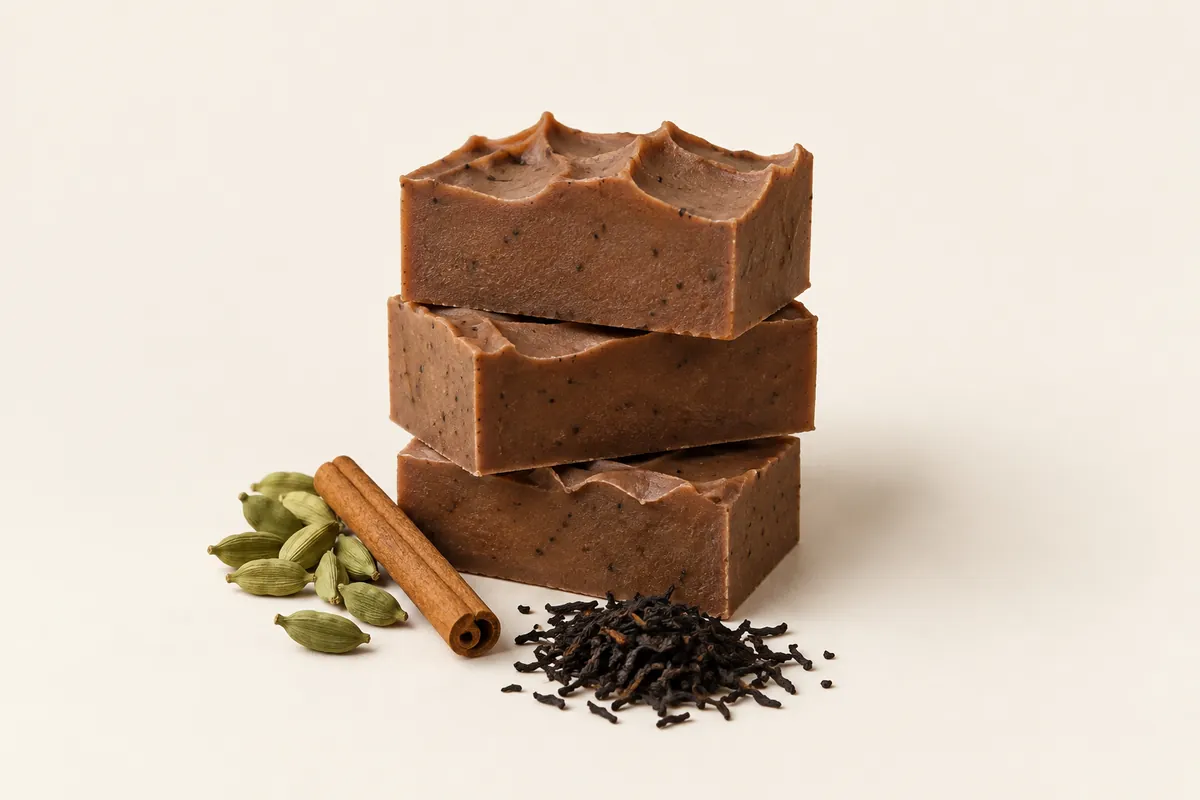
An everyday bar made with strong home-brewed chai as all of its liquid, scented with cardamom and ginger and flecked with a pinch of cinnamon. Black tea turns it a deep brown, but the lather stays white.
- Skill
- Beginner
- Method
- Cold process
- Batch
- 1000 g of oils about 1447 g of batter
- Hands-on
- 1 hour
- Cure
- 6 weeks
- Gel phase
- No keep it cool
What you need
For 1000 g of oils, which fills a 1.5 litre loaf mould. Weigh everything, liquids included.
| Olive Oil · 35.0 % | 350 g | 12.35 oz |
| Coconut Oil · 25.0 % | 250 g | 8.82 oz |
| Shea Butter · 20.0 % | 200 g | 7.05 oz |
| Cocoa Butter · 10.0 % | 100 g | 3.53 oz |
| Sunflowerseed Oil - High Oleic Acid · 5.0 % | 50 g | 1.76 oz |
| Castor Oil · 5.0 % | 50 g | 1.76 oz |
| Sodium hydroxide (NaOH) · the lye, 100 % pure | 137.3 g | 4.84 oz |
| Chai (spiced black tea), brewed strong and chilled · all of the liquid; brewed without cloves | 280 g | 9.86 oz |
| Ground cinnamon · a large pinch, for a few specks | 0.5 g | 0.02 oz |
| Black tea, green cardamom and fresh ginger, for the chai · 8 g of tea (about 4 bags), 2 g of cardamom (about 8 pods, lightly crushed) and 10 g of fresh ginger (4 thin slices), simmered together and strained out | 8 g | 0.28 oz |
| Cardamom essential oil · 2.0 % of the oils, at trace | 20 g | 0.71 oz |
| Ginger essential oil · 1.0 % of the oils, at trace | 10 g | 0.35 oz |
- Superfat
- 6 %
- Temperatures
- Chai lye and oils at 32 to 38 °C (90 to 100 °F)
Method
-
Brew the chai a day ahead
Simmer 4 black tea bags, 8 lightly crushed green cardamom pods and 4 thin slices of fresh ginger in about 400 ml of distilled water for 5 minutes, then take it off the heat and steep for 10 minutes more. Strain it and chill it overnight in a covered jug. -
Get ready
Put on goggles, gloves and long sleeves, open a window or run the extractor, weigh every ingredient and line the mould. -
Melt the oils
Melt the coconut oil, shea butter and cocoa butter, stir in the olive, sunflower and castor oils, and let them cool to 32 to 38 °C (90 to 100 °F). -
Add the lye to the chai
Weigh 279.5 g of the cold chai into a heat-safe jug standing in cold water and sprinkle in the 137.3 g of sodium hydroxide a spoonful at a time, stirring until each dissolves; never pour the tea onto the lye. It goes very dark and smells strong, so keep your face away, and let it cool to 32 to 38 °C (90 to 100 °F). -
Combine
Pour the chai lye into the oils down the shaft of the stick blender and blend in short bursts to light trace, like thin custard. -
Scent it
Stir in 20 g cardamom and 10 g ginger essential oil by hand. Spice oils can thicken batter quickly, so have the mould ready and pour soon after. -
Add the cinnamon specks
Sprinkle 0.5 g of ground cinnamon, a large pinch, over the batter and fold it in with a spatula, just until it is spread through. -
Pour
Pour into the mould, tap it on the bench to release air, and texture the top with the back of a spoon if you like. -
Keep it cool
Leave the mould uncovered in a cool room rather than wrapping it: tea soap that gels hot can show pale, translucent veins called glycerin rivers. If the top starts to dome, move it somewhere cooler. -
Unmould and cut
Unmould with gloves on after 24 to 48 hours, when the loaf is firm, and cut it into bars. -
Cure
Cure the bars on a rack with air around them for six weeks, turning them now and then.
Tips
- Ground cinnamon carries cinnamaldehyde, a skin sensitiser the EU lists as the allergen cinnamal. A pinch for specks is as far as it should go: leave it out for sensitive skin, and never swap in cinnamon or clove essential oil.
- Shop chai blends often contain cloves and cinnamon bark. Brewing your own from black tea, cardamom and ginger keeps both out of the liquid.
- Black tea goes very dark in lye, so expect a medium to dark brown bar however cool you keep it. The lather is still white.
The oils
| Oil | Share |
|---|---|
| Olive Oil (virgin / refined / olive oil) | 35.0 % |
| Coconut Oil | 25.0 % |
| Shea Butter | 20.0 % |
| Cocoa Butter (Theobroma Oil) | 10.0 % |
| Sunflowerseed Oil - High Oleic Acid | 5.0 % |
| Castor Oil | 5.0 % |
How it is made
| Process | Cold process |
| Alkali | NaOH |
| Superfat | 6 % |
| Water | lye water at 33 % |
| Iodine value | 54 |
| INS | 150 |
Why make it
An everyday bar for people who like a warm, spicy soap: a quarter coconut for lather and 30 % shea and cocoa butter for a firm bar that lasts, cleansing 17 and conditioning 55 on our scale. The chai is there for colour and the idea; black tea turns the bar a deep brown, and there is no good evidence that tea does anything for skin in a soap that is rinsed off. Cardamom and ginger are chosen for their scent, sweet and peppery. The caveat is the spice cupboard: cinnamon carries cinnamal and cloves carry eugenol, both fragrance allergens that EU law requires on labels, which is why this recipe brews its chai without cloves and uses only a pinch of ground cinnamon for specks and no cinnamon or clove oil. Anyone with a fragrance allergy should choose an unscented bar.
Sources
- Commission Regulation (EU) 2023/1545 on the labelling of fragrance allergens in cosmetic products · Official Journal of the European Union, 2023
What tradition, makers' experience and research say about soaps like this, each labelled for what it is. It is not medical advice, and no soap treats a skin condition: if you have one, ask a doctor or pharmacist.
What the numbers say
- Lauric acid 12.3 %
- Myristic acid 4.7 %
- Palmitic acid 10.7 %
- Stearic acid 13.8 %
- Ricinoleic acid 4.4 %
- Oleic acid 43.3 %
- Linoleic acid 7.0 %
- Other 4.9 %
Saturated : unsaturated 45 : 55
Computed from the fatty acids of the fats above. The bands are what the craft has settled on, not chemistry — a bar outside one is not wrong.
From the guides
All guides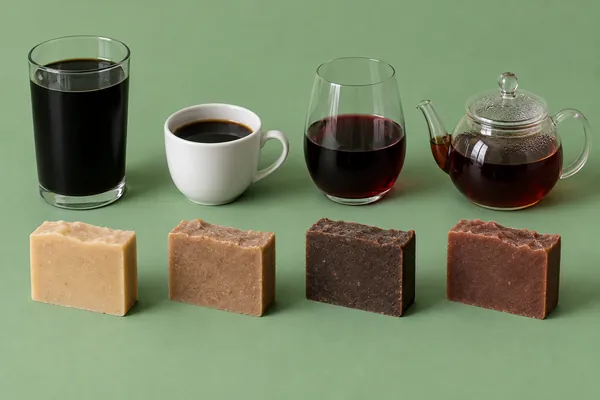
Beer, wine, coffee, tea and juice in soap
Using beer, wine, coffee, tea or juice in place of soap's water: how to prepare each one, add the lye safely, and what the calculator does with the liquid.
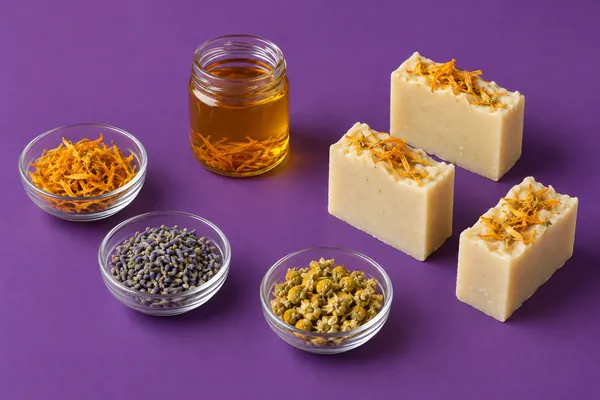
Herbs, flowers and infusions in soap
What dried herbs, petals, infused oils and herbal teas really do in soap: which survive lye, how to infuse an oil, and which claims a herbal soap can make.

Scenting soap: essential oils and fragrance oils
How much essential or fragrance oil to use in soap, what ounces per pound mean in percent, the IFRA limits for common essential oils, and EU allergen labelling.
Where these proportions come from
Our own formulation: a palm-free everyday bar with a quarter coconut oil for lather and 30 % shea and cocoa butter for a firm bar, at a 6 % superfat. Strong chai brewed without cloves is all of the liquid, as in Corley Barto's chai tea soap.