Coconut liquid dish soap
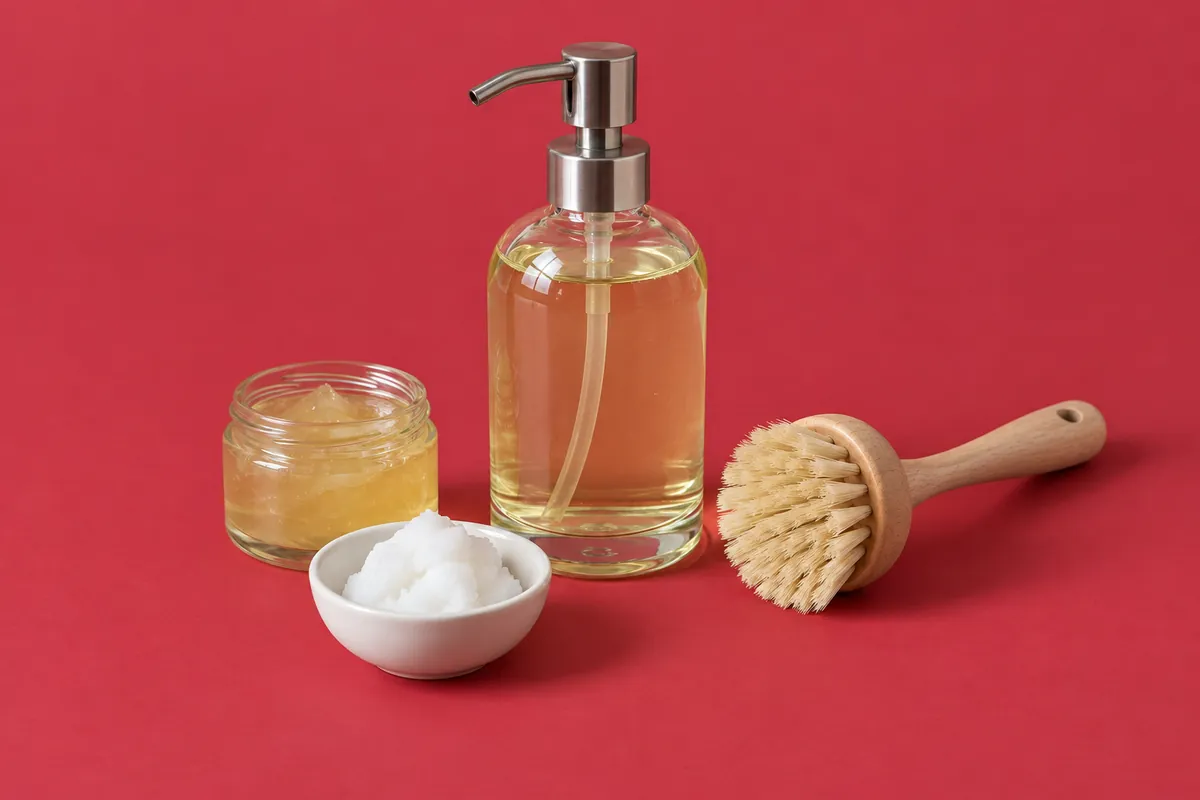
A thin, clear washing-up liquid made the old way: 85 % coconut oil cooked with potassium hydroxide into a paste, then diluted to a fifth soap. Coconut soap dissolves in cool water and cuts grease, but it is true soap: for the sink, never the dishwasher.
- Skill
- Advanced
- Method
- Hot process
- Batch
- 500 g of oils about 1025 g of batter
- Hands-on
- 1 h 30 min
- Cure
- 2 weeks
- Gel phase
- In the pot it gels as it cooks
What you need
For 500 g of oils, which fills three 1-litre squeeze or pump bottles once diluted. Weigh everything, liquids included.
| Coconut Oil · 85.0 % | 425 g | 14.99 oz |
| Castor Oil · 15.0 % | 75 g | 2.65 oz |
| Potassium hydroxide (KOH) · the lye, 90 % pure; if your label says otherwise, weigh 139.0 g at 85 % or 124.4 g at 95 % | 131.3 g | 4.63 oz |
| Distilled water · for a 25 % lye solution | 393.8 g | 13.89 oz |
| Boiling water, for the clarity test · to dissolve 28 g of cooked paste and see whether it runs clear | 59 ml | |
| Distilled water, for diluting the paste · boiling; 3091 g less the weight of the cooked paste, about 2066 g if the cook lost no steam and more if it did | 2066 g | 72.88 oz |
- Superfat
- 3.5 %
- Temperatures
- Lye solution cooled below 82 °C (180 °F), oils at 65 to 71 °C (150 to 160 °F), cooked on low
Method
-
Get ready
Put on sealed goggles, nitrile gloves and long sleeves, and keep them on until the paste is cooked. Weigh 425 g of coconut oil and 75 g of castor oil into a slow cooker of 4.5 litres or more, 393.8 g of distilled water into a heat-proof jug and 131.3 g of potassium hydroxide flakes into a dry container, then close the flake tub at once. -
Make the lye solution
At an open window, add the flakes to the water a little at a time, stirring, never the water to the flakes. It fizzes loudly and runs hotter than sodium hydroxide; let it cool below 82 °C (180 °F), and keep it away from aluminium, tin and zinc, which it attacks, giving off hydrogen. -
Warm the oils
Melt the coconut oil in the slow cooker on low, stir in the castor oil and bring them to 65 to 71 °C (150 to 160 °F). -
Blend to a stiff paste
Pour in the lye solution and stick blend in short bursts, keeping the blender head under the surface. This much coconut oil stays thin and milky for a while, then thickens all at once as big bubbles rise; stop when it has set into a stiff, opaque paste the blender can barely move, before it strains the motor. -
Cover and cook
Put the lid on and leave the cooker on low. Coconut-rich potash soap swells as it cooks, so never leave it in the first hour: check after 15 to 20 minutes and again 15 to 20 minutes later, stirring it down and folding in any liquid, then stir every 30 to 45 minutes. -
Cook until translucent
Over 2 to 3 hours the paste turns pale gold and translucent from the edges inwards. It is ready to test when no opaque, creamy patches come up as you fold it over. -
Test a spoonful in boiling water
Stir 28 g (1 oz) of paste into 59 ml (2 fl oz) of boiling water until it dissolves, and let it cool. Clear or faintly hazy means the paste is done; milky, or with an oily film on top, means another hour and a second test. -
Weigh the paste
Turn off the cooker, let the paste cool and weigh all of it. It will weigh less than the 1025.1 g that went in, because steam left the pot, and the dilution needs the real figure. -
Work out the water
The paste holds 618.2 g of soap: the 500 g of oils plus the 118.2 g of pure potassium hydroxide in 131.3 g of 90 % flakes. At 20 % soap, which pours easily from a squeeze bottle, that makes 3091 g of dish soap however much steam the cook drove off, so the water to add is 3091 g minus your paste's weight, about 2 g for every gram of paste if it lost none; the liquid soap dilution calculator does the same sum. -
Dilute it overnight
Break the paste into a large pot or jar and pour on all but the last 200 g of that water, boiling hot. Stir gently without whipping up foam, cover it and leave it overnight; the foam settles by morning, so there is no need for the alcohol spray some recipes use. -
Finish the strength
The next day, at room temperature, stir in the rest of the water only if the soap is still thicker than you want. Coconut soap stays thin whatever you do and salt will not thicken it, so for a heavier soap dilute your next jar of paste with less water. -
Settle and bottle
Leave it covered for a week or two so any haze sinks, then pour the clear soap off the sediment into clean squeeze or pump bottles. For a foaming pump, mix one part of it with one part of distilled water, which makes it about 10 % soap. -
Wash up with it
Squeeze a little into a sink of hot water, or straight onto the brush for a greasy pan, and rinse the dishes. In hard water some of the soap goes to scum before it lathers, so you need more, and glasses can dry with a film: rinse them in clean hot water. Never use it in a dishwasher, where true soap foams over. -
Keep it clean
Diluted, this is four-fifths water, and it can grow bacteria and mould once they get in: never top up a half-empty bottle, and keep the rest as paste in a closed jar, diluting a little at a time.
Tips
- The lye assumes potassium hydroxide flakes of 90 % purity, the usual label figure. If your label says otherwise, enter it in the calculator before you weigh: flakes purer than the figure you used make the paste lye-heavy.
- It is a cleaning soap. At 85 % coconut oil it is more stripping than our hand soap, so wear gloves for long sessions at the sink if your hands are sensitive.
- A chelator stirred into the bottle does little against a sink of hard water, because each squirt carries too little of it, as our hard water guide works out. Softer water, a little more soap and a hot rinse do more.
- It is left unscented. Citrus oils, the usual kitchen scents, can thin or cloud liquid soap, so stir half a teaspoon into 85 g of warm soap first and wait half an hour; if it stays clear, use 0.5 to 1 % of the diluted soap's weight.
The oils
| Oil | Share |
|---|---|
| Coconut Oil | 85.0 % |
| Castor Oil | 15.0 % |
How it is made
| Process | Hot process |
| Alkali | KOH |
| Superfat | 3.5 % |
| Water | lye water at 25 % |
| Iodine value | 20 |
| INS | 225 |
Why make it
For people who want a washing-up liquid made from two oils and nothing else. Coconut oil makes a very soluble soap that dissolves in cool water and lifts grease, cleansing 58 on our scale, far too stripping for skin but right for pans, and potash soft soaps were a household cleaner long before synthetic washing-up liquids arrived in the twentieth century. The honest caveat is hard water. True soap reacts with calcium to form scum, so in hard-water areas it takes more soap, and glasses can dry with a film, as the US Geological Survey explains. It must never go in a dishwasher, where it foams over, and once diluted it can grow mould, so dilute a little at a time.
Sources
- Hardness of Water · US Geological Survey, Water Science School
What tradition, makers' experience and research say about soaps like this, each labelled for what it is. It is not medical advice, and no soap treats a skin condition: if you have one, ask a doctor or pharmacist.
What the numbers say
- Lauric acid 41.8 %
- Myristic acid 16.1 %
- Palmitic acid 7.8 %
- Stearic acid 2.9 %
- Ricinoleic acid 13.3 %
- Oleic acid 7.0 %
- Linoleic acid 2.2 %
- Other 12.3 %
Saturated : unsaturated 78 : 22
Computed from the fatty acids of the fats above. The bands are what the craft has settled on, not chemistry — a bar outside one is not wrong.
From the guides
All guides
Liquid soap from potassium hydroxide paste
Real liquid soap from scratch: a potassium hydroxide paste cooked until it dissolves clear, diluted by weight, thickened with salt and kept free of microbes.
Soap in hard water: scum, chelators and rinse
Why soap turns to scum in hard water, how much soap each litre wastes, what a chelator in the bar can and cannot do, and why coconut soap copes best.
Sodium hydroxide, potassium hydroxide and dual lye explained
Why NaOH makes bars and KOH makes soft soap, converting between them, KOH purity, dual-lye recipes, and the calculator slip that turns a bar caustic.
Where these proportions come from
Adapted from Alicia Grosso's liquid soap in the slow cooker, which she built on Catherine Failor's methods: her coconut and castor oils, about 81 and 15 %, made 85 and 15 with her 4 % of jojoba left out, since jojoba is a liquid wax and half of it is fatty alcohol that can never become soap. Her 6.25 oz of potassium hydroxide for 27 oz of oils states no purity and reads as a 12.8 % superfat with ordinary 90 % flakes; here the lye is weighed at 3.5 %, the lowest in half-point steps at which the published saponification ranges cannot leave the paste lye-heavy, and the paste is made at a 25 % lye solution and diluted by weight, as in our coconut liquid hand soap.
Formulation adapted from The Everything Soapmaking Book, 3rd edition by Alicia Grosso (Adams Media, 2013). The method and notes are ours.