Coffee kitchen scrub bar
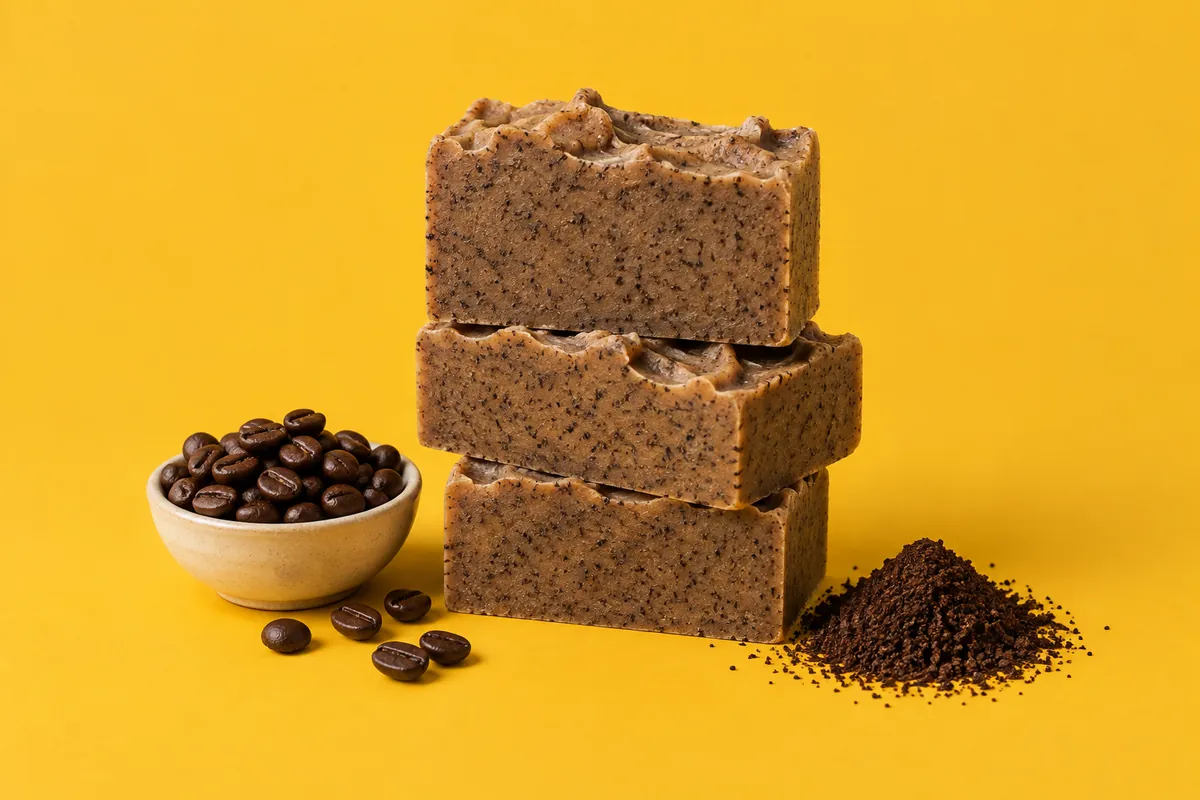
A hard, scrubby hand bar for the kitchen sink, made with strong brewed coffee in place of the water and dried coffee grounds for grip. A third of the oils is coconut for a quick lather, and an 8 % superfat keeps it kind to hands that wash all day.
- Skill
- Beginner
- Method
- Cold process
- Batch
- 1000 g of oils about 1436 g of batter
- Hands-on
- 1 hour
- Cure
- 4 weeks
- Gel phase
- Either way gel or not, both work
What you need
For 1000 g of oils, which fills a 1.5 litre loaf mould. Weigh everything, liquids included.
| Coconut Oil · 35.0 % | 350 g | 12.35 oz |
| Olive Oil · 35.0 % | 350 g | 12.35 oz |
| Shea Butter · 15.0 % | 150 g | 5.29 oz |
| Cocoa Butter · 10.0 % | 100 g | 3.53 oz |
| Castor Oil · 5.0 % | 50 g | 1.76 oz |
| Sodium hydroxide (NaOH) · the lye, 100 % pure | 139.0 g | 4.90 oz |
| Strong brewed coffee, chilled · all of the liquid; the lye goes into it cold | 284 g | 10.02 oz |
| Used coffee grounds, dried · 2 tbsp, kept from brewing the coffee and dried until they run loose | 12.6 g | 0.44 oz |
| Ground coffee, for brewing · brewed double strength with 450 ml of distilled water; the used grounds, dried, become the scrub | 50 g | 1.76 oz |
- Superfat
- 8 %
- Temperatures
- Coffee lye and oils both at 35 to 40 °C (95 to 104 °F)
Method
-
Brew the coffee a day ahead
Brew 50 g of ground coffee with 450 ml of distilled water, about twice the usual strength, for about 350 g of coffee. Strain it through a paper filter and chill it overnight in a covered jug. Keep the used grounds. -
Dry the grounds
Spread the grounds thinly on a baking tray and dry them in a low oven, about 100 °C (212 °F), for an hour, stirring once, until they run loose. Damp grounds can grow mould in the bar. -
Get ready
Put on goggles, gloves and long sleeves, open a window or turn on the extractor, weigh every ingredient and line the mould. -
Melt the oils
Melt the coconut oil, shea butter and cocoa butter gently, stir in the olive and castor oils, and let them cool to 35 to 40 °C (95 to 104 °F). -
Add the lye to the coffee
Weigh 284 g of the cold coffee into a heat-safe jug standing in cold water and sprinkle in the 139.0 g of sodium hydroxide a spoonful at a time, stirring until each dissolves; never pour the coffee onto the lye. It turns green, then brown, and smells strong, so keep your face away from the jug. -
Combine
When the coffee lye has cooled to 35 to 40 °C (95 to 104 °F), pour it into the oils down the shaft of the stick blender and blend in short bursts to light trace. Cooler than that, the cocoa butter starts to set and thickens the batter before any soap has formed. -
Thicken and add the grounds
Blend a little longer, to medium trace, like pudding, then stir in 2 tablespoons of the dried grounds by hand. In thinner batter they sink to the bottom of the loaf. -
Pour and texture
Pour into the mould, tap it firmly on the bench to release air, and rough up the top with the back of a spoon if you like. -
Keep it from overheating
Lay baking paper or a board over the mould but no towel, and leave it in a cool room for a day. If the top starts to crack or dome, move it somewhere cooler or into the fridge. -
Unmould and cut
Unmould with gloves on after 24 to 48 hours, when the loaf is firm, and cut it into bars straight away. Soap this high in coconut oil can get hard enough to chip if it waits several days. -
Cure
Stand the bars on edge on a rack with air around them for four weeks, turning them now and then, before they go to the sink.
Tips
- Use only brewed grounds, and dry them well: unbrewed grounds bleed brown streaks into the soap, and damp ones can grow mould in it.
- For a paler bar with less coffee smell, brew the coffee at your ordinary strength instead of double.
- Kitchen folklore says coffee lifts garlic and onion smells from hands. The soap and the scrub do most of that, and if you sell the bar, a claim that it deodorises makes it a cosmetic in the US, so call it what it is: a coffee soap.
- A draining soap dish keeps it hard: a coconut-rich bar lasts well by the sink as long as it doesn't sit in water.
The oils
| Oil | Share |
|---|---|
| Coconut Oil | 35.0 % |
| Olive Oil (virgin / refined / olive oil) | 35.0 % |
| Shea Butter | 15.0 % |
| Cocoa Butter (Theobroma Oil) | 10.0 % |
| Castor Oil | 5.0 % |
How it is made
| Process | Cold process |
| Alkali | NaOH |
| Superfat | 8 % |
| Water | lye water at 33 % |
| Iodine value | 48 |
| INS | 164 |
Why make it
A hand bar for the kitchen or workshop sink, where hands need grip as well as soap. A third coconut oil gives a fast lather, cleansing 24 on our scale, and the 8 % superfat takes some of the edge off for hands that wash all day, while the dried grounds add a firm but not harsh scrub. Kitchen folklore holds that coffee lifts garlic and onion smells from the hands, and many cooks swear by it, but there is no good evidence for it, and the soap and the scrub do most of that work. The brewed coffee colours the bar a deep brown and leaves only a faint coffee note. It is not a face bar: the grounds are too coarse for it.
What tradition, makers' experience and research say about soaps like this, each labelled for what it is. It is not medical advice, and no soap treats a skin condition: if you have one, ask a doctor or pharmacist.
What the numbers say
- Lauric acid 17.2 %
- Myristic acid 6.6 %
- Palmitic acid 11.2 %
- Stearic acid 11.8 %
- Ricinoleic acid 4.4 %
- Oleic acid 37.5 %
- Linoleic acid 6.4 %
- Other 6.2 %
Saturated : unsaturated 51 : 49
Computed from the fatty acids of the fats above. The bands are what the craft has settled on, not chemistry — a bar outside one is not wrong.
From the guides
All guides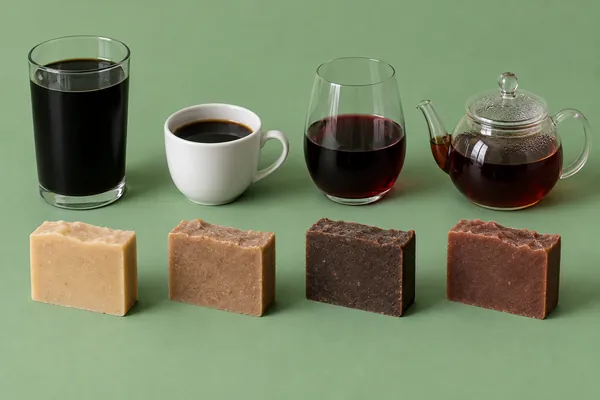
Beer, wine, coffee, tea and juice in soap
Using beer, wine, coffee, tea or juice in place of soap's water: how to prepare each one, add the lye safely, and what the calculator does with the liquid.

Soap additives: salt, sugar, sodium lactate, clays, oats, silk and more
What common soap additives do, how much to use and when they go in: sourced doses for sodium lactate, salt, sugar, honey, citric acid, clays, oats and silk.

Natural colourants: what herbs, clays and spices really do in soap
Clays, charcoal and plant colours in cold-process soap: doses per 500 g of oils, infused oil, powder or lye, and the colour each one actually turns.
Where these proportions come from
Our own formulation: a palm-free hand bar for the kitchen sink, a third coconut oil for a fast, big lather and shea and cocoa butter for a hard bar that lasts, superfatted at 8 % so the coconut does not dry hands that wash all day. Strong brewed coffee is all of the liquid, as in Corley Barto's espresso soap.