Dandelion zebra-stripe bar
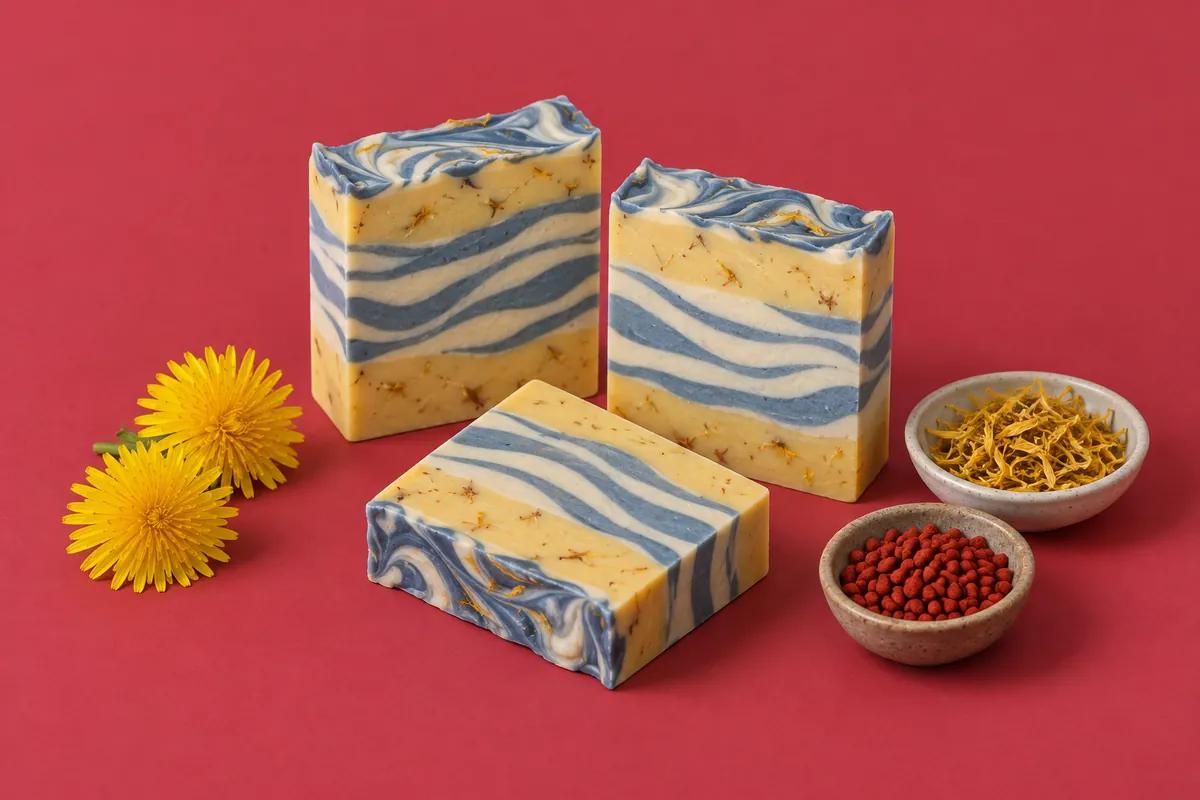
Annatto yellow with thin cream and indigo blue zebra stripes poured down a sheet of card between two yellow layers. Dandelions go in twice: simmered into the liquid the lye dissolves in, and as dried petals in the yellow.
- Skill
- Advanced
- Method
- Cold process
- Batch
- 900 g of oils about 1356 g of batter
- Hands-on
- 2 hours
- Cure
- 6 weeks
- Gel phase
- Yes insulate the mould
What you need
For 900 g of oils, which fills a 25 × 9 cm loaf mould filled 6 cm deep (about 1.4 litres). Weigh everything, liquids included.
| Olive Oil · 38.0 % | 342 g | 12.06 oz |
| Coconut Oil · 25.0 % | 225 g | 7.94 oz |
| Sunflowerseed Oil - High Oleic Acid · 15.0 % | 135 g | 4.76 oz |
| Rice Bran Oil · 14.0 % | 126 g | 4.44 oz |
| Apricot Kernel Oil · 8.0 % | 72 g | 2.54 oz |
| Sodium hydroxide (NaOH) · the lye, 100 % pure | 125.7 g | 4.43 oz |
| Dandelion water (a strained infusion) · all of the recipe water, made the day before from the fresh dandelions below and chilled | 289 g | 10.19 oz |
| Sodium lactate (60 % solution) · 2 tsp, stirred into the lye solution once it has cooled a little | 13.1 g | 0.46 oz |
| Annatto seed · 1.5 tsp, infused ahead in 40 g of extra high-oleic sunflower oil and strained; 15 g of that oil goes into each yellow portion as part of the recipe's sunflower oil | 3.1 g | 0.11 oz |
| Dried dandelion petals · 2 g, about a heaped tablespoon, in each yellow portion | 4 g | 0.14 oz |
| Indigo powder · 1 tsp, blue portion only, dispersed in 15 g of the recipe's sunflower oil | 1.7 g | 0.06 oz |
| Fresh whole dandelions, for the dandelion water · flowers, leaves and stems from an unsprayed patch, simmered in distilled water; the strained, chilled liquid is the recipe's water | 20 g | 0.71 oz |
| Isopropyl alcohol (rubbing alcohol), in a spray bottle · a light mist over the top against soda ash; it evaporates, so keep it away from flames | 5 ml | |
| Lime oil · 1.5 % of the oils, at trace | 13.5 g | 0.48 oz |
| Peppermint oil · 1.0 % of the oils, at trace | 9 g | 0.32 oz |
- Superfat
- 5 %
- Temperatures
- Chill the dandelion water before the lye goes in, then soap at 38 to 43 °C (100 to 110 °F)
Method
-
Dry the petals ahead
A week or so before, pick open dandelion heads from a patch that has not been sprayed, away from roads, and pinch the yellow petals out of their green bases. Spread them on paper in an airy room out of the sun for a few days until crisp, and keep them in a closed jar. -
Infuse the annatto ahead
A day or more before, put 1½ teaspoons of annatto seed and 40 g of high-oleic sunflower oil, extra to the recipe's, in a jar and stand it in a pan of hot water on the lowest heat for about 4 hours. Keep the oil near 49 °C (120 °F) and below 54 °C (130 °F), checking with a thermometer, never over a direct flame or unattended, then strain it through fine cloth. -
Brew the dandelion water
The day before, rinse 20 g of fresh whole dandelions, flowers, leaves and stems, from the same unsprayed patch. Pour 400 g of boiling distilled water over them in a pan and simmer for 15 minutes, until the liquid turns yellow, then strain it and chill it in the fridge. -
Get ready
Put on goggles, gloves and long sleeves and open a window. Set the mould level where it can stay for a day, cut a manila folder or thin card to the mould's width and 13 cm tall, and set out four jugs labelled yellow 1, yellow 2, cream and blue, with a spatula and a chopstick. -
Set out the jug oils
Weigh 105 g of sunflower oil instead of 135 g, because 30 g of the annatto oil stands in for the rest. Put 15 g of annatto oil and 2 g of petals in each yellow jug, 15 g of the plain sunflower oil in the cream jug, and 15 g in the blue jug with 1 teaspoon of indigo stirred in until smooth. -
Make the lye solution
Weigh 289 g of the dandelion water, topping it up with distilled water if you are short, and stand the jug in a bowl of iced water where the air moves. Add the 125.7 g of sodium hydroxide a spoonful at a time, stirring until each dissolves, never pouring the liquid onto the lye; it turns bright orange-yellow. When it has cooled a little, stir in 2 teaspoons (13.1 g) of sodium lactate and leave it to cool to 38 to 43 °C (100 to 110 °F). -
Melt and scent the oils
Melt the coconut oil, add the olive, rice bran and apricot kernel oils and the rest of the sunflower oil, and let them cool to 38 to 43 °C (100 to 110 °F). Stir in 13.5 g lime and 9 g peppermint essential oil. -
Blend to very thin trace
Pour the lye solution in down the blender shaft through a sieve, tap out trapped air, and blend in short pulses only until the batter is smooth with no oily streaks. The stripes need a runny batter. -
Fill the jugs
Weigh 322 g of batter into each jug, the last taking what is left, and whisk each until even. From here on, whisk the cream and blue jugs rather than blending them, so they stay runny. -
Pour the first yellow
Pulse yellow 1 with the blender for a few seconds, until it thickens slightly, then pour it into the mould and tap it level. -
Pour the zebra stripes
Rest the card in the mould at an angle, its bottom edge just touching the yellow without pushing in. Pour a thin strip of cream across the top of the card so it runs down onto the layer, then a strip of blue over it without moving the card, and repeat for five passes of each, keeping about 60 g of each colour back. -
Cover with yellow
Lift the card out, whisk yellow 2 to loosen it and pour it low and slowly over the back of a spatula until the stripes are covered. -
Draw the top
Pour the rest of the blue in a wide line down the middle of the top, then a thin line of cream down the centre of the blue. Push a chopstick about 6 mm into the cream near one end, spiral it outwards to just inside the blue, lift it out and wipe it, and repeat every 4 cm or so along the loaf. -
Cover so it gels
Mist the top lightly with isopropyl alcohol against soda ash, away from any flame, then cover the mould with a board that doesn't touch the top and wrap it in a towel for a day. The gel deepens the indigo and firms these soft oils sooner. -
Unmould after 4 to 5 days
This soft blend sets slowly, so wait 4 to 5 days before unmoulding with gloves on, and another day if it still clings. -
Cut it on its side
Lay the loaf on one long side so the knife runs along the stripes instead of dragging blue through the yellow, and cut bars about 2.5 cm (1 in) thick. -
Cure
Stand the bars on edge with air between them for 6 weeks, turning them every few days, out of direct light.
Tips
- Use dried petals only. Fresh ones hold water, brown and can grow mould in the bar. Dandelion petals, like calendula, owe their yellow to carotenoids rather than the pigments lye destroys, so they stay golden for a good while, though some flecks darken over the months.
- Out of dandelion season, steep 10 g of dried dandelion leaf sold as a tea for the liquid, and use dried calendula petals for the flecks.
- Faiola's original uses titanium dioxide for the white and ultramarine for the blue. Use those for crisper, brighter stripes; plain batter and indigo give softer lines and keep every colour botanical.
- Lime fades fast in cold process soap, so after a few weeks the peppermint carries the scent.
The oils
| Oil | Share |
|---|---|
| Olive Oil (virgin / refined / olive oil) | 38.0 % |
| Coconut Oil | 25.0 % |
| Sunflowerseed Oil - High Oleic Acid | 15.0 % |
| Rice Bran Oil | 14.0 % |
| Apricot Kernel Oil | 8.0 % |
How it is made
| Process | Cold process |
| Alkali | NaOH |
| Superfat | 5 % |
| Water | lye water at 30 % |
| Iodine value | 69 |
| INS | 137 |
Why make it
A design bar for makers who like to forage and want a challenge: three colours, zebra stripes and a spiral top, every colour from a plant. The base is gentle, olive-rich and palm-free, cleansing 17 and conditioning 65 on our scale. Dandelions are among the most familiar wild plants in Europe and North America and have a long place in folk herbalism, but in this soap they are there for the story and the colour, a yellow infusion and golden petal flecks; there is no evidence that they do anything for skin in a bar that is rinsed off. Lime and peppermint give a fresh scent, with the peppermint lasting longer. The caveats: pick only from ground that has not been sprayed, and expect the petals to darken a little over the months.
What tradition, makers' experience and research say about soaps like this, each labelled for what it is. It is not medical advice, and no soap treats a skin condition: if you have one, ask a doctor or pharmacist.
What the numbers say
- Lauric acid 12.3 %
- Myristic acid 4.9 %
- Palmitic acid 11.1 %
- Stearic acid 3.0 %
- Oleic acid 51.5 %
- Linoleic acid 13.1 %
- Other 5.4 %
Saturated : unsaturated 35 : 65
Computed from the fatty acids of the fats above. The bands are what the craft has settled on, not chemistry — a bar outside one is not wrong.
From the guides
All guides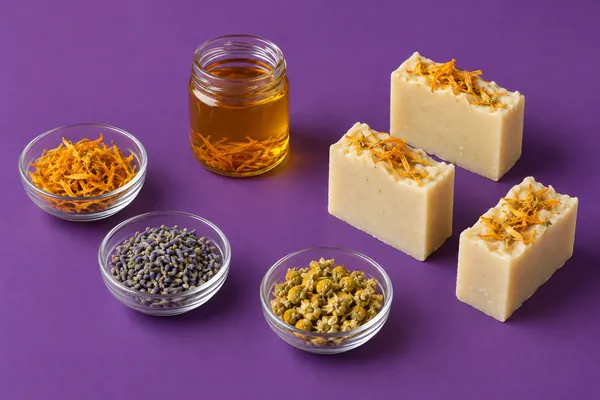
Herbs, flowers and infusions in soap
What dried herbs, petals, infused oils and herbal teas really do in soap: which survive lye, how to infuse an oil, and which claims a herbal soap can make.
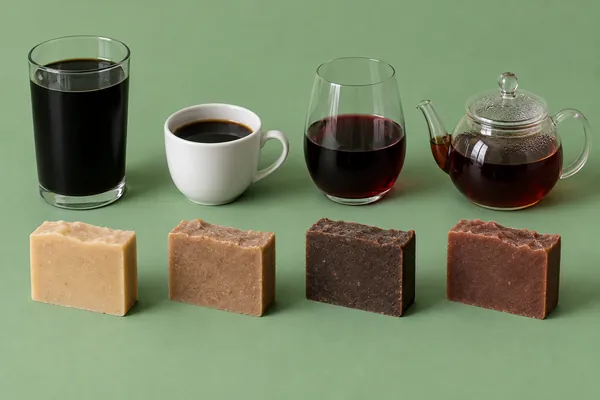
Beer, wine, coffee, tea and juice in soap
Using beer, wine, coffee, tea or juice in place of soap's water: how to prepare each one, add the lye safely, and what the calculator does with the liquid.
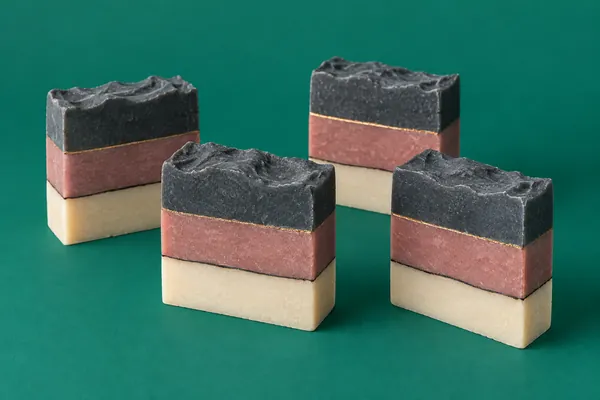
Layers, mica lines and pencil lines
Layered cold-process soap: batter thickness, pouring over a spatula, working out each layer from the mould, and pencil lines that don't split the bar.
Where these proportions come from
Adapted from Anne-Marie Faiola's dandelion zebra stripes, a technique she credits to Vinvela Ebony: her oils with high-oleic sunflower in place of ordinary sunflower oil, a dandelion infusion as the whole liquid and petals in the yellow. Plain batter and indigo replace her titanium dioxide and ultramarine, so every colour comes from a plant, the petals are dried first, and her lime and peppermint drop from 4 % of the oils to 2.5 %.
Formulation adapted from Pure Soapmaking by Anne-Marie Faiola (Storey Publishing, 2016). The method and notes are ours.