Hand-milled glycerin bar
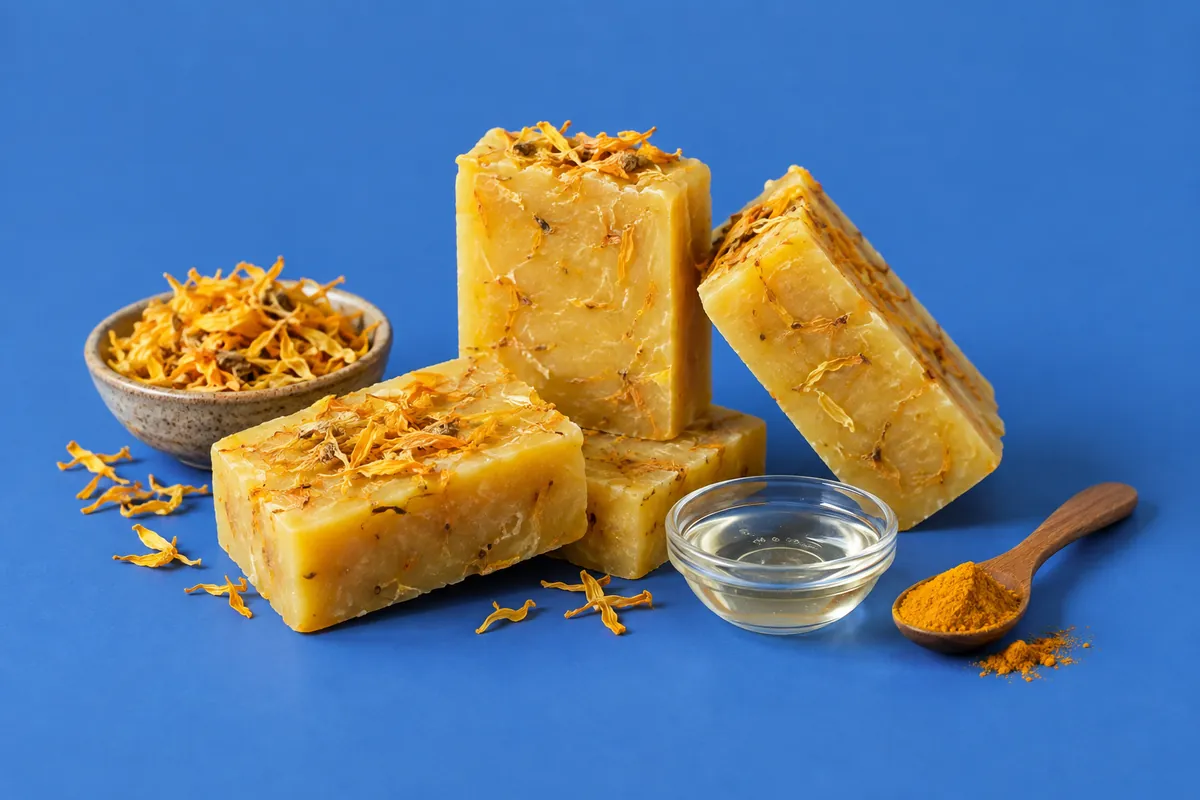
A plain cold process bar, grated a week after it is made and gently remelted with a little water, extra glycerin, turmeric and calendula petals, then scented with bergamot and lavender off the heat. Hand-milling is where a scent that fresh lye would dull goes in, and the bars come out dense, rustic and golden.
- Skill
- Intermediate
- Method
- Cold process
- Batch
- 500 g of oils about 753 g of batter
- Hands-on
- 2 hours
- Cure
- 4 weeks
- Gel phase
- Either way gel or not, both work
What you need
For 500 g of oils, which fills a 0.9 litre loaf mould, used for the base and again for the milled soap. Weigh everything, liquids included.
| Olive Oil · 40.0 % | 200 g | 7.05 oz |
| Coconut Oil · 25.0 % | 125 g | 4.41 oz |
| Shea Butter · 15.0 % | 75 g | 2.65 oz |
| Rice Bran Oil · 15.0 % | 75 g | 2.65 oz |
| Castor Oil · 5.0 % | 25 g | 0.88 oz |
| Sodium hydroxide (NaOH) · the lye, 100 % pure | 69.4 g | 2.45 oz |
| Distilled water · for a 33 % lye solution | 140.9 g | 4.97 oz |
| Glycerin · at milling, about 4 % of the shreds, with the turmeric stirred into it | 28 g | 0.99 oz |
| Turmeric powder · 0.5 tsp, at milling, stirred into the glycerin first so it cannot streak | 1.5 g | 0.05 oz |
| Dried calendula petals · 3 tbsp, at milling: 2 tbsp stirred through, 1 tbsp pressed onto the top | 3.4 g | 0.12 oz |
| Distilled water, for milling · at milling, a week later: sprinkled over the shreds, about a tenth of their weight, with a spoonful more if the mash looks dry | 70 g | 2.47 oz |
| Bergamot essential oil · 1.5 % of the oils, at trace | 7.5 g | 0.26 oz |
| Lavender essential oil · 0.5 % of the oils, at trace | 2.5 g | 0.09 oz |
- Superfat
- 5 %
- Temperatures
- Base: oils and lye solution at 35 to 43 °C (95 to 110 °F). Milling: low, gentle heat, and the scent in below 82 °C (180 °F)
Method
-
Get ready for the base
Put on splash goggles, nitrile gloves and long sleeves, open a window or turn on the extractor fan, and keep children and pets out of the room. Line the loaf mould. -
Make the lye solution
Weigh 140.9 g distilled water into a heat-safe jug and 69.4 g sodium hydroxide into a dry container. Where the air moves, pour the lye slowly into the water, never the water onto the lye, stir until clear and leave it to cool, labelled and out of reach. -
Melt the oils
Melt 125 g coconut oil and 75 g shea butter on the lowest heat, then stir in 200 g olive oil, 75 g rice bran oil and 25 g castor oil. -
Make the base
When the oils and the lye solution are each between 35 and 43 °C (95 and 110 °F), pour the lye into the oils down the blender shaft and pulse and stir to light trace. Pour it into the mould plain, with no scent or colour, and cover it with baking paper and a towel for a day or two, until firm. -
Leave it a week
With gloves on, unmould the base, cut it into thick slices and stand them on a rack for a week. Soap a day or two old can still be caustic; by a week the lye is spent, and the soap still holds enough of its water to remelt smoothly. -
Grate it
Grate all of the base on the coarse side of a box grater, or in a food processor kept for soap, and weigh the shreds: expect 680 to 700 g. If you have much more or less, scale the milling amounts to match. -
Dampen the shreds
Put the shreds in a slow cooker or a heatproof bowl, sprinkle the 70 g of milling water over them and stir until they are evenly damp, then cover. -
Melt it low and slow
Heat the slow cooker on low, or set the bowl over a pan of simmering water, and stir and scrape down the sides every 15 to 20 minutes. Within about an hour the edges turn translucent and the whole lot softens into a thick, glossy mash; if it looks dry, sprinkle on a spoonful more water, and never let it boil or leave it unattended. -
Mix the colour into the glycerin
While it heats, stir ½ tsp (1.5 g) turmeric into the 28 g of glycerin until smooth. -
Stir in the extras
Take the mash off the heat and stir in the glycerin and turmeric until the colour is even, then 2 tbsp of the calendula petals. Keep your gloves on: the hot soap is sticky and holds its heat. -
Scent it
Let the mash cool for a few minutes, to below about 82 °C (180 °F), then stir in 7.5 g bergamot and 2.5 g lavender essential oil quickly and thoroughly, before it stiffens. -
Pack the mould
Spoon the soap into the mould, pressing it into the corners with the back of the spoon, and bang the mould on the worktop to knock out air pockets. Scatter the last tablespoon of petals over the top and press them in lightly. -
Unmould and cut
Leave it in the mould for two to four days, until it comes out cleanly, then unmould it and cut it into bars. -
Cure for four weeks
Stand the bars on a rack with air around them and turn them every few days for four weeks, five from the day you made the base, while the milling water dries out.
Tips
- Why only 4 % glycerin: the base already holds all the glycerin its oils release, about 7 to 8 % of the soap. Simmons and Appleton's 6 to 8 % went into factory soap that had given up most of its own to the spent lye. Much more here gives a bar that stays soft and beads with moisture in a steamy bathroom; keep cured bars somewhere dry.
- Bergamot's scent rests mainly on esters that free alkali breaks down, which Simmons and Appleton warned soapmakers about in 1908. By the time this base is milled its lye is spent, so the bergamot meets finished soap.
- No slow cooker? Mill half the shreds at a time in the microwave: covered, a minute at 70 % power, then 10-second bursts at 50 %, stirring between, until the soap puffs up soft like lumpy mashed potato. Letcavage and Buck mill young bars this way; the bowl gets very hot, so lift it out with oven gloves.
- Turmeric fades in daylight, so cure and store the bars out of the sun. Leave it out for a cream bar: the calendula petals show up well against the soap's own colour.
The oils
| Oil | Share |
|---|---|
| Olive Oil (virgin / refined / olive oil) | 40.0 % |
| Coconut Oil | 25.0 % |
| Shea Butter | 15.0 % |
| Rice Bran Oil | 15.0 % |
| Castor Oil | 5.0 % |
How it is made
| Process | Cold process |
| Alkali | NaOH |
| Superfat | 5 % |
| Water | lye water at 33 % |
| Iodine value | 63 |
| INS | 142 |
Why make it
Hand-milling is how makers add what fresh lye would spoil. Bergamot owes its scent to esters that free alkali breaks down, as Simmons and Appleton warned soapmakers in 1908, so here it goes into week-old soap whose lye is spent, along with calendula petals and a little turmeric, and the bars come out dense, rustic and golden. The base is a balanced everyday bar, cleansing 17 and conditioning 59 on our scale. Glycerin is a well-studied humectant in products left on the skin (Fluhr and colleagues); cold process soap already keeps all the glycerin its oils release, and the extra here gives a smoother feel, but most of it rinses away, so the bar will not do what a cream does. The price is time: two sessions a week apart.
Sources
- The Handbook of Soap Manufacture · Scott, Greenwood & Son, 1908
- Glycerol and the skin: holistic approach to its origin and functions · British Journal of Dermatology, 2008
What tradition, makers' experience and research say about soaps like this, each labelled for what it is. It is not medical advice, and no soap treats a skin condition: if you have one, ask a doctor or pharmacist.
What the numbers say
- Lauric acid 12.3 %
- Myristic acid 4.8 %
- Palmitic acid 11.1 %
- Stearic acid 8.6 %
- Ricinoleic acid 4.4 %
- Oleic acid 43.2 %
- Linoleic acid 11.2 %
- Other 5.1 %
Saturated : unsaturated 40 : 60
Computed from the fatty acids of the fats above. The bands are what the craft has settled on, not chemistry — a bar outside one is not wrong.
From the guides
All guides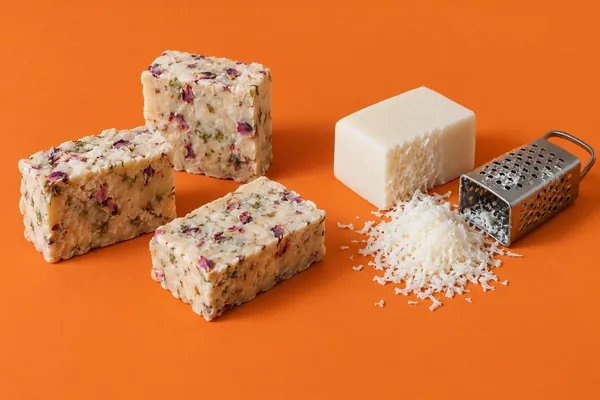
Rebatching soap: saving a batch or making milled bars
How to grate and remelt finished soap with a little liquid, to fix a mistake you can measure or add what fresh lye would ruin, and when a batch is past saving.

Soap additives: salt, sugar, sodium lactate, clays, oats, silk and more
What common soap additives do, how much to use and when they go in: sourced doses for sodium lactate, salt, sugar, honey, citric acid, clays, oats and silk.

Scenting soap: essential oils and fragrance oils
How much essential or fragrance oil to use in soap, what ounces per pound mean in percent, the IFRA limits for common essential oils, and EU allergen labelling.
Where these proportions come from
Our own palm-free base of olive, coconut, shea, rice bran and castor oils at a 5 % superfat, made as plain cold process soap and milled a week later. The milling follows Alicia Grosso's hand-milling method, with water at about a tenth of the shreds' weight rather than her quarter: a week-old soap still holds most of its own water, which is why Letcavage and Buck mill their bars young. Glycerin is milled in as Simmons and Appleton describe for glycerine soap, at 4 % rather than their 6 to 8 %: their factory soap had lost most of its glycerine to the spent lye, and a cold process base keeps all of its own.
Formulation adapted from The Everything Soapmaking Book, 3rd edition by Alicia Grosso (Adams Media, 2013); Basic Soap Making by Elizabeth Letcavage and Patsy Buck (Stackpole Books, 2009); The Handbook of Soap Manufacture by W. H. Simmons and H. A. Appleton (Scott, Greenwood & Son, 1908). The method and notes are ours.