Indigo and annatto funnel pour bar
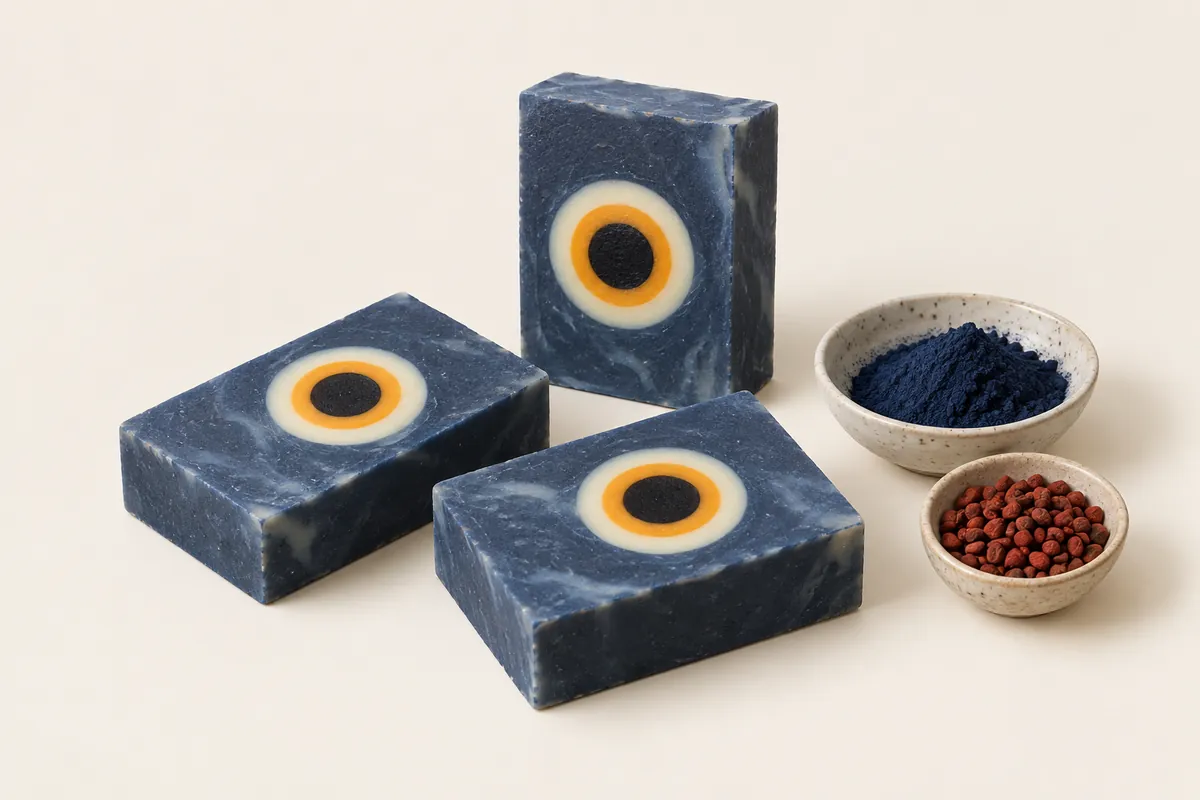
A dark indigo base poured round five pipes and gelled hot, then the holes filled a day later with white, orange and black poured in turn, so every bar shows a ringed target. Palm-free, coloured with indigo, alkanet, annatto and charcoal, and made as two batches of one recipe.
- Skill
- Advanced
- Method
- Cold process
- Batch
- 1000 g of oils about 1491 g of batter
- Hands-on
- 2 h 30 min
- Cure
- 6 weeks
- Gel phase
- Yes insulate the mould
What you need
For 1000 g of oils, which fills a rigid 25 × 9 cm loaf mould at least 7 cm deep, with five 10 cm lengths of 1-inch PVC pipe. Weigh everything, liquids included.
| Rapeseed Oil - Low Erucic Acid · 25.0 % | 250 g | 8.82 oz |
| Rice Bran Oil · 25.0 % | 250 g | 8.82 oz |
| Coconut Oil · 25.0 % | 250 g | 8.82 oz |
| Shea Butter · 15.0 % | 150 g | 5.29 oz |
| Avocado Oil · 10.0 % | 100 g | 3.53 oz |
| Sodium hydroxide (NaOH) · the lye, 100 % pure | 138.4 g | 4.88 oz |
| Distilled water · for a 31 % lye solution | 302.9 g | 10.68 oz |
| Sodium lactate (60 % solution) · 2 tsp, 1½ tsp in batch one's lye solution and ½ tsp in batch two's; it helps the base let go of the pipes | 13.1 g | 0.46 oz |
| Indigo powder · 1 tbsp, batch one only, whisked into its hot lye solution | 5 g | 0.18 oz |
| Alkanet root powder · about 2 tsp, for batch one's dark portion only, dispersed in 25 g of its canola oil | 4 g | 0.14 oz |
| Titanium dioxide, for the pale spiral · 0.5 tsp, batch one's pale portion, dispersed in 7 g of its canola oil | 2.3 g | 0.08 oz |
| Annatto seed · 1 tsp, infused ahead in 30 g of extra canola oil and strained; 10 g of that oil goes into batch two's orange jug as part of its canola oil | 2.1 g | 0.07 oz |
| Titanium dioxide, for the white rings · 0.25 tsp, batch two's white jug, dispersed in 10 g of its canola oil | 1.2 g | 0.04 oz |
| Activated charcoal · 0.13 tsp, batch two's black jug, dispersed in 10 g of its canola oil | 0.3 g | 0.01 oz |
| Canola oil, for the annatto infusion · extra to the recipe's oils; 10 g of the strained oil replaces 10 g of batch two's canola oil | 30 g | 1.06 oz |
| Mineral oil, to coat the pipes · a thin film so the base lets go; mineral oil never turns to soap | 1 tsp | |
| Isopropyl (rubbing) alcohol, 91 to 99 %, in a spray bottle · misted over the filled top to keep soda ash off; it evaporates and is not part of the soap | 30 ml | |
| Lemongrass oil · 1.6 % of the oils, at trace | 16 g | 0.56 oz |
| Rosemary oil · 0.8 % of the oils, at trace | 8 g | 0.28 oz |
- Superfat
- 5 %
- Temperatures
- Batch one's oils and lye solution at 49 to 54 °C (120 to 130 °F) for a hot gel; batch two's at 41 to 43 °C (105 to 110 °F)
Method
-
Plan the two batches
This is one recipe made as two batches a day or two apart. Three quarters of every amount makes the dark base, poured round five pipes; the last quarter fills the holes they leave. The weighing list's 138.4 g of sodium hydroxide and 302.9 g of water are the totals for both, so work out three quarters and a quarter of each and write the four figures down. -
Infuse the annatto ahead
A day or more before, put the teaspoon of annatto seeds in a small jar with 30 g of canola oil, extra to the recipe's. Stand the jar in a pan of hot water on the lowest heat for 4 hours with a thermometer in the oil, holding it at about 49 °C (120 °F): above about 54 °C (130 °F) the seeds scorch. Never heat it over a direct flame or leave it unattended, and strain it through fine cloth. -
Set the pipes in the mould
Rub five 10 cm lengths of 1-inch PVC pipe, about 3.3 cm across the outside, with a thin film of mineral oil, which never turns to soap, and wipe off the excess. Stand them upright in a row down the middle of the lined mould, 5 cm apart and the end ones 2.5 cm from the ends, and hold each to the floor with a rubber band stretched under the mould and over its top, so no batter creeps underneath. Set the mould level on a heating pad, switched off, where it can stay for the next few days. -
Make batch one's lye solution
Put on goggles, gloves and long sleeves and open a window. Weigh three quarters of the sodium hydroxide and of the water, pour the lye slowly into the water, never the reverse, and stir until clear. Stir the tablespoon of indigo in gently until no dry lumps are left, then 1½ teaspoons of the sodium lactate, and leave it labelled and out of reach. -
Weigh and warm batch one's oils
Weigh 187.5 g canola oil, 187.5 g rice bran oil, 187.5 g coconut oil, 112.5 g shea butter and 75 g avocado oil. Take 32 g of the canola: stir the alkanet into 25 g of it in a cup and the ½ teaspoon of titanium dioxide into the other 7 g in a spouted jug. Melt the coconut oil and shea butter, add the rest of the liquid oils, and bring both the oils and the lye solution to 49 to 54 °C (120 to 130 °F): the base has to start warm to gel hot. -
Blend to light trace
Stir the lye solution to lift the indigo that has settled, pour it in down the blender shaft, tap out trapped air, and blend in short pulses to light trace, thin custard that holds a faint line for a few seconds. Stir in 12 g of the lemongrass oil and 6 g of the rosemary oil. -
Split the base
Pour 250 g of batter into the titanium dioxide jug and whisk it to a pale blue-grey. Whisk the alkanet into the batter left in the pot, about 830 g, until it is evenly dark. -
Spiral the pale into the dark
Hold the pale jug about 15 cm (6 in) above the pot and pour all of it into the dark batter in a spiral, from the edge towards the middle. Don't stir. -
Pour round the pipes
Pour the batter into one corner of the mould and let it find its own way round the pipes, drawing the pale streaks with it; tap the mould gently if it heaps up instead of flowing. It should stand about 6 cm deep. -
Gel it hot
Cover the mould with a board and a towel and switch the heating pad to medium for 30 minutes, looking every 10: a crack, bubbling or a rising middle means it is too hot, so switch off and uncover it. Then switch the pad off and leave the mould covered on it for 24 hours. Indigo needs the heat of a full gel to come out blue; without it, it stays greyer. -
Pull the pipes
After 24 hours, take off the bands and pull each pipe straight up, slowly and without twisting, pressing the soap down beside it with your other hand. If one will not come, leave it another day. Keep the base in the mould and fill it within a day or two, while it is fresh enough to bond. -
Weigh batch two
Weigh the last quarter: 52.5 g canola oil, 62.5 g rice bran oil, 62.5 g coconut oil, 37.5 g shea butter and 25 g avocado oil, with 10 g of the annatto oil standing in for the rest of the canola. Put that 10 g in one jug; from the canola, stir the ¼ teaspoon of titanium dioxide into 10 g in a second jug and the charcoal into 10 g in a third. -
Make batch two
With goggles and gloves on again, make the lye solution with the last quarter of the sodium hydroxide and water as before, stir in the last ½ teaspoon of sodium lactate, and let it cool to 41 to 43 °C (105 to 110 °F). Melt the coconut oil and shea butter, add the rest of the liquid oils, and bring them to the same temperature. -
Blend and colour
Blend to light trace, stir in the last 4 g of lemongrass and 2 g of rosemary oil, and pour a third, about 113 g, into each jug. Whisk each one smooth, white, orange or black, and keep them thin: this pour needs batter that runs. -
Funnel-pour the holes
Hold the white jug about 15 cm (6 in) above the first hole and pour a thin, steady stream into it for a count of three, then do the same over each hole. Pour the orange into the middle of each white from the same height, so it breaks through, then the black into the middle of the orange. -
Repeat until full
Keep going round, white, orange, black, until the holes are full to the top of the base, and pour anything left into a small mould the same way. Mist the top with alcohol, away from any flame, and leave the mould for 2 days. -
Cut through the rings
Unmould with gloves on and cut the loaf across into five blocks about 5 cm wide, each with a circle in its middle. Lay each block on its side and cut it in half parallel to the top, so every bar shows a target of white, orange and black rings on its cut face. -
Cure
Stand the bars with air between them, out of direct sun, for 6 weeks, turning them every few days.
Tips
- No PVC pipe? Any smooth, rigid tube works, a cardboard tube wrapped in packing tape among them, as long as it stands taller than the mould's sides so the band can hold it down.
- Fill the holes within a day or two of pulling the pipes. Fresh soap bonds with the batter poured into it; a base left for a week may let the circles loosen as the bar wears.
- The scent is lighter than Faiola's on purpose: IFRA caps lemongrass in soap at about 1.7 % of the finished bar, and her 3 % of the oils goes over it. Here it is about 1.1 %.
- If you sell the soap, tell your safety assessor about the indigo: the EU's scientific committee could not rule out a weak potential for skin sensitisation.
The oils
| Oil | Share |
|---|---|
| Rapeseed Oil - Low Erucic Acid (Canola Oil) | 25.0 % |
| Rice Bran Oil | 25.0 % |
| Coconut Oil | 25.0 % |
| Shea Butter | 15.0 % |
| Avocado Oil | 10.0 % |
How it is made
| Process | Cold process |
| Alkali | NaOH |
| Superfat | 5 % |
| Water | lye water at 31 % |
| Iodine value | 73 |
| INS | 131 |
Why make it
An advanced design for a maker who wants every colour from a plant or a mineral. Indigo is among the oldest dyes known, found on 6,000-year-old cotton from Peru (Splitstoser and colleagues), and annatto seed is a colour the US Food and Drug Administration lists for both food and cosmetics; with alkanet and charcoal they give a deep blue ground and a ringed target in every bar. The base is a palm-free everyday bar, cleansing 17 and conditioning 60 on our scale. The colours are there for the eye: no plant dye in a soap does anything for skin. Indigo varies between suppliers, and the EU's scientific committee could not rule out a weak potential for skin sensitisation, so tell your safety assessor if you sell it.
Sources
- Early pre-Hispanic use of indigo blue in Peru · Science Advances, 2016
- Summary of color additives for use in the United States in foods, drugs, cosmetics, and medical devices · U.S. Food and Drug Administration, 2025
- Opinion on hair dye Indigofera tinctoria (C170) · European Commission, Scientific Committee on Consumer Safety, 2020
What tradition, makers' experience and research say about soaps like this, each labelled for what it is. It is not medical advice, and no soap treats a skin condition: if you have one, ask a doctor or pharmacist.
What the numbers say
- Lauric acid 12.3 %
- Myristic acid 4.9 %
- Palmitic acid 10.0 %
- Stearic acid 8.4 %
- Oleic acid 41.1 %
- Linoleic acid 16.2 %
- α-Linolenic acid 3.1 %
- Other 6.0 %
Saturated : unsaturated 39 : 61
Computed from the fatty acids of the fats above. The bands are what the craft has settled on, not chemistry — a bar outside one is not wrong.
From the guides
All guides
Natural colourants: what herbs, clays and spices really do in soap
Clays, charcoal and plant colours in cold-process soap: doses per 500 g of oils, infused oil, powder or lye, and the colour each one actually turns.
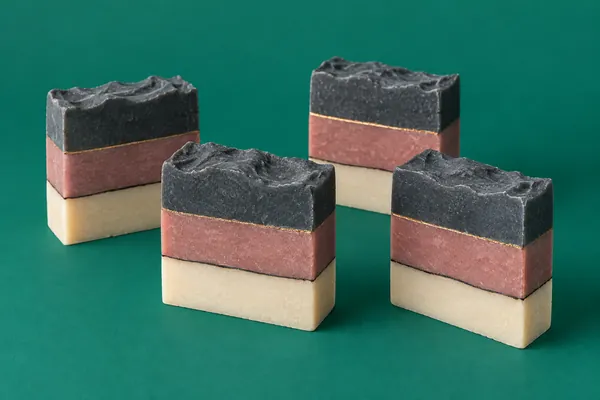
Layers, mica lines and pencil lines
Layered cold-process soap: batter thickness, pouring over a spatula, working out each layer from the mould, and pencil lines that don't split the bar.
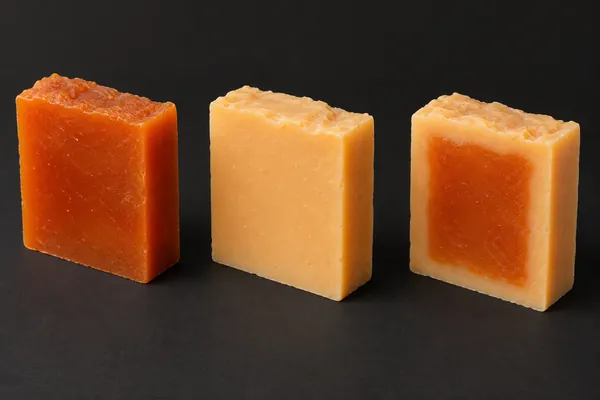
Gel phase: to insulate or keep it cool
What gel phase is, why a loaf turns dark and translucent, how gelled and ungelled bars differ, why partial gel is cosmetic, and how to cause or prevent it.
Where these proportions come from
Adapted from Anne-Marie Faiola's indigo and annatto negative-space funnel pour: her palm-free blend of canola, rice bran, coconut and avocado oils with shea butter, one recipe made as two batches, the first coloured with indigo in the lye and alkanet and gelled hot around oiled pipes, the second poured into the holes they leave. Rescaled to five pipes in a 25 × 9 cm loaf, at our 5 % superfat and a 31 % lye solution, with charcoal in place of her black oxide and the lemongrass cut to well inside its IFRA limit.
Formulation adapted from Pure Soapmaking by Anne-Marie Faiola (Storey Publishing, 2016). The method and notes are ours.