Lemon, annatto and cocoa linear swirl bar
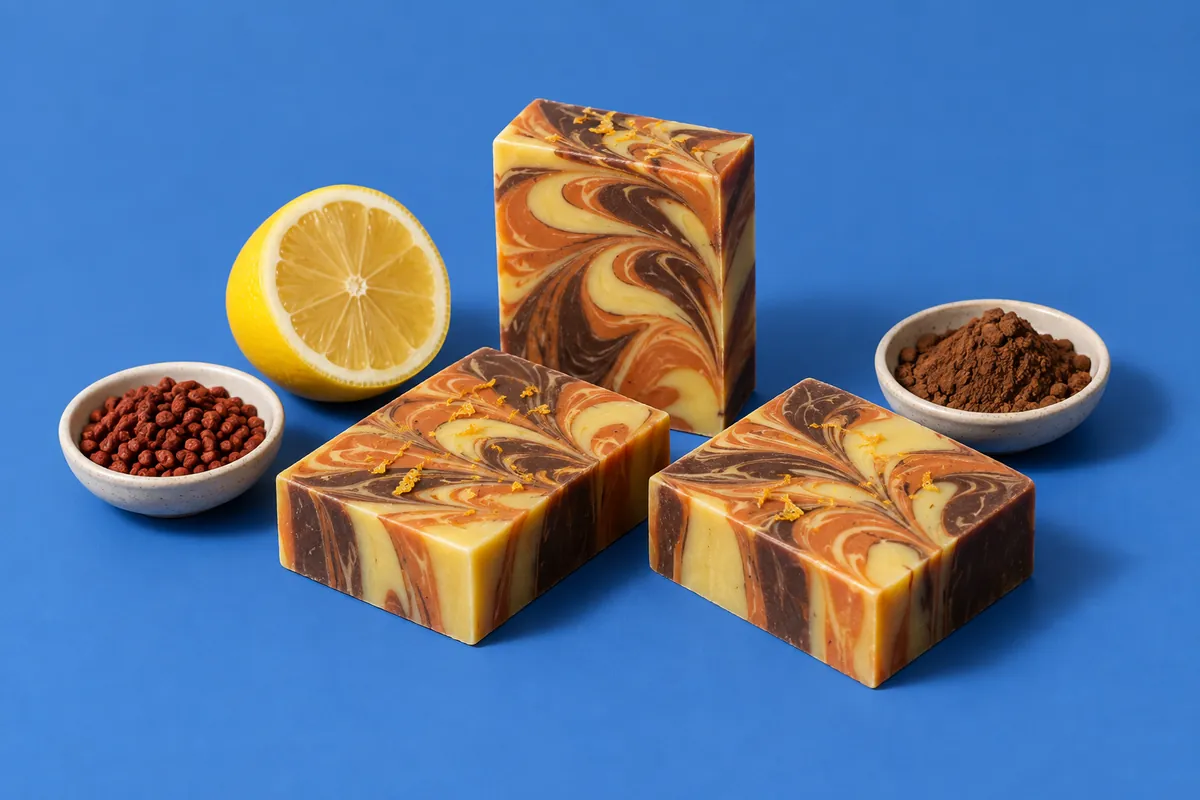
A palm-free bar made with fresh lemon juice and zest, split into annatto orange, cocoa brown and cream and drawn into a linear swirl across a slab. Gelled for the richest colour, and scented with bergamot and litsea.
- Skill
- Intermediate
- Method
- Cold process
- Batch
- 1000 g of oils about 1497 g of batter
- Hands-on
- 1 h 30 min
- Cure
- 6 weeks
- Gel phase
- Yes insulate the mould
What you need
For 1000 g of oils, which fills a 20 cm (8 in) square slab mould at least 4.5 cm deep. Weigh everything, liquids included.
| Olive Oil · 28.0 % | 280 g | 9.88 oz |
| Coconut Oil · 22.0 % | 220 g | 7.76 oz |
| Rice Bran Oil · 16.0 % | 160 g | 5.64 oz |
| Almond Oil · 14.0 % | 140 g | 4.94 oz |
| Shea Butter · 12.0 % | 120 g | 4.23 oz |
| Cocoa Butter · 8.0 % | 80 g | 2.82 oz |
| Sodium hydroxide (NaOH) · the lye, 100 % pure | 140.3 g | 4.95 oz |
| Distilled water · for a 36 % lye solution | 252.1 g | 8.89 oz |
| Lemon juice, fresh and strained · from about 2 lemons, at room temperature; part of the recipe's water, and the lye is raised for its citric acid | 60 g | 2.12 oz |
| Lemon zest, finely grated · the yellow part only, stirred into the juice | 6 g | 0.21 oz |
| Annatto seed · 1 tsp, infused ahead in 20 g of extra sweet almond oil and strained; 15 g of that oil goes into the orange jug as part of the recipe's almond oil | 2.1 g | 0.07 oz |
| Cocoa powder, unsweetened · 2 tsp, brown jug only, dispersed in 15 g of the recipe's sweet almond oil | 3.6 g | 0.13 oz |
| Titanium dioxide · 1 tsp, white jug only, dispersed in 15 g of the recipe's sweet almond oil | 4.7 g | 0.17 oz |
| Sweet almond oil for the annatto infusion · extra to the recipe's; 15 g of the strained oil goes into the orange jug as part of the recipe's almond oil | 20 g | 0.71 oz |
| Isopropyl alcohol, 91 % or stronger, in a spray bottle · a light mist over the top against soda ash, well away from any flame | 30 ml | |
| Bergamot oil · 1.5 % of the oils, at trace | 15 g | 0.53 oz |
| Litsea oil (May Chang) · 1.5 % of the oils, at trace | 15 g | 0.53 oz |
- Superfat
- 5 %
- Temperatures
- Oils and lye solution at 41 to 43 °C (105 to 110 °F), the lemon juice at room temperature
Method
-
Infuse the annatto ahead
A day or more before, put the teaspoon of annatto seeds in a small jar with 20 g of sweet almond oil, extra to the recipe's. Stand the jar in a pan of hot water on the lowest heat for 4 hours with a thermometer in the oil, holding it at about 49 °C (120 °F): above about 54 °C (130 °F) the seeds scorch. Never heat it over a direct flame or leave it unattended, and strain it through fine cloth. -
Get ready
Put on goggles, gloves and long sleeves and open a window. Line the slab mould and set it level where it can stay for a day, with three spouted jugs, a whisk and a chopstick in reach. -
Prepare the lemon
Squeeze and strain the juice of about 2 lemons and weigh 60 g of it. Finely grate the yellow zest of one, about 6 g, and stir it into the juice. Keep it at room temperature: cold juice would chill the cocoa butter and thicken the batter early. -
Set out each jug's oil
Weigh 125 g of sweet almond oil instead of the full 140 g, because 15 g of the annatto oil stands in for the rest; put that 15 g in the orange jug. From the 125 g, stir the cocoa into 15 g in the brown jug and the titanium dioxide into 15 g in the white jug, until a smear on a white plate shows no grains. -
Make the lye solution
Where the air moves, pour the 140.3 g of sodium hydroxide slowly into the 252.1 g of water, never the reverse, and stir until clear; the lemon juice brings the rest of the recipe's water. Leave it labelled and out of reach to cool to 41 to 43 °C (105 to 110 °F). -
Melt and scent the oils
Melt the coconut oil, cocoa butter and shea butter gently, add the olive and rice bran oils and the rest of the almond oil, and keep them at 41 to 43 °C (105 to 110 °F) while they stay clear. Stir in the bergamot and litsea oils. -
Blend to thin trace
Pour the lye solution in down the blender shaft, tap out trapped air, and blend in short pulses only until the batter is smooth and just starting to thicken, like single cream. -
Add the lemon
Pour in the juice and zest and pulse a few times until they disappear into the batter. It turns a warm yellow. -
Split into thirds
Pour about 480 g of batter into each jug and whisk each one smooth: orange, brown and cream. -
Pour S-curves
Pour loose S-shaped ribbons of each colour across the bottom of the mould, some thick and some thin, until about half of each jug is used. -
Pour lines
Pour the rest in thin lines from one side of the mould to the other, all running the same way and changing colour each time, until the surface is covered. -
Swirl across the lines
Push a chopstick to the bottom at one corner and draw it back and forth across the lines in S-curves, working along them to the far side. -
Swirl along the lines
Go back to the starting corner and draw the chopstick in long S-curves along the lines this time, working across to the other side. Stop there: more passes blur the colours. -
Cover so it gels
Tap the mould, mist the top lightly with isopropyl alcohol against soda ash, away from any flame, then cover it with a board and a towel, two if the room is below about 24 °C (75 °F), and leave it for a day. The cocoa needs a full gel to turn a rich brown, and the other colours come out brighter for it. -
Unmould and cut
Unmould with gloves on after 2 days, once firm, and cut the slab into 12 bars, three strips one way and four the other. -
Cure
Stand the bars on edge with air between them, out of direct sun, for 6 weeks, turning them every few days.
Tips
- Lemon juice is nearly 5 % citric acid, which uses up lye, so the weighing list carries a little more sodium hydroxide than the oils alone need. If you leave the juice out, take it out in the calculator too, so the lye comes down with it.
- Litsea is what keeps the lemon scent; bergamot is bright on the day and fades. Faiola's blend ran to more than 7 % of the oils; at 3 % it is still clearly lemony, and litsea stays well inside its IFRA limit of about 1.7 % of the bar.
- Grate only the yellow zest, as fine as you can: coarse pieces scratch.
- If the batter thickens before the lines go on, spoon the rest over in dollops and make only the second pass with the chopstick. The swirl comes out broader, not spoiled.
The oils
| Oil | Share |
|---|---|
| Olive Oil (virgin / refined / olive oil) | 28.0 % |
| Coconut Oil | 22.0 % |
| Rice Bran Oil | 16.0 % |
| Almond Oil (Sweet Almond Oil) | 14.0 % |
| Shea Butter | 12.0 % |
| Cocoa Butter (Theobroma Oil) | 8.0 % |
How it is made
| Process | Cold process |
| Alkali | NaOH |
| Superfat | 5 % |
| Water | lye water at 31 % |
| Iodine value | 65 |
| INS | 140 |
Why make it
Make this one for the look: three natural colours drawn into fine lines across a slab, and a good way to practise a linear swirl. Underneath is a gentle everyday bar, cleansing 15 and conditioning 60 on our scale, with shea and cocoa butter to keep it firm, which suits normal to dry skin and daily washing. Lemon juice is about 5 % citric acid (Penniston et al.), which the lye neutralises, so the calculator adds a little sodium hydroxide for it; the zest leaves fine yellow flecks. Lemon's own smell fades in soap, which is why litsea carries the scent. Annatto, the seed that colours Red Leicester cheese, gives the orange, and cocoa a brown that deepens with gel. The colours and the lemon are there for pleasure: in a rinse-off bar they do nothing a mild soap does not.
Sources
- Quantitative assessment of citric acid in lemon juice, lime juice, and commercially-available fruit juice products · K. L. Penniston et al., Journal of Endourology 22(3), 2008
What tradition, makers' experience and research say about soaps like this, each labelled for what it is. It is not medical advice, and no soap treats a skin condition: if you have one, ask a doctor or pharmacist.
What the numbers say
- Lauric acid 10.8 %
- Myristic acid 4.3 %
- Palmitic acid 12.2 %
- Stearic acid 9.8 %
- Oleic acid 46.0 %
- Linoleic acid 13.3 %
- Other 4.5 %
Saturated : unsaturated 40 : 60
Computed from the fatty acids of the fats above. The bands are what the craft has settled on, not chemistry — a bar outside one is not wrong.
From the guides
All guides
Natural colourants: what herbs, clays and spices really do in soap
Clays, charcoal and plant colours in cold-process soap: doses per 500 g of oils, infused oil, powder or lye, and the colour each one actually turns.
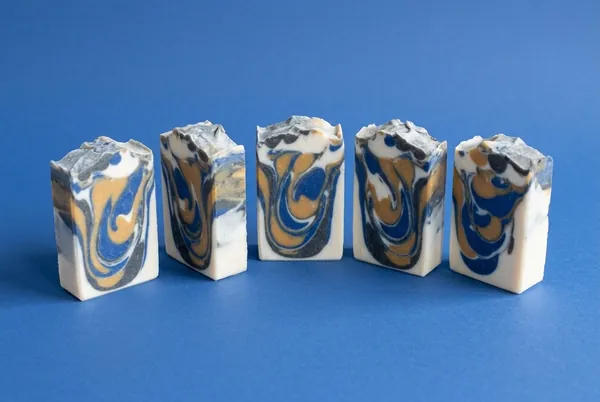
Swirl techniques: in the pot, drop, hanger, spoon and Taiwan
Seven cold-process swirls step by step, with the batter, recipe and temperatures that keep soap fluid, and why swirls turn muddy or lumpy.
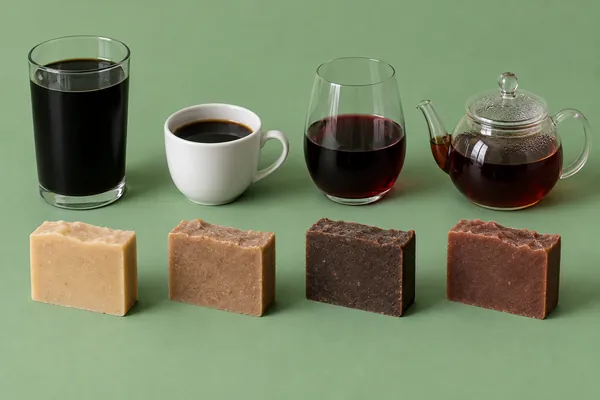
Beer, wine, coffee, tea and juice in soap
Using beer, wine, coffee, tea or juice in place of soap's water: how to prepare each one, add the lye safely, and what the calculator does with the liquid.
Where these proportions come from
Adapted from Anne-Marie Faiola's lemon linear swirls: her olive, rice bran and sweet almond oils with the palm and palm kernel replaced by more coconut oil, cocoa butter and shea butter, fresh lemon juice and zest at thin trace, and annatto, cocoa and white thirds swirled in a slab and gelled. We use a 31 % lye solution so the white stays clear of glycerin rivers in a full gel, count the lemon's citric acid in the lye, and cut her scent from more than 7 % of the oils to 3 %.
Formulation adapted from Pure Soapmaking by Anne-Marie Faiola (Storey Publishing, 2016). The method and notes are ours.