Lemon and poppy seed layered bar
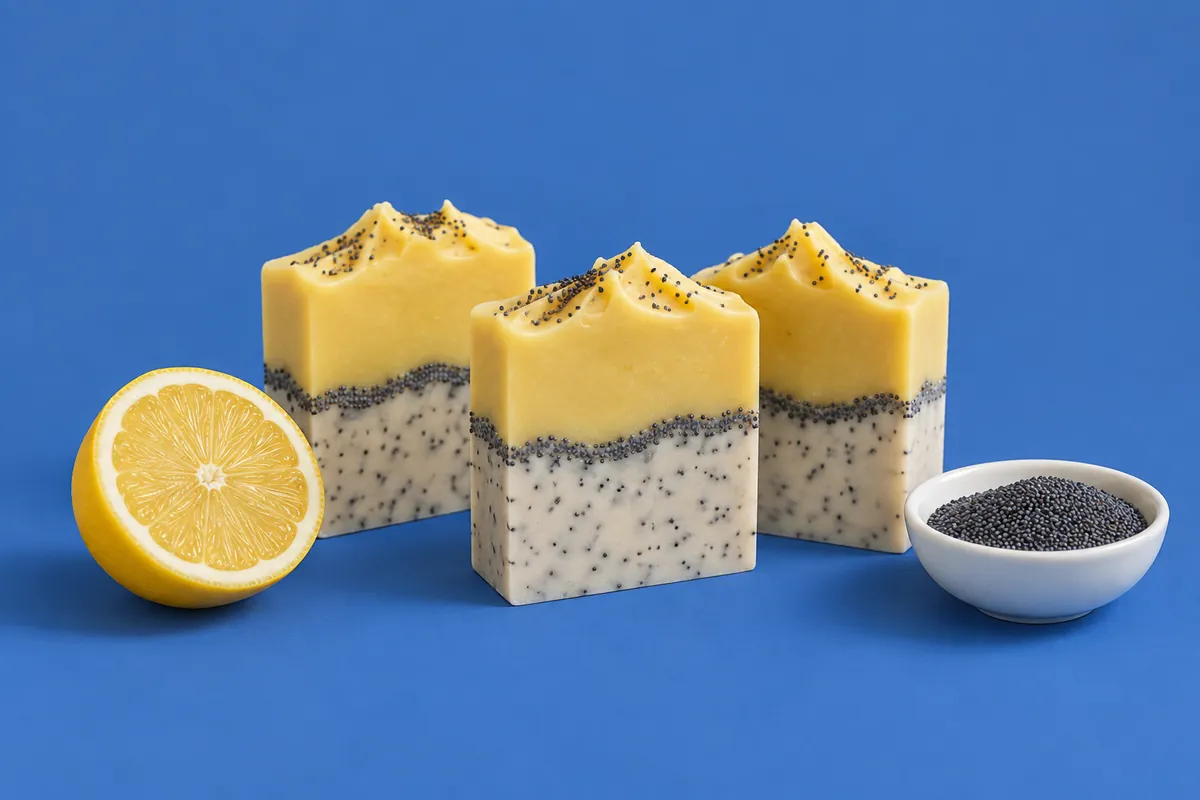
Two layers in one loaf: a creamy base flecked with poppy seeds under a soft yellow top, with a line of seeds between them. The poppy seeds give a light scrub, and litsea carries the lemon scent, since lemon oil alone fades fast in soap.
- Skill
- Intermediate
- Method
- Cold process
- Batch
- 1000 g of oils about 1456 g of batter
- Hands-on
- 1 h 30 min
- Cure
- 4 weeks
- Gel phase
- Yes insulate the mould
What you need
For 1000 g of oils, which fills a 1.5 litre loaf mould. Weigh everything, liquids included.
| Olive Oil · 40.0 % | 400 g | 14.11 oz |
| Coconut Oil · 25.0 % | 250 g | 8.82 oz |
| Shea Butter · 15.0 % | 150 g | 5.29 oz |
| Sunflowerseed Oil - High Oleic Acid · 15.0 % | 150 g | 5.29 oz |
| Castor Oil · 5.0 % | 50 g | 1.76 oz |
| Sodium hydroxide (NaOH) · the lye, 100 % pure | 137.2 g | 4.84 oz |
| Distilled water · for a 33 % lye solution | 278.5 g | 9.82 oz |
| Turmeric powder · 0.5 tsp, top layer only, stirred into 1 tbsp of the recipe's olive oil | 1.5 g | 0.05 oz |
| Poppy seeds · 2 tsp, stirred into the bottom layer | 5.6 g | 0.20 oz |
| Poppy seeds, to scatter · 1 tsp, half between the layers, half on top | 2.8 g | 0.10 oz |
| Litsea (May Chang) essential oil · 1.5 % of the oils, at trace | 15 g | 0.53 oz |
| Lemon essential oil · 1.5 % of the oils, at trace | 15 g | 0.53 oz |
- Superfat
- 6 %
- Temperatures
- Oils and lye solution each at 35 to 40 °C (95 to 104 °F)
Method
-
Get ready
Open a window, put on splash goggles, nitrile gloves and long sleeves, and set a lined 1.5 litre loaf mould on a level surface where it can stay. Have a second jug and a flexible spatula to hand for the layers. -
Weigh everything
Weigh 250 g coconut oil and 150 g shea butter into the pot, and 400 g olive oil, 150 g high-oleic sunflower oil and 50 g castor oil into a jug. Weigh 15 g litsea and 15 g lemon essential oil into a small glass, 278.5 g distilled water into the lye jug and 137.2 g sodium hydroxide last, into a dry container. -
Make the lye solution
At an open window or under the extractor fan, pour the sodium hydroxide slowly into the water, never the water onto the lye, and stir until clear. Keep your face out of the vapour and leave it to cool, labelled and out of reach. -
Prepare the colour and seeds
Stir ½ tsp (1.5 g) turmeric into 1 tbsp (about 14 g) of the olive oil from the jug until smooth; wear gloves, as it stains. Measure 2 tsp (5.6 g) poppy seeds into one cup and 1 tsp (2.8 g) into another. -
Melt the fats
Melt the coconut oil and shea butter on the lowest heat, then pour in the rest of the olive oil and the sunflower and castor oils. Let the oils and the lye solution each come to 35 to 40 °C (95 to 104 °F). -
Blend to light trace and scent
Pour the lye solution into the oils down the shaft of the stick blender and pulse in short bursts, stirring between them, to light trace. Stir in the litsea and lemon oils by hand. -
Split the batter
Pour half the batter, about 715 g, into the second jug and whisk the turmeric oil into it until evenly yellow; it looks orange now and softens to yellow within a day. Leave the plain half in the pot. -
Pour the bottom layer
Pulse the plain half to medium trace, like pudding that holds a drizzled line on its surface, then stir in the 2 tsp of poppy seeds and pour it into the mould. Tap the mould on the worktop and smooth the top level. -
Scatter the seed line
Scatter half the remaining seeds thinly over the surface, a light sprinkle and not a crust, or the layers will not bond. Wait 3 to 5 minutes, until the surface holds its shape when touched with the spatula. -
Pour the top layer
Whisk the yellow batter to a light-to-medium trace, then pour it slowly onto the back of the spatula held just above the bottom layer, starting at one end and moving along, so it spreads sideways instead of breaking through. Tap the mould gently. -
Finish and insulate
Swirl the top into soft peaks with a spoon and scatter the last of the seeds over it. Cover the mould and wrap it in a towel so the whole loaf gels evenly. -
Clean up
With your gloves still on, wipe the batter off the pot, jugs and tools with paper towels into the bin, then wash everything in hot soapy water. -
Unmould and cut
After 24 to 48 hours, when the loaf is firm, put your gloves back on and unmould it. Lay it on its side and cut it into bars about 2.5 cm (1 in) thick, so the knife doesn't drag seeds from the top down through the layers. -
Cure
Stand the bars on edge on a rack with air around them, out of the sun, for four to six weeks, turning them every few days.
Tips
- Lemon essential oil on its own fades within weeks in soap; litsea, which smells of lemon sherbet, is what keeps the scent. Keep both bottles closed and cool.
- Turmeric's yellow fades in light. Cure and store the bars out of the sun, and use the dose given: more turmeric stains washcloths.
- If the top layer punches through, the bottom layer was too soft. Next time let it firm a few more minutes and pour lower over the spatula.
The oils
| Oil | Share |
|---|---|
| Olive Oil (virgin / refined / olive oil) | 40.0 % |
| Coconut Oil | 25.0 % |
| Shea Butter | 15.0 % |
| Sunflowerseed Oil - High Oleic Acid | 15.0 % |
| Castor Oil | 5.0 % |
How it is made
| Process | Cold process |
| Alkali | NaOH |
| Superfat | 6 % |
| Water | lye water at 33 % |
| Iodine value | 61 |
| INS | 144 |
Why make it
A cheerful, lightly scrubby bar for hands and body. Poppy seeds are small, hard and round, so they polish rather than scratch, and they sit in the lower layer, leaving the yellow top to lather smooth. Makers like them because, unlike fresh botanicals, they keep their dark colour in the bar. The base is mild and palm-free, cleansing 17 and conditioning 62 on our scale at a 6 % superfat, so it suits everyday washing and skin that dries easily. The lemon smell comes from litsea, because lemon oil alone fades within weeks in soap, and the soft yellow from a little turmeric. The American Academy of Dermatology notes that scrubbing can be too much for dry or sensitive skin, so keep this one for hands, arms and legs rather than the face.
Sources
- How to safely exfoliate at home · American Academy of Dermatology
What tradition, makers' experience and research say about soaps like this, each labelled for what it is. It is not medical advice, and no soap treats a skin condition: if you have one, ask a doctor or pharmacist.
What the numbers say
- Lauric acid 12.3 %
- Myristic acid 4.7 %
- Palmitic acid 8.9 %
- Stearic acid 8.9 %
- Ricinoleic acid 4.4 %
- Oleic acid 49.2 %
- Linoleic acid 7.9 %
- Other 5.1 %
Saturated : unsaturated 38 : 62
Computed from the fatty acids of the fats above. The bands are what the craft has settled on, not chemistry — a bar outside one is not wrong.
From the guides
All guides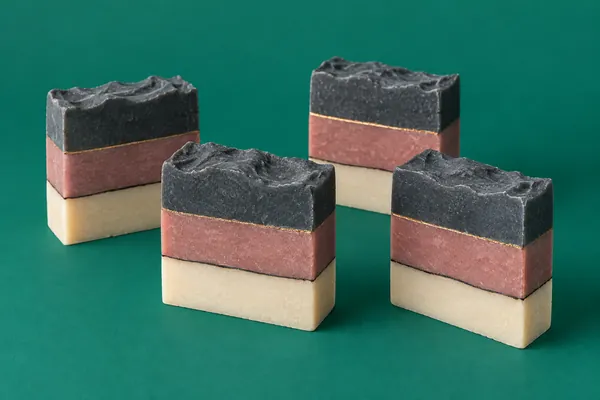
Layers, mica lines and pencil lines
Layered cold-process soap: batter thickness, pouring over a spatula, working out each layer from the mould, and pencil lines that don't split the bar.

Scenting soap: essential oils and fragrance oils
How much essential or fragrance oil to use in soap, what ounces per pound mean in percent, the IFRA limits for common essential oils, and EU allergen labelling.

Natural colourants: what herbs, clays and spices really do in soap
Clays, charcoal and plant colours in cold-process soap: doses per 500 g of oils, infused oil, powder or lye, and the colour each one actually turns.
Guides with this recipe
Where these proportions come from
Our own formulation: a palm-free base of olive oil, a quarter coconut oil, shea butter and high-oleic sunflower oil with a little castor oil, at a 6 % superfat. With mostly liquid oils the batter stays slow enough to split, thicken and layer without hurrying.