Linseed soft soap
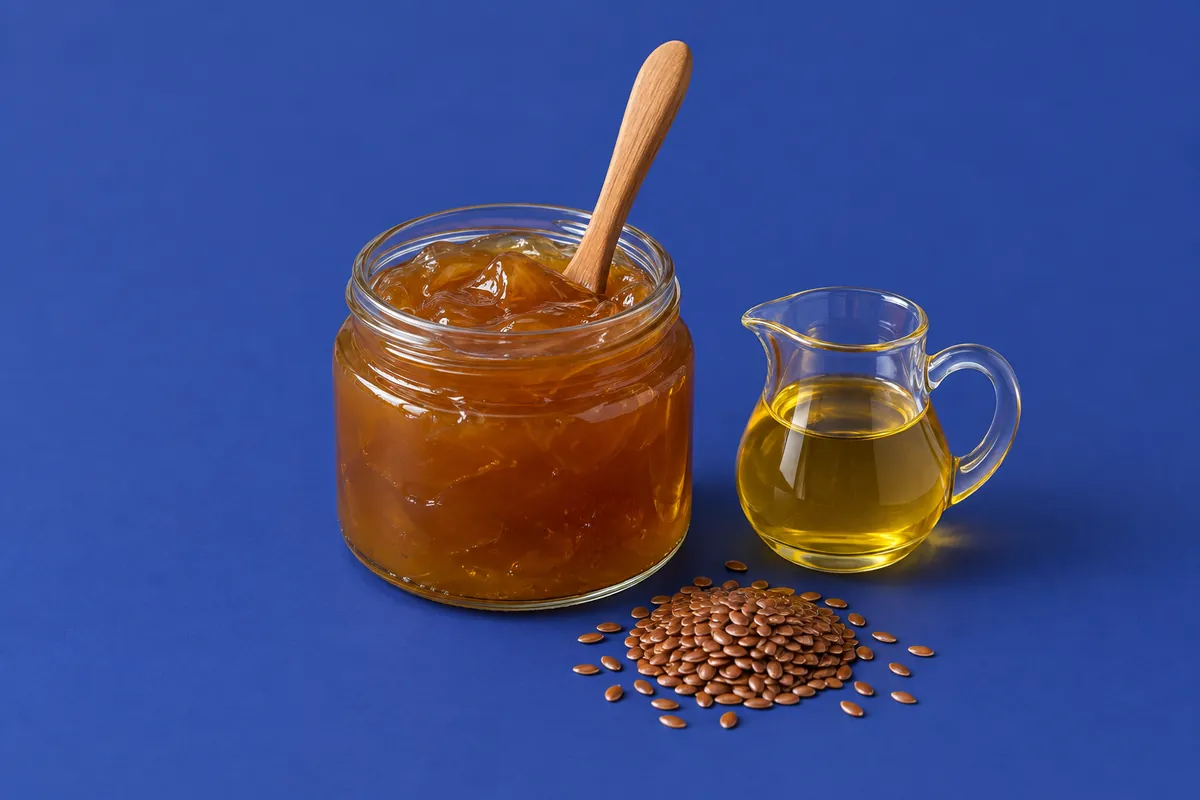
A soft, amber potash soap for the house: linseed oil cooked with potassium hydroxide and kept as a paste rather than diluted. A spoonful in a bucket of warm water washes floors and paintwork, and a dab on a brush shifts greasy marks. A drop on cold glass tells you it is ready, as it told soap boilers in 1908.
- Skill
- Advanced
- Method
- Hot process
- Batch
- 500 g of oils about 1103 g of batter
- Hands-on
- 1 h 15 min
- Cure
- None ready once cool
- Gel phase
- In the pot it gels as it cooks
What you need
For 500 g of oils, which fills about 1.2 litres of lidded jars. Weigh everything, liquids included.
| Flaxseed Oil · 100.0 % | 500 g | 17.64 oz |
| Potassium hydroxide (KOH) · the lye, 90 % pure; if your label says otherwise, weigh 108.4 g at 85 % or 97.0 g at 95 % | 102.4 g | 3.61 oz |
| Distilled water · for a 17 % lye solution | 500.0 g | 17.64 oz |
| Rosemary extract · stirred into the oil before the lye, because linseed oil oxidises fast | 0.5 g | 0.02 oz |
| Linseed oil, kept back for a correction · only if the glass test shows spare lye: stirred in, then cooked 30 minutes more | 10 g | 0.35 oz |
- Superfat
- 3.5 %
- Temperatures
- Lye solution cooled below 82 °C (180 °F), oil at 65 to 71 °C (150 to 160 °F), cooked on low
Method
-
Get ready
Put on sealed goggles, nitrile gloves and long sleeves, and keep them on until the soap is cooked. Weigh 500 g linseed oil into a slow cooker of 3.5 litres or more and stir in 0.5 g rosemary extract, then weigh 500 g distilled water into a heat-proof jug and 102.4 g potassium hydroxide flakes into a dry container, and close the flake tub at once. -
Make the lye solution
At an open window, add the flakes to the water a little at a time, stirring, never the water to the flakes. It fizzes and gets hot; let it cool below 82 °C (180 °F), and keep it away from aluminium, tin and zinc, which it attacks, giving off hydrogen. -
Warm the oil
Heat the linseed oil in the slow cooker on low to 65 to 71 °C (150 to 160 °F). -
Blend to a paste
Pour the lye solution into the oil and stick blend in bursts of a minute or two, stirring between them. With this much water the batter stays thin for a long time, then thickens, separates and comes back, sometimes several times; keep going until it holds together as a thick, opaque paste, which can take half an hour or more. -
Cover and cook
Put the lid on and leave the cooker on low. Stir back any liquid that has separated after 15 to 20 minutes and again 15 to 20 minutes later, then stir every 30 to 45 minutes. -
Cook until clear
Over 2 to 3 hours the paste darkens to amber and turns translucent from the edges inwards. It is ready to test when no opaque, creamy streaks come up as you fold it over. -
Test a drop on glass
Drop a teaspoon of the soap onto a cold glass plate and let it cool for a few minutes. Good soft soap sets into a firm jelly that breaks off short instead of stretching, with a faintly cloudy rim, and looks clear when you hold it up to the light. -
Read the drop
If it draws out in threads, it holds more water than it needs: cook it with the lid off for 20 minutes and test again. A cloudy rim that forms and then fades means it is not finished, so give it another half hour. A drop that sets whitish and cloudy right through means spare lye, from a weighing slip or flakes purer than 90 %: stir in 10 g more linseed oil, cook for 30 minutes and test again. -
Pot it
Turn off the cooker, stir the soap smooth and ladle it into clean jars while it is still warm and soft. Put the lids on once it has cooled; it sets to a soft, translucent amber jelly. -
Clean up safely
Scrape the pot and tools with paper towels into the bin, then wash them. Soak any towel or cloth that has raw linseed oil on it in water before you throw it away: linseed oil heats as it dries, and a heap of oily rags can catch fire. -
Use it
For floors, tiles and paintwork, stir a tablespoon into a bucket of warm water. For greasy marks, rub a little straight onto a damp brush or cloth, scrub, then rinse. -
Store it
Keep the jars closed, away from heat and light. Linseed oil is among the most unsaturated oils there is, so make a batch you will use within a few months rather than a year's supply.
Tips
- Use cold-pressed linseed oil, sold as flaxseed oil for food or as raw linseed oil. Never use boiled linseed oil from a hardware shop: it contains metal driers and sometimes solvent.
- The lye assumes potassium hydroxide flakes of 90 % purity, the usual label figure. Purer flakes leave spare lye, which the glass test shows as a whitish drop; weaker ones leave free oil, a cloudy rim that keeps fading however long you cook. Enter your label's figure in the calculator before you weigh.
- Old soft soaps often held rosin, which the Dutch soft-soap makers limited to 5 % of the fats, as Simmons and Appleton recorded. It is left out here: rosin, or colophony, is a common cause of contact allergy.
- The calculator scores this soap 0 for cleansing, because that figure counts only lauric and myristic acids. Soft soap of linseed oil's unsaturated acids still cleans, and it dissolves readily even in cold water.
The oils
| Oil | Share |
|---|---|
| Flaxseed Oil (Linseed Oil) | 100.0 % |
How it is made
| Process | Hot process |
| Alkali | KOH |
| Superfat | 3.5 % |
| Water | 100 % of the oils |
| Iodine value | 191 |
| INS | 1 |
Why make it
Soft soap was the everyday cleaning soap of old Europe: a potash soap of the fluid oils, kept as a paste and spooned into water. Simmons and Appleton named linseed first among its oils in 1908, and the soft soap of the United States Pharmacopoeia was a potash soap of linseed oil (AMA, 1913). In Scandinavia linseed soft soap is still the traditional wash for scrubbed wooden floors, a reputation built on long use rather than on tests. Make it if you want one plain, unscented soap for floors, tiles and paintwork that dissolves even in cold water. Our cleansing figure of 0 undersells it, since it counts only lauric and myristic acids. The caveats: it is made here as a household paste rather than a skin soap, it takes an afternoon of cooking, and linseed oil turns rancid quickly, so make a small batch.
Sources
- The Handbook of Soap Manufacture · W. H. Simmons and H. A. Appleton, Scott, Greenwood & Son, 1908
- A Handbook of Useful Drugs · Council on Pharmacy and Chemistry, American Medical Association, 1913
What tradition, makers' experience and research say about soaps like this, each labelled for what it is. It is not medical advice, and no soap treats a skin condition: if you have one, ask a doctor or pharmacist.
What the numbers say
- Palmitic acid 5.1 %
- Stearic acid 3.5 %
- Oleic acid 18.6 %
- Linoleic acid 15.2 %
- α-Linolenic acid 56.6 %
- Other 2.3 %
Saturated : unsaturated 10 : 90
Computed from the fatty acids of the fats above. The bands are what the craft has settled on, not chemistry — a bar outside one is not wrong.
From the guides
All guides
Cream soap and soft soaps
Cream soap explained: stearic acid, mostly potassium lye, a long cook and a whip, and why it turns pearly as it rests. Plus savon noir and the old potash soft soaps.
Liquid soap from potassium hydroxide paste
Real liquid soap from scratch: a potassium hydroxide paste cooked until it dissolves clear, diluted by weight, thickened with salt and kept free of microbes.
Sodium hydroxide, potassium hydroxide and dual lye explained
Why NaOH makes bars and KOH makes soft soap, converting between them, KOH purity, dual-lye recipes, and the calculator slip that turns a bar caustic.
Where these proportions come from
Our own formulation, on the lead of Simmons and Appleton's Handbook of Soap Manufacture (1908), which describes soft soap as a potash soap of the fluid oils, naming linseed first among them though it says linseed itself was used only to a limited extent, and gives the test on glass for judging it. It is all linseed oil, at a 3.5 % superfat, the lowest in half-point steps at which linseed oil's published saponification range cannot leave the paste lye-heavy (at 2 % it could be by 1.2 %), with water equal to the oil as in our savon noir, and a little rosemary extract because linseed oil oxidises fast.