Madder and alkanet swirl bar
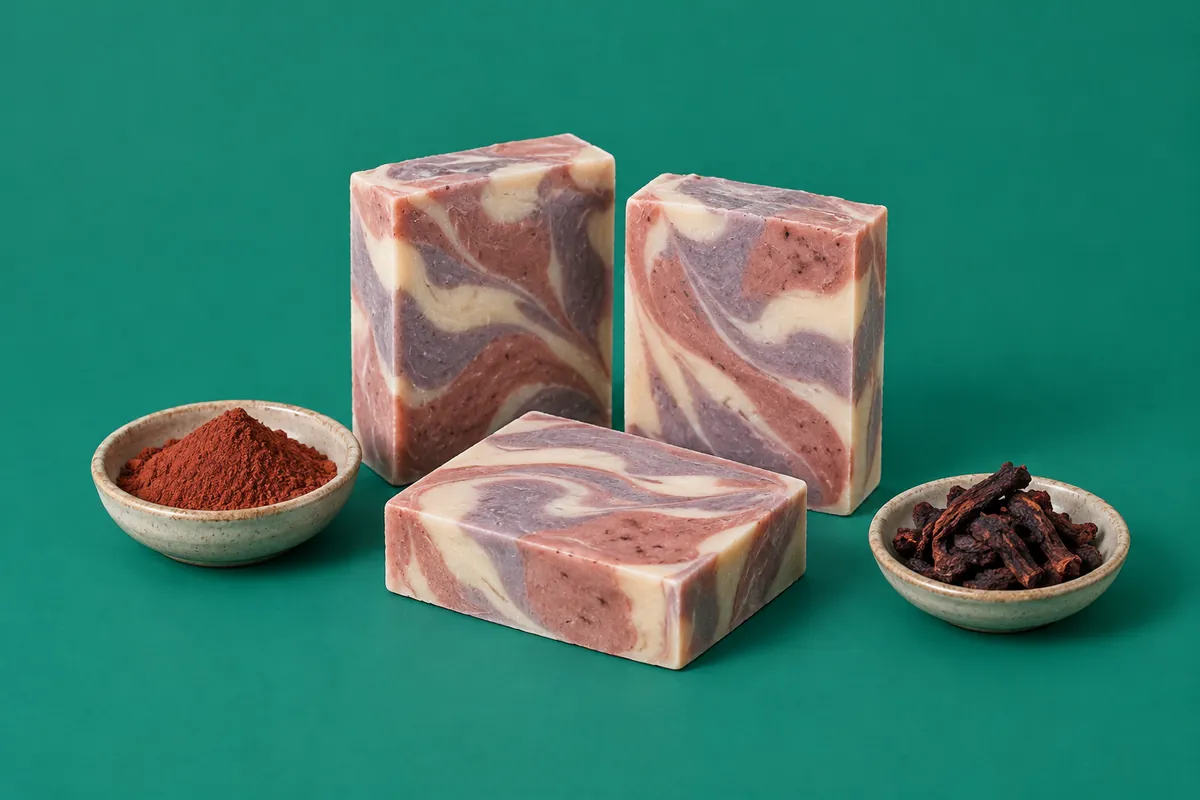
Dusky rose from madder root and purple from alkanet-infused oil, poured in layers with plain cream and marbled with a chopstick. All natural colour, and gelled on purpose so the madder comes out red rather than mauve.
- Skill
- Advanced
- Method
- Cold process
- Batch
- 900 g of oils about 1335 g of batter
- Hands-on
- 1 h 30 min
- Cure
- 6 weeks
- Gel phase
- Yes insulate the mould
What you need
For 900 g of oils, which fills a 25 × 9 cm loaf mould filled 6 cm deep (about 1.4 litres). Weigh everything, liquids included.
| Olive Oil · 45.0 % | 405 g | 14.29 oz |
| Coconut Oil · 25.0 % | 225 g | 7.94 oz |
| Shea Butter · 15.0 % | 135 g | 4.76 oz |
| Sunflowerseed Oil - High Oleic Acid · 15.0 % | 135 g | 4.76 oz |
| Sodium hydroxide (NaOH) · the lye, 100 % pure | 125.1 g | 4.41 oz |
| Distilled water · for a 31 % lye solution | 278.5 g | 9.82 oz |
| Alkanet root · infused ahead in 40 g of extra olive oil and strained; 14 g of that oil goes into the purple portion as part of the recipe's olive oil | 10 g | 0.35 oz |
| Madder root powder · 2 tsp, pink portion only, dispersed in 14 g of the recipe's olive oil | 4.2 g | 0.15 oz |
| Olive oil for the alkanet infusion · extra to the recipe's; 14 g of the strained oil goes into the purple portion as part of the recipe's olive oil | 40 g | 1.41 oz |
| Lavender oil · 2.0 % of the oils, at trace | 18 g | 0.63 oz |
| Geranium oil · 1.0 % of the oils, at trace | 9 g | 0.32 oz |
- Superfat
- 5 %
- Temperatures
- Oils and lye solution at 32 to 38 °C (90 to 100 °F)
Method
-
Infuse the alkanet ahead
A day or more before, put the 10 g of alkanet root in a jar with 40 g of olive oil, extra to the recipe's. Stand the jar in a pan of hot water for 2 to 4 hours, keeping the oil at about 49 °C (120 °F) and below 54 °C (130 °F), never over a direct flame and never unattended, then let it cool and strain it through fine cloth. -
Get ready
Put on goggles, gloves and long sleeves and open a window. Line the mould and set it level where it can stay for a day, with two spouted jugs, a chopstick and a spatula in reach. -
Set out each portion's oil
Weigh 391 g of olive oil instead of the full 405 g, because 14 g of the alkanet oil stands in for the rest; put that 14 g in the purple jug. From the 391 g, stir the madder into 14 g in the pink jug and set another 14 g aside plain for the cream. -
Make the lye solution
Where the air moves, pour the 125.1 g of sodium hydroxide slowly into the 278.5 g of water, never the reverse, and stir until clear. Leave it labelled and out of reach to cool to 32 to 38 °C (90 to 100 °F). -
Melt and scent the oils
Melt the coconut oil and shea butter gently, add the rest of the olive oil and the sunflower oil, and let them cool to 32 to 38 °C (90 to 100 °F) while they stay clear. Stir in the lavender and geranium oils. -
Blend to light trace
Pour the lye solution in down the blender shaft, tap out trapped air, and blend in short pulses with stirring between until light trace: thin custard that holds a faint line for a few seconds. -
Split into thirds
Weigh 430 g of batter into the purple jug and 430 g into the pink jug and whisk each smooth. Stir the 14 g of plain olive oil into the batter left in the pot, about 430 g: now each third has its full share of oil. -
Pour in layers
Pour about 110 g of cream along the mould from just above the surface, then 110 g of pink, then 110 g of purple, and repeat for four rounds. Tap the mould after each round. -
Swirl across
Push a chopstick to the bottom in one corner and drag it side to side across the width in tight zigzags, working along to the far end without lifting it out. -
Swirl along
Drag it back in long zigzags along the length, working across the width, so the second pass crosses the first. Stop while the three colours are still distinct. -
Cover so it gels
Cover the mould with a board or lid and wrap it in a towel for a day, two towels in a room below about 24 °C (75 °F). The madder needs the gel to turn red; kept cool, it stays a dusky mauve. -
Unmould and cut
Unmould with gloves on after 2 to 3 days, once firm, and cut bars about 2.5 cm (1 in) thick. -
Cure in the dark
Stand the bars on edge with air between them for 6 weeks, turning them every few days, somewhere dark: plant colours fade in light.
Tips
- Alkanet often cuts blue-grey and settles towards purple over the first weeks of the cure, so judge the colour at the end, not on the first day.
- Every portion gets the same 14 g of oil for a reason: oil added to one part of the batter and not another leaves that part softer and the rest harsher.
- If you sell the soap, tell your safety assessor about the madder. One of its compounds is genotoxic, and two others caused kidney tumours in rats that were fed them.
- Alkanet stains cloth, so keep an old towel for wiping the jugs.
The oils
| Oil | Share |
|---|---|
| Olive Oil (virgin / refined / olive oil) | 45.0 % |
| Coconut Oil | 25.0 % |
| Shea Butter | 15.0 % |
| Sunflowerseed Oil - High Oleic Acid | 15.0 % |
How it is made
| Process | Cold process |
| Alkali | NaOH |
| Superfat | 5 % |
| Water | lye water at 31 % |
| Iodine value | 61 |
| INS | 145 |
Why make it
Two of the oldest plant colours in one bar. Madder root dyed leather in Egypt around 2000 BC and was grown across the Roman world for red cloth (Newman and Gates), and alkanet belongs to a family of red roots long used to colour silk and food (Malik et al.). Soap shows how differently they behave in alkali: alkannin turns blue at high pH, so the purple starts blue-grey and settles over the following weeks, and madder turns red only if the loaf gels. The bar underneath is a slow, palm-free everyday soap, cleansing 17 and conditioning 61 on our scale, mild enough for daily washing. Choose it for natural colour rather than for any effect on skin, and keep it out of the light, which fades plant colours. If you sell it, mention the madder to your safety assessor: two of its compounds caused kidney tumours in rats fed them (Inoue et al.).
Sources
- The Matter of Madder in the Ancient World · Richard Newman and Glenn Alan Gates, in Mummy Portraits of Roman Egypt, J. Paul Getty Museum, 2020
- Natural plant-derived compounds in food and cosmetics: a paradigm of shikonin and its derivatives · Malik S. et al., Materials 16, 2023
- Carcinogenic potential of alizarin and rubiadin, components of madder color, in a rat medium-term multi-organ bioassay · Inoue K. et al., Cancer Science 100, 2009
What tradition, makers' experience and research say about soaps like this, each labelled for what it is. It is not medical advice, and no soap treats a skin condition: if you have one, ask a doctor or pharmacist.
What the numbers say
- Lauric acid 12.3 %
- Myristic acid 4.7 %
- Palmitic acid 9.5 %
- Stearic acid 8.9 %
- Oleic acid 52.5 %
- Linoleic acid 8.3 %
- Other 5.2 %
Saturated : unsaturated 39 : 61
Computed from the fatty acids of the fats above. The bands are what the craft has settled on, not chemistry — a bar outside one is not wrong.
From the guides
All guides
Natural colourants: what herbs, clays and spices really do in soap
Clays, charcoal and plant colours in cold-process soap: doses per 500 g of oils, infused oil, powder or lye, and the colour each one actually turns.
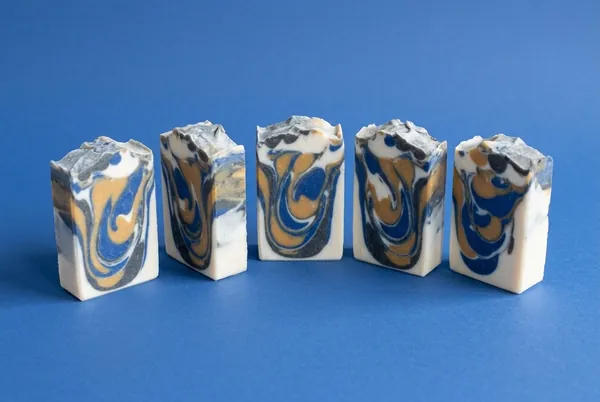
Swirl techniques: in the pot, drop, hanger, spoon and Taiwan
Seven cold-process swirls step by step, with the batter, recipe and temperatures that keep soap fluid, and why swirls turn muddy or lumpy.
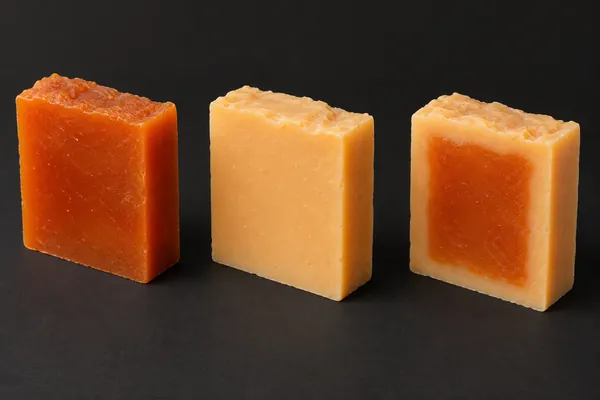
Gel phase: to insulate or keep it cool
What gel phase is, why a loaf turns dark and translucent, how gelled and ungelled bars differ, why partial gel is cosmetic, and how to cause or prevent it.
Where these proportions come from
Our own slow palm-free blend at a 31 % lye solution, gelled so the madder turns red; alkanet is infused in oil and madder dispersed in oil, as Kelly Cable and David Fisher colour with them, and the layered pour with its crossed chopstick passes is Fisher's free-form swirl.
Formulation adapted from The Natural Soap Making Book for Beginners by Kelly Cable (Althea Press, 2017); The Complete Photo Guide to Soap Making by David Fisher (Creative Publishing International, 2018). The method and notes are ours.