Madder root ombre bar
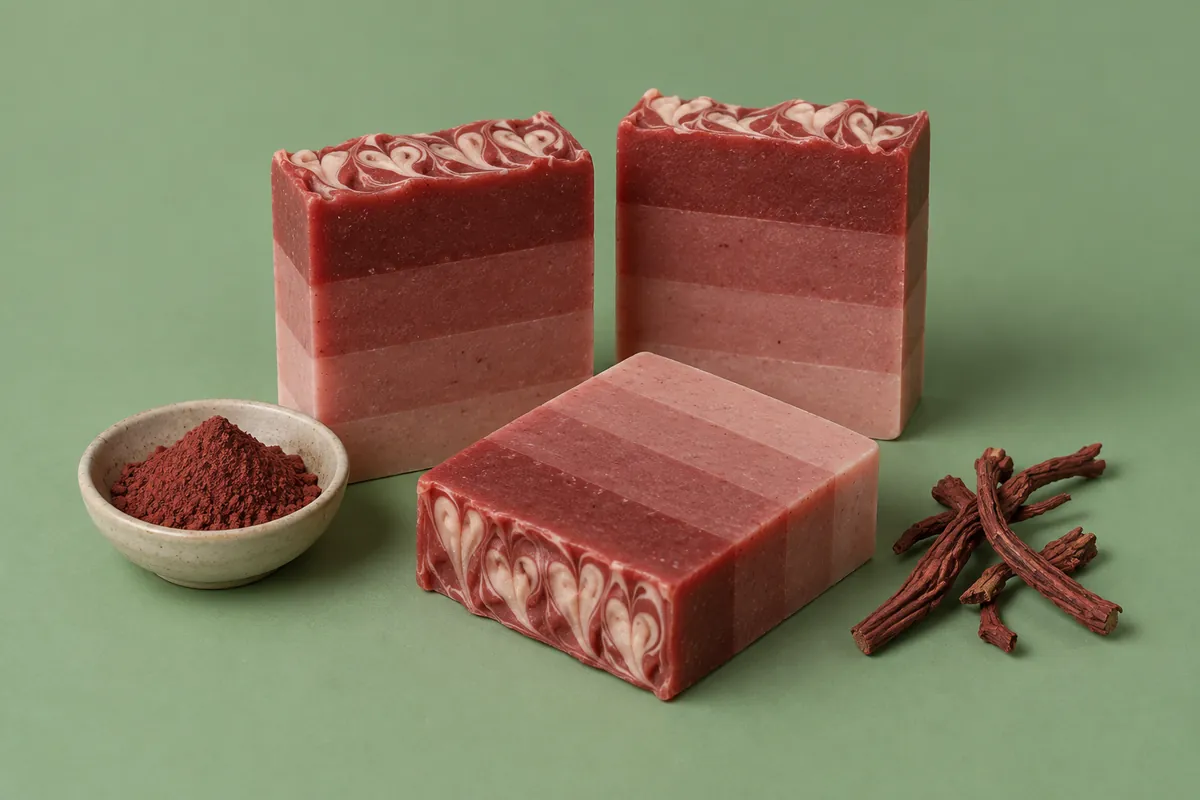
Four layers of madder root, stepping from soft rose at the base to deep brick red on top, with plain loops drawn through the top. Palm-free, and gelled hot on a heating pad, because madder only turns red when the soap gels.
- Skill
- Intermediate
- Method
- Cold process
- Batch
- 900 g of oils about 1338 g of batter
- Hands-on
- 1 h 40 min
- Cure
- 6 weeks
- Gel phase
- Yes insulate the mould
What you need
For 900 g of oils, which fills a 25 × 9 cm silicone loaf mould filled 6 cm deep (about 1.4 litres). Weigh everything, liquids included.
| Olive Oil · 30.0 % | 270 g | 9.52 oz |
| Coconut Oil · 25.0 % | 225 g | 7.94 oz |
| Rice Bran Oil · 20.0 % | 180 g | 6.35 oz |
| Shea Butter · 15.0 % | 135 g | 4.76 oz |
| Cocoa Butter · 10.0 % | 90 g | 3.17 oz |
| Sodium hydroxide (NaOH) · the lye, 100 % pure | 125.4 g | 4.42 oz |
| Distilled water · for a 31 % lye solution | 279.2 g | 9.85 oz |
| Madder root powder · 5.25 tsp, ¾, 1, 1½ and 2 tsp in the four layers, palest at the bottom, each dispersed in 15 g of the recipe's olive oil | 11 g | 0.39 oz |
| Isopropyl alcohol, 91 % or stronger, in a spray bottle · a light mist over the top against soda ash, well away from any flame | 30 ml | |
| Lemongrass oil · 1.5 % of the oils, at trace | 13.5 g | 0.48 oz |
| Black pepper oil · 1.0 % of the oils, at trace | 9 g | 0.32 oz |
- Superfat
- 5 %
- Temperatures
- Oils and lye solution at 40 to 45 °C (104 to 113 °F), then a heating pad for a full gel
Method
-
Get ready
Put on goggles, gloves and long sleeves and open a window. Stand the mould level on a board you can lift, so it can go onto the heating pad later without tilting, and set out four jugs numbered 1 to 4, a squeeze bottle, a spatula, a chopstick and a towel. -
Dose the madder jugs
Weigh the 270 g of olive oil and take 63 g of it: 15 g into each jug and 3 g into the squeeze bottle. Stir the madder into the jugs, ¾ teaspoon in jug 1, 1 teaspoon in jug 2, 1½ teaspoons in jug 3 and 2 teaspoons in jug 4, until a smear on a white plate shows no grains. -
Make the lye solution
Where the air moves, pour the 125.4 g of sodium hydroxide slowly into the 279.2 g of water, never the reverse, and stir until clear. Leave it labelled and out of reach to cool to 40 to 45 °C (104 to 113 °F). -
Melt and scent the oils
Melt the coconut oil, shea butter and cocoa butter gently, add the rice bran oil and the rest of the olive oil, and let them cool to 40 to 45 °C (104 to 113 °F) while they stay clear. Stir in the lemongrass and black pepper oils. -
Blend to thin trace
Pour the lye solution in down the blender shaft, tap out trapped air, and blend in short pulses with stirring between, only until the batter is smooth and a drizzle stays visible on the surface for a few seconds. -
Fill the bottle and the jugs
Pour 60 g of plain batter into the squeeze bottle, cap it and shake it with its oil. Weigh 301 g of batter into each numbered jug, the last taking what is left, and whisk each until the colour is even. -
Pour the palest layer
Pulse jug 1 with the blender until it reaches medium trace, like pudding, pour it into the mould and tap it level. Wait until a light touch leaves a mark that doesn't close, usually 5 to 10 minutes. -
Pour the middle layers
Bring jug 2 to medium trace and pour it slowly onto the back of a spatula held just above the surface, moving along the mould so it spreads over the layer below without breaking in, and tap gently. Wait again until it holds a mark, then pour jug 3 the same way. -
Pour the deepest layer
Pour jug 4 over the spatula in the same way and smooth the top. Later jugs thicken as they wait, so they need fewer pulses than the first. -
Draw the loops
Squeeze a row of plain dots about 1 cm apart down the middle of the top. Push the chopstick about 6 mm into the soap at one end and draw it through the dots in one continuous line of figure-of-eight loops to the far end. -
Heat it into gel
Mist the top lightly with isopropyl alcohol against soda ash, away from any flame, cover the mould with a board and wrap it in the towel. Lift it onto a heating pad set to medium for 30 minutes, checking after 15: if the top cracks or starts to rise, unwrap it and switch the pad off. -
Cool it slowly
After 30 minutes switch the pad off and leave the wrapped mould on it overnight. The heat is what turns madder red; a loaf that stays cool comes out mauve. -
Unmould
Unmould with gloves on after 2 to 3 days, once the loaf is firm and pulls away from the sides. -
Cut it on its side
Lay the loaf on one long side, so the layers stand upright, and cut bars about 2.5 cm (1 in) thick. The knife then runs along each layer instead of dragging the deep top down through the pale ones. -
Cure in the dark
Stand the bars on edge with air between them for 6 weeks, turning them every few days, somewhere dark. Light fades plant colours, though madder's reds go more slowly than greens.
Tips
- Madder's colour depends on the gel. Fully gelled it is rose to brick red; kept cool it stays mauve, and a loaf that gels only in the middle has redder centres and paler ends. Madder also varies between suppliers, so treat a first batch as a test of yours.
- Faiola soaps madder a little hotter, at 49 to 54 °C (120 to 130 °F), to be sure of the gel. She also warns that soap which overheats in silicone can come out with small pock marks, so this recipe soaps below 49 °C (120 °F) and lets the heating pad, watched, finish the job.
- Each jug gets 15 g of oil and the dots their 3 g for a reason: oil taken out of the pot and never put back leaves that part of the batter short of oil and harsh. Returned as written, every layer has the same 5 % superfat.
- If you sell the soap, tell your safety assessor about the madder. Its lucidin is genotoxic, and alizarin and rubiadin, two more of its compounds, caused kidney tumours in rats fed them.
The oils
| Oil | Share |
|---|---|
| Olive Oil (virgin / refined / olive oil) | 30.0 % |
| Coconut Oil | 25.0 % |
| Rice Bran Oil | 20.0 % |
| Shea Butter | 15.0 % |
| Cocoa Butter (Theobroma Oil) | 10.0 % |
How it is made
| Process | Cold process |
| Alkali | NaOH |
| Superfat | 5 % |
| Water | lye water at 31 % |
| Iodine value | 60 |
| INS | 146 |
Why make it
Four shades from one plant colour, and a clear lesson in how dose and heat decide what madder does. Madder root is among the oldest dyes there are: it has been found on Egyptian leather of about 2000 BC, and the Romans grew it widely for red cloth (Newman and Gates). In soap its shade depends on the gel, red when the loaf heats right through and mauve when it stays cool, which is why this one finishes on a heating pad. The base is firm and palm-free, hardness 42 and cleansing 17 on our scale, with shea and cocoa butter for a bar that lasts and suits daily washing. Make it for the look and the natural colour; madder does nothing for skin in a rinse-off bar. If you sell it, tell your safety assessor about the madder, since two of its compounds caused kidney tumours in rats fed them (Inoue et al.).
Sources
- The Matter of Madder in the Ancient World · Richard Newman and Glenn Alan Gates, in Mummy Portraits of Roman Egypt, J. Paul Getty Museum, 2020
- Carcinogenic potential of alizarin and rubiadin, components of madder color, in a rat medium-term multi-organ bioassay · Inoue K. et al., Cancer Science 100, 2009
What tradition, makers' experience and research say about soaps like this, each labelled for what it is. It is not medical advice, and no soap treats a skin condition: if you have one, ask a doctor or pharmacist.
What the numbers say
- Lauric acid 12.3 %
- Myristic acid 4.8 %
- Palmitic acid 13.2 %
- Stearic acid 11.7 %
- Oleic acid 41.7 %
- Linoleic acid 11.7 %
- Other 5.0 %
Saturated : unsaturated 46 : 54
Computed from the fatty acids of the fats above. The bands are what the craft has settled on, not chemistry — a bar outside one is not wrong.
From the guides
All guides
Natural colourants: what herbs, clays and spices really do in soap
Clays, charcoal and plant colours in cold-process soap: doses per 500 g of oils, infused oil, powder or lye, and the colour each one actually turns.
Layers, mica lines and pencil lines
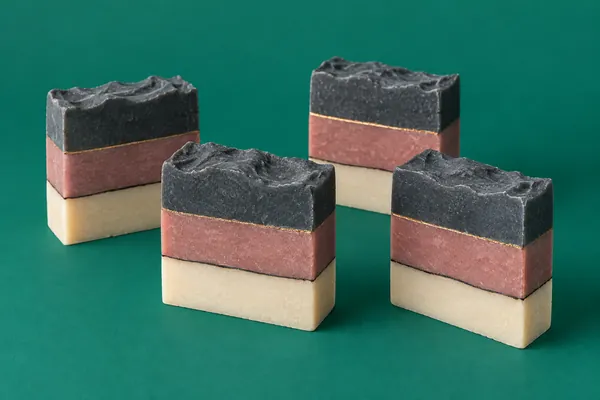
Layered cold-process soap: batter thickness, pouring over a spatula, working out each layer from the mould, and pencil lines that don't split the bar.
Gel phase: to insulate or keep it cool
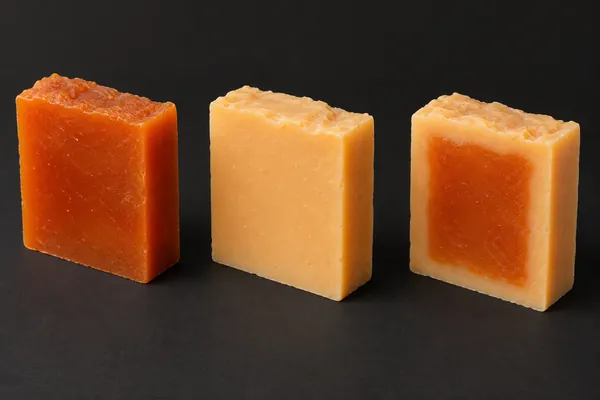
What gel phase is, why a loaf turns dark and translucent, how gelled and ungelled bars differ, why partial gel is cosmetic, and how to cause or prevent it.
Where these proportions come from
Adapted from Anne-Marie Faiola's madder root ombre bars: her four layers of rising madder, each dispersed in oil, and her hot gel on a heating pad. We replace her palm oil with shea butter and more cocoa butter, work at a 31 % lye solution for time to layer, keep every layer's madder within 1 to 3 teaspoons per pound of soap, and cut her lemongrass and black pepper from 4.5 % of the oils to 2.5 %.
Formulation adapted from Pure Soapmaking by Anne-Marie Faiola (Storey Publishing, 2016). The method and notes are ours.