Red wine bar
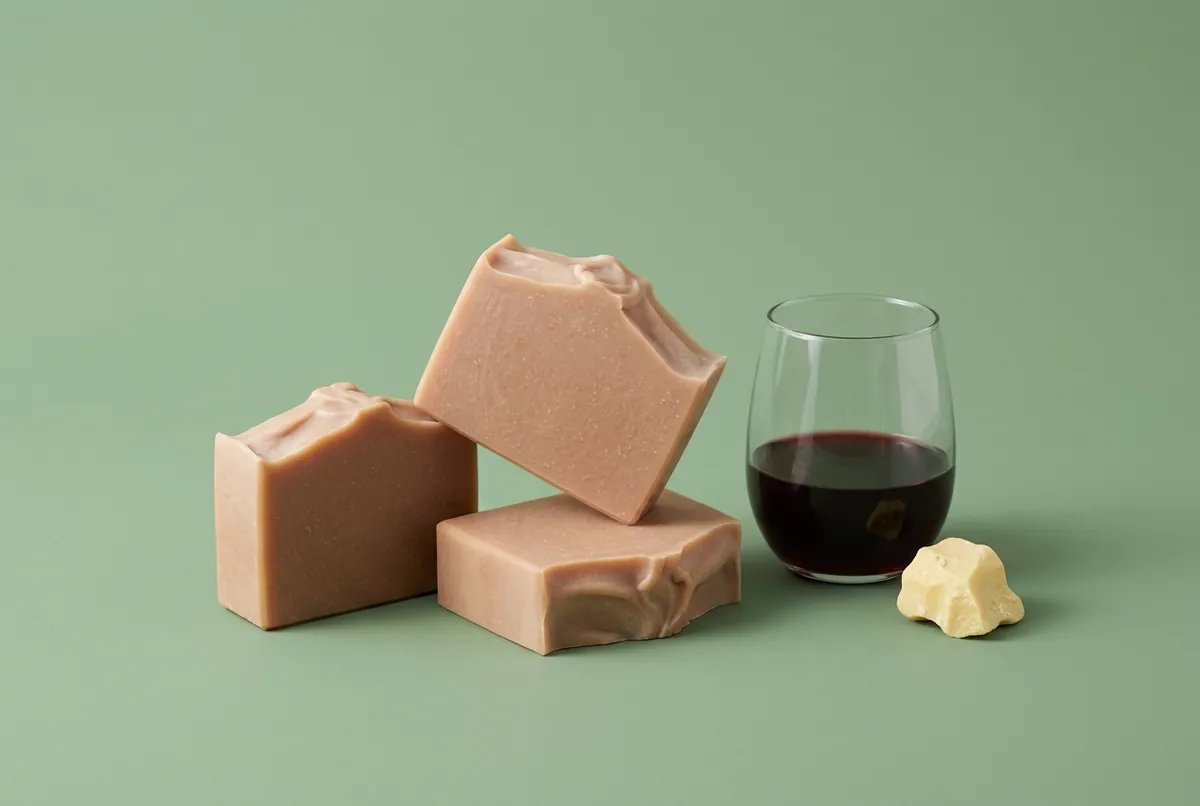
A rich, butter-heavy bar with reduced red wine as half of its liquid, scented with lavender and clary sage. The wine gives a warm tan with a hint of red-brown rather than a red bar, and the shea and cocoa butter give a hard bar with a creamy lather.
- Skill
- Intermediate
- Method
- Cold process
- Batch
- 1000 g of oils about 1462 g of batter
- Hands-on
- 1 h 15 min
- Cure
- 6 weeks
- Gel phase
- No keep it cool
What you need
For 1000 g of oils, which fills a 1.5 litre loaf mould. Weigh everything, liquids included.
| Olive Oil · 35.0 % | 350 g | 12.35 oz |
| Coconut Oil · 20.0 % | 200 g | 7.05 oz |
| Shea Butter · 15.0 % | 150 g | 5.29 oz |
| Cocoa Butter · 15.0 % | 150 g | 5.29 oz |
| Avocado Oil · 10.0 % | 100 g | 3.53 oz |
| Castor Oil · 5.0 % | 50 g | 1.76 oz |
| Sodium hydroxide (NaOH) · the lye, 100 % pure | 135.5 g | 4.78 oz |
| Distilled water · for a 33 % lye solution | 137.6 g | 4.85 oz |
| Dry red wine, reduced and cooled · half of the liquid, from about 250 g of wine simmered down by a third; frozen with the water | 159 g | 5.61 oz |
| Lavender essential oil · 2.0 % of the oils, at trace | 20 g | 0.71 oz |
| Clary sage essential oil · 1.0 % of the oils, at trace | 10 g | 0.35 oz |
- Superfat
- 6 %
- Temperatures
- Wine lye kept below 30 °C (86 °F); oils at 32 to 35 °C (90 to 95 °F) when it goes in
Method
-
Reduce the wine
Simmer about 250 g of dry red wine uncovered for 10 to 15 minutes, until about a third has boiled away, watching it because it foams. Let it cool. -
Freeze the liquid
Weigh 159 g of the cooled wine and 137.6 g of distilled water into a jug, stir them together, and freeze them overnight in an ice-cube tray. -
Get ready
Put on goggles, gloves and long sleeves, open a window or run the extractor, weigh the oils and lye, and line the mould. -
Melt the oils
Melt the shea butter, cocoa butter and coconut oil, stir in the olive, avocado and castor oils, and let them cool to 32 to 35 °C (90 to 95 °F), still clear. -
Add the lye to the frozen wine
Put the cubes in a heat-safe jug standing in iced water and sprinkle in the 135.5 g of sodium hydroxide a spoonful at a time, stirring until each dissolves; never pour the liquid onto the lye. Take 10 to 15 minutes and keep it below 30 °C (86 °F); a murky colour and a sharp smell are normal. -
Strain and combine
With the oils at 32 to 35 °C (90 to 95 °F), pour the cold wine lye through a stainless steel sieve into them, which shows you no lye is left undissolved, and stick blend in short bursts to light trace. -
Scent it
Stir in the lavender and clary sage oils by hand until evenly mixed. -
Pour
Pour into the mould, tap it on the bench to release air, and swirl the top with the back of a spoon if you like. -
Keep it cool
Leave the mould uncovered in a cool room rather than wrapping it: wine batches run hot. If the top domes or cracks, move it into the fridge. -
Unmould and cut
Unmould with gloves on after 24 to 48 hours, when the loaf is firm, and cut it into bars. -
Cure
Cure the bars on a rack with air around them for six weeks, turning them now and then.
Tips
- Red wine won't make the bar red: its colour comes from anthocyanins, which break down in alkali, so it cures a warm tan with a hint of red-brown. For a wine-red swirl, colour part of the batter with a pigment such as red iron oxide.
- Use a dry red. A cheap one works as well as a good one, and sweet wines carry more sugar, which heats the batch more.
- Simmering doesn't remove all the alcohol; over a third of it stays. It cuts enough that the wine doesn't overheat when the lye goes in, and the freezing and the ice bath do the rest.
The oils
| Oil | Share |
|---|---|
| Olive Oil (virgin / refined / olive oil) | 35.0 % |
| Coconut Oil | 20.0 % |
| Shea Butter | 15.0 % |
| Cocoa Butter (Theobroma Oil) | 15.0 % |
| Avocado Oil | 10.0 % |
| Castor Oil | 5.0 % |
How it is made
| Process | Cold process |
| Alkali | NaOH |
| Superfat | 6 % |
| Water | lye water at 33 % |
| Iodine value | 58 |
| INS | 144 |
Why make it
A rich, butter-heavy bar to keep for yourself or give away, with a bottle's story on the label. Thirty per cent shea and cocoa butter make it hard and creamy, 40 and 30 on our scale, and it is mild, cleansing 14 at a 6 % superfat, so it suits dry skin and daily washing. Wine's appeal in soap is mostly the idea of it: its red anthocyanins break down in alkali (Enaru et al.), so the bar comes out tan rather than red, and whatever reputation wine has in the glass does not carry over to a bar that is rinsed off. What it does bring is a little sugar for the lather and a warm colour. Lavender and clary sage give a soft herbal scent. Simmering leaves much of the alcohol in the wine (USDA), which is why the method freezes it and adds the lye over ice.
Sources
- Anthocyanins: Factors Affecting Their Stability and Degradation · B. Enaru et al., Antioxidants 10(12), 2021
- USDA Table of Nutrient Retention Factors, Release 6 (alcohol) · US Department of Agriculture, Agricultural Research Service, 2007
What tradition, makers' experience and research say about soaps like this, each labelled for what it is. It is not medical advice, and no soap treats a skin condition: if you have one, ask a doctor or pharmacist.
What the numbers say
- Lauric acid 9.8 %
- Myristic acid 3.8 %
- Palmitic acid 12.7 %
- Stearic acid 13.3 %
- Ricinoleic acid 4.4 %
- Oleic acid 44.3 %
- Linoleic acid 7.6 %
- Other 4.7 %
Saturated : unsaturated 42 : 58
Computed from the fatty acids of the fats above. The bands are what the craft has settled on, not chemistry — a bar outside one is not wrong.
From the guides
All guides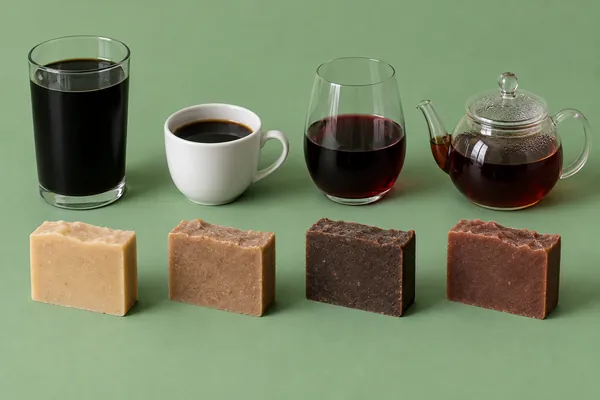
Beer, wine, coffee, tea and juice in soap
Using beer, wine, coffee, tea or juice in place of soap's water: how to prepare each one, add the lye safely, and what the calculator does with the liquid.
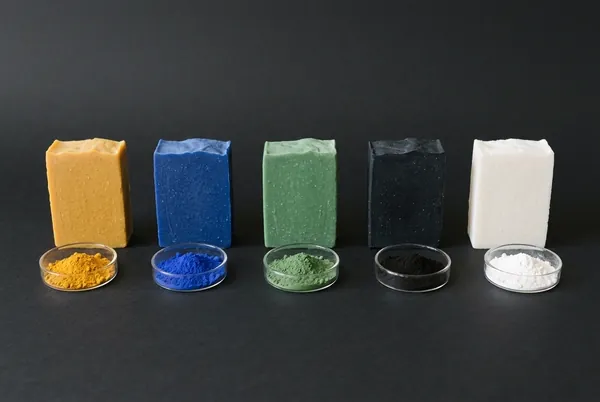
Colouring soap: micas, oxides, ultramarines and pigments
Which colourants survive cold-process soap, how much to use per 500 g of oils, how to disperse and split colour, and what the EU, UK and US rules ask.
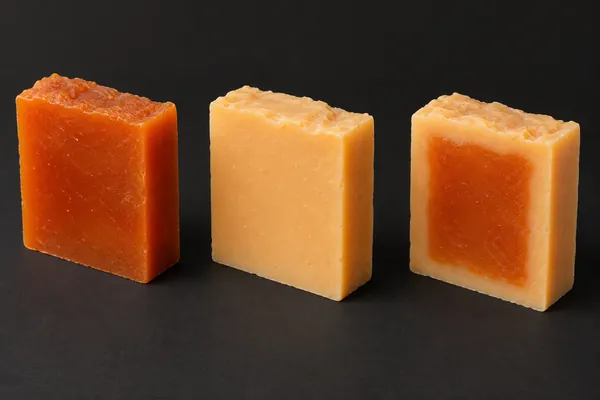
Gel phase: to insulate or keep it cool
What gel phase is, why a loaf turns dark and translucent, how gelled and ungelled bars differ, why partial gel is cosmetic, and how to cause or prevent it.
Where these proportions come from
Our own formulation: a butter-rich bar with 30 % shea and cocoa butter for hardness and a creamy lather, avocado and castor oil, and a fifth coconut oil, at a 6 % superfat. Reduced red wine is half of the liquid, close to the share in Cable's mulled wine soap.