Rosemary and mint bar
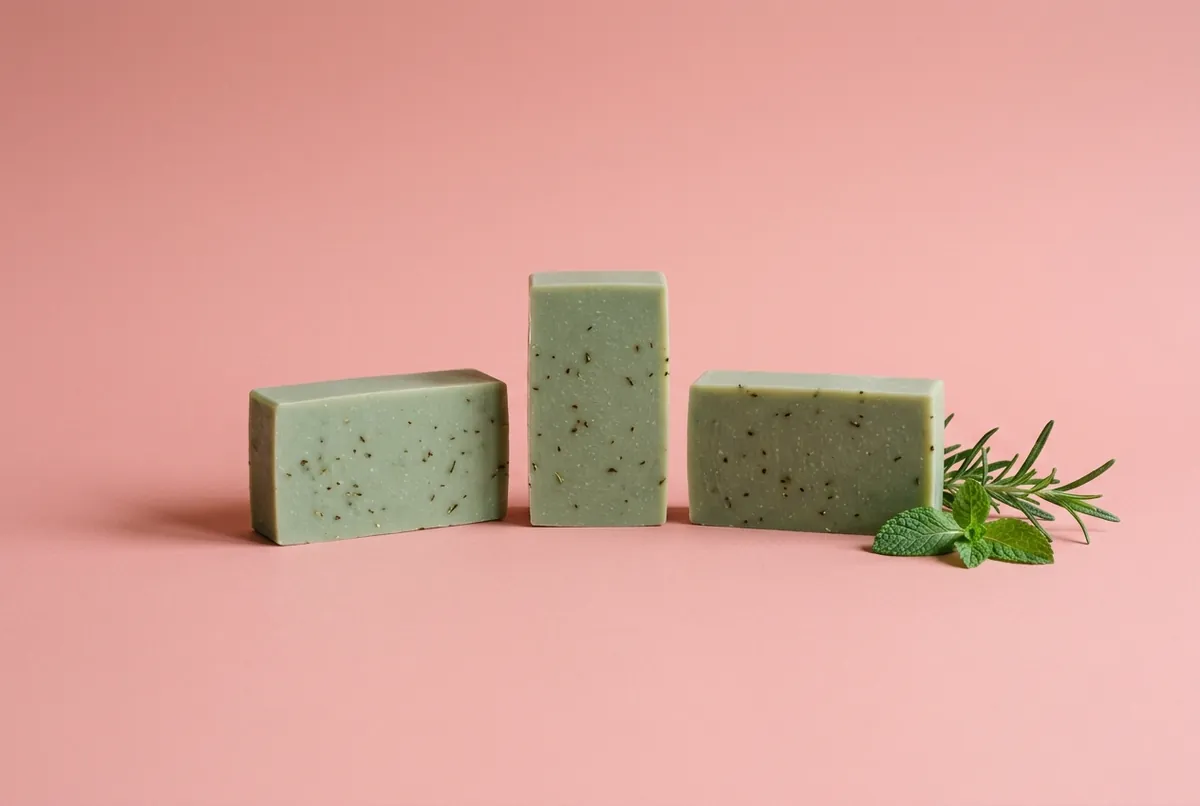
An everyday herbal bar scented with rosemary and peppermint essential oils, coloured green with spirulina and flecked with steeped mint leaves. Kept cool so the green lasts, it cuts into a fresh-looking bar with a clean, bright scent.
- Skill
- Beginner
- Method
- Cold process
- Batch
- 1000 g of oils about 1457 g of batter
- Hands-on
- 1 h 10 min
- Cure
- 5 weeks
- Gel phase
- No keep it cool
What you need
For 1000 g of oils, which fills a 1.5 litre loaf mould. Weigh everything, liquids included.
| Olive Oil · 35.0 % | 350 g | 12.35 oz |
| Coconut Oil · 25.0 % | 250 g | 8.82 oz |
| Sunflowerseed Oil - High Oleic Acid · 20.0 % | 200 g | 7.05 oz |
| Cocoa Butter · 15.0 % | 150 g | 5.29 oz |
| Castor Oil · 5.0 % | 50 g | 1.76 oz |
| Sodium hydroxide (NaOH) · the lye, 100 % pure | 139.6 g | 4.92 oz |
| Distilled water · for a 33 % lye solution | 283.4 g | 10.00 oz |
| Spirulina powder · 1 tbsp, stirred into 3 tablespoons of the recipe's liquid oils | 7 g | 0.25 oz |
| Dried peppermint leaf · about one tea bag's worth, steeped first and dried again, for flecks | 2 g | 0.07 oz |
| Boiling water, for steeping the mint · poured over the dried leaves the day before and then thrown away; it is not part of the recipe's water | 1 cup | |
| Rosemary essential oil · 1.5 % of the oils, at trace | 15 g | 0.53 oz |
| Peppermint essential oil · 1.0 % of the oils, at trace | 10 g | 0.35 oz |
- Superfat
- 5 %
- Temperatures
- Oils and lye solution each at 35 to 38 °C (95 to 100 °F), and the loaf kept cool after pouring
Method
-
Steep and dry the mint
The day before, pour a cup of boiling water over 2 g of dried peppermint leaf, about one tea bag's worth, and leave it for 10 minutes; the tea itself isn't used. Strain it, press out as much water as you can, and spread the leaves thinly on a paper towel to dry overnight, until they are crisp again. -
Get ready
Open a window or turn on the extractor fan, send children and pets out, and put on splash goggles, nitrile gloves and long sleeves. Set out a 1.5 litre loaf mould and clear a shelf in the fridge for it. -
Weigh everything
Weigh 250 g coconut oil and 150 g cocoa butter into the pot, and 350 g olive oil, 200 g high-oleic sunflower oil and 50 g castor oil into a jug. Weigh 283.4 g of distilled water into the lye jug, 15 g of rosemary and 10 g of peppermint essential oil into a small cup, and the 139.6 g of sodium hydroxide last, into a dry container. -
Make the lye solution
Where air moves, pour the sodium hydroxide slowly into the water, never the water onto the lye, and stir until it turns clear. Keep your face away from the vapour and leave it to cool, labelled and out of reach. -
Mix the spirulina
Spoon 3 tablespoons of the liquid oils out of the jug into a small cup and stir in 1 tablespoon of spirulina until it is smooth, with no dry lumps. -
Melt the fats
Melt the coconut oil and cocoa butter on the lowest heat until just clear, then pour in the rest of the liquid oils from the jug. -
Blend to light trace
When the oils and the lye solution are each at 35 to 38 °C (95 to 100 °F), pour the lye solution into the oils down the blender shaft. Pulse and stir until the batter looks like thin custard and a drizzle leaves a faint line. -
Colour and scent
Whisk in the spirulina oil until the batter is an even green, then stir in the rosemary and peppermint oils by hand. -
Add the mint
Crumble in the steeped mint leaves and stir until the flecks are spread evenly. If they sink, pulse a few seconds more so the batter thickens enough to hold them. -
Pour
Pour into the mould, scraping the pot clean, tap the mould on the worktop to release air, and smooth the top. -
Keep it cool
Put the mould, uncovered, in the fridge overnight, or in the coolest room you have, so the loaf doesn't gel: heat dulls spirulina's green. -
Unmould and cut
Let the loaf come back to room temperature, then unmould it with gloves on, 24 to 48 hours after pouring, and cut it into bars. Let any condensation dry off before the bars go to cure. -
Cure
Stand the bars on edge for five weeks somewhere dry, airy and out of the light, which fades spirulina, turning them every few days.
Tips
- Spirulina is brightest the day you cut the bars and softens to sage or olive within a week or two. Keeping the loaf cool and the bars in the dark slows that down.
- Steep the mint, then dry it again. Unsteeped mint bleeds a brown halo into the soap around each fleck, and leaves still damp can bleed or go mouldy. Even so, the flecks turn dark green to brown.
- Peppermint is the strong one. If you want more scent, raise the rosemary rather than the peppermint.
The oils
| Oil | Share |
|---|---|
| Olive Oil (virgin / refined / olive oil) | 35.0 % |
| Coconut Oil | 25.0 % |
| Sunflowerseed Oil - High Oleic Acid | 20.0 % |
| Cocoa Butter (Theobroma Oil) | 15.0 % |
| Castor Oil | 5.0 % |
How it is made
| Process | Cold process |
| Alkali | NaOH |
| Superfat | 5 % |
| Water | lye water at 33 % |
| Iodine value | 58 |
| INS | 148 |
Why make it
A middle-of-the-road everyday bar, cleansing 17 and conditioning 60 on our scale, made palm-free with cocoa butter and high-oleic sunflower oil, so it suits most skin for hands and body. People choose it for the scent: rosemary's herbal, camphor-like note with the cool edge of peppermint, a fresh smell many enjoy in a morning shower. The coolness has a real basis: menthol, the main component of peppermint oil, switches on the same nerve receptor that senses cold (McKemy and colleagues, 2002), though at 1 % of the oils in a rinse-off bar the effect is slight. The green is spirulina and the flecks are steeped mint leaf, both there for looks, and both fade towards olive within a few weeks. Peppermint stings the eyes, so rinse well around them.
Sources
What tradition, makers' experience and research say about soaps like this, each labelled for what it is. It is not medical advice, and no soap treats a skin condition: if you have one, ask a doctor or pharmacist.
What the numbers say
- Lauric acid 12.3 %
- Myristic acid 4.7 %
- Palmitic acid 11.9 %
- Stearic acid 7.8 %
- Ricinoleic acid 4.4 %
- Oleic acid 48.0 %
- Linoleic acid 7.4 %
- Other 5.1 %
Saturated : unsaturated 40 : 60
Computed from the fatty acids of the fats above. The bands are what the craft has settled on, not chemistry — a bar outside one is not wrong.
From the guides
All guides
Natural colourants: what herbs, clays and spices really do in soap
Clays, charcoal and plant colours in cold-process soap: doses per 500 g of oils, infused oil, powder or lye, and the colour each one actually turns.
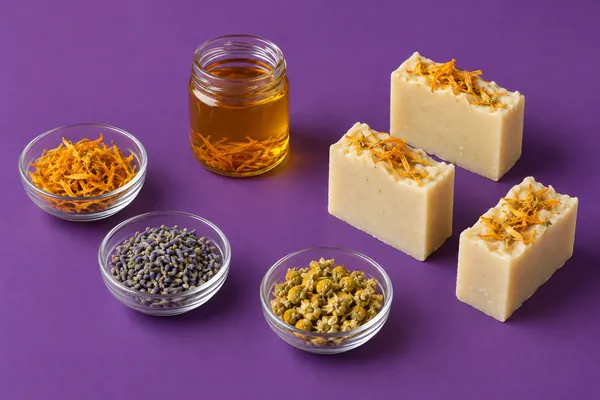
Herbs, flowers and infusions in soap
What dried herbs, petals, infused oils and herbal teas really do in soap: which survive lye, how to infuse an oil, and which claims a herbal soap can make.
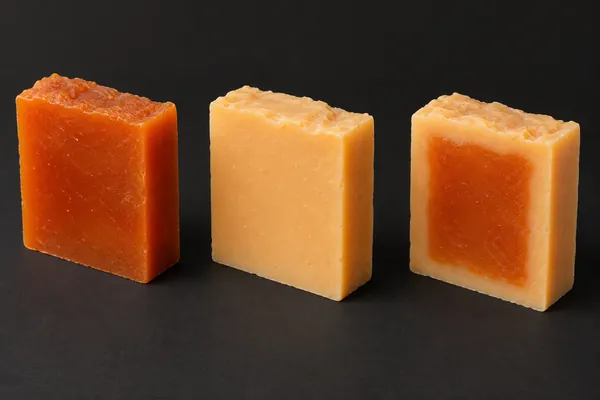
Gel phase: to insulate or keep it cool
What gel phase is, why a loaf turns dark and translucent, how gelled and ungelled bars differ, why partial gel is cosmetic, and how to cause or prevent it.
Where these proportions come from
Our own palm-free formulation at a 5 % superfat, with high-oleic sunflower oil and cocoa butter for a pale base so the spirulina reads green. The mint flecks are steeped tea leaves stirred in at trace, as Heidi Corley Barto does in her peppermint tea soap.
Formulation adapted from The Natural Soap Chef by Heidi Corley Barto (Ulysses Press, 2012). The method and notes are ours.