Seawater marine soap
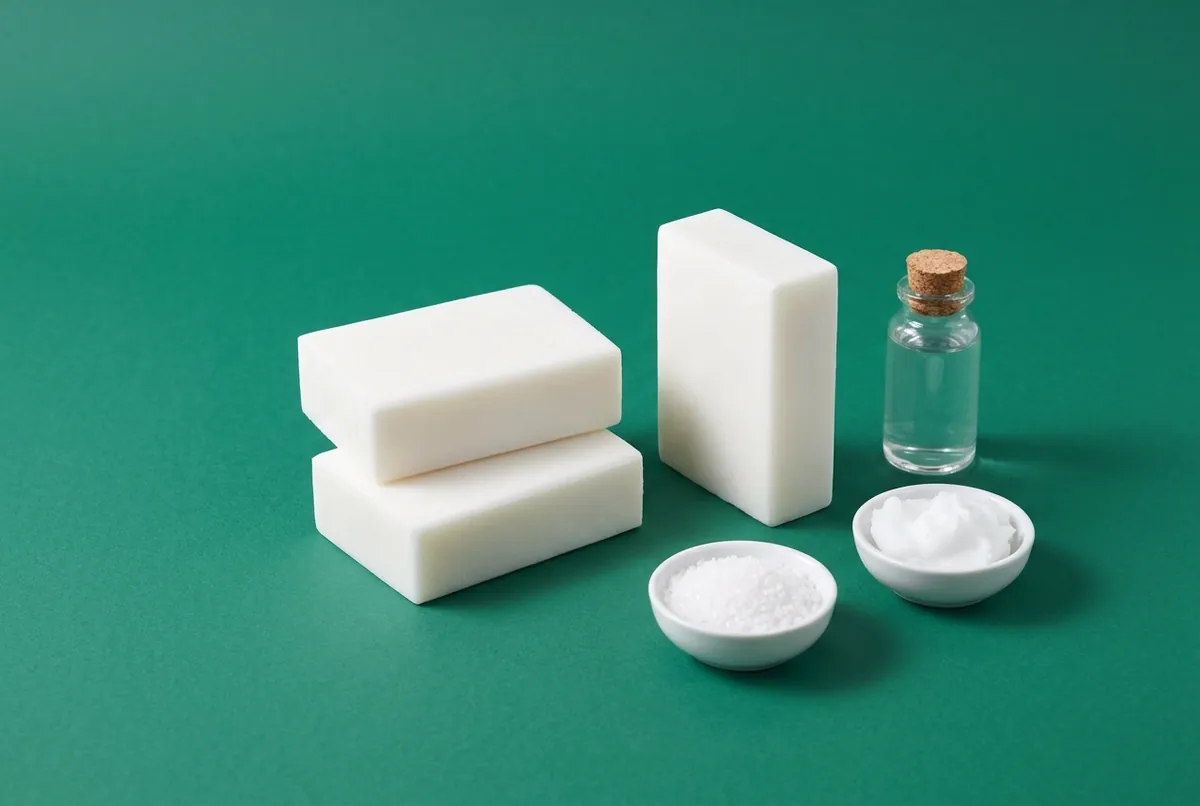
A hard, white coconut bar made with water salted to the strength of the sea, after the marine soaps once made for washing at sea: coconut soap stays dissolved in brine, so it still lathers in sea water. An 18 % superfat keeps this much coconut mild, and a little potash makes it smoother.
- Skill
- Intermediate
- Method
- Cold process
- Batch
- 1000 g of oils about 1502 g of batter
- Hands-on
- 50 min
- Cure
- 6 weeks
- Gel phase
- Either way gel or not, both work
What you need
For 1000 g of oils, which fills a 1.5 litre loaf mould. Weigh everything, liquids included.
| Coconut Oil · 90.0 % | 900 g | 31.75 oz |
| Olive Oil · 5.0 % | 50 g | 1.76 oz |
| Castor Oil · 5.0 % | 50 g | 1.76 oz |
| Sodium hydroxide (NaOH) · the lye, 100 % pure | 131.2 g | 4.63 oz |
| Potassium hydroxide (KOH) · the lye, 90 % pure; if your label says otherwise, weigh 24.1 g at 85 % or 21.5 g at 95 % | 22.7 g | 0.80 oz |
| Distilled water · for a 33 % lye solution | 312.4 g | 11.02 oz |
| Fine sea salt · dissolved in the water before the lye, 35 g to the litre; leave it out if you use real seawater | 10.9 g | 0.38 oz |
| Lavender essential oil · 1.5 % of the oils, at trace | 15 g | 0.53 oz |
| Rosemary essential oil · 1.0 % of the oils, at trace | 10 g | 0.35 oz |
- Superfat
- 18 %
- Temperatures
- Oils and lye solution each at 32 to 38 °C (90 to 100 °F), left uncovered
Method
-
Get ready
Open a window, put on splash goggles, nitrile gloves and long sleeves, and line a 1.5 litre loaf mould. Weigh 900 g coconut oil into the pot, 50 g olive oil and 50 g castor oil into a jug, and 15 g lavender and 10 g rosemary essential oil into a small glass. -
Salt the water
Weigh 312.4 g distilled water into the lye jug and stir in 10.9 g fine sea salt until it has dissolved: 35 g to the litre, about as salty as the open sea. By a clean shore you can use 312 g of real seawater in place of both, collected away from harbours, outfalls and river mouths and strained through a coffee filter. -
Make the lye solution
Weigh 131.2 g sodium hydroxide and 22.7 g potassium hydroxide flakes into dry containers. At the open window, stir them into the salt water a little at a time, never the water onto the lye, and leave it to cool, labelled and out of reach. Real seawater turns milky as its magnesium drops out as a fine white powder; that is harmless, and all of it goes into the soap. -
Melt the oils
Melt the coconut oil until just clear, stir in the olive and castor oils, and let the oils and the lye solution each come to 32 to 38 °C (90 to 100 °F). Don't let the oils get much cooler: coconut oil starts to set below about 24 °C (75 °F). -
Blend to light trace
Stir the lye solution, pour all of it into the oils down the shaft of the stick blender and pulse briefly, stirring between pulses. This much coconut oil traces fast, so stop at light trace, when a drizzle leaves a faint line on the surface. -
Add the scent
Stir in the lavender and rosemary oils by hand with the spatula until the batter is even. -
Pour and leave it uncovered
Pour into the mould and tap it on the worktop to let air out. Leave it uncovered in a cool room with no towel over it: coconut soap makes plenty of heat of its own and can crack if it is kept warm. -
Cut it early
From about 8 hours after pouring, press the loaf with a gloved finger, and unmould and cut it as soon as it holds a clean edge. Don't leave it for days: a coconut loaf left too long cuts with chips and cracks. -
Cure
Stand the bars on a rack with air around them for six weeks, turning them now and then. They get very hard, and the drier a bar is, the longer it lasts in a wet place. -
Wash in sea water
Wet the bar and your skin, rub the bar on and work up the lather on your skin rather than in a bucket of sea water. Every litre of sea water turns about 30 g of coconut soap into scum, so lather needs a lot of soap in a little water. -
Keep it dry between washes
Carry it in a tin with holes or a mesh bag, and let it dry after use. A bar left wet, or shut in a sealed box, softens and wastes away.
Tips
- The quality numbers read harsh, with cleansing about 61, because they are worked out from the fatty acids alone and cannot see the 18 % superfat. That spare fat is what makes this much coconut soap mild enough for skin.
- Sodium stearate, the soap of tallow's hardest acid, is thrown out of a salt solution of 5 %, while sodium laurate, coconut's main soap, holds out until 17 %, as Simmons and Appleton recorded. Sea water, at about 3.5 % salt, sits close to the first figure and far from the second, which is why ships' marine soap was coconut soap.
- With real seawater, the sea's magnesium and calcium use up about 1.6 g of your sodium hydroxide as white hydroxides, which nudges the superfat up by about a point. There is nothing to correct.
- Potassium hydroxide does a tenth of the saponification, the little potash that made the old coconut soap smoother. The recipe assumes 90 % flakes, so enter the figure on your label in the calculator before you weigh.
The oils
| Oil | Share |
|---|---|
| Coconut Oil | 90.0 % |
| Olive Oil (virgin / refined / olive oil) | 5.0 % |
| Castor Oil | 5.0 % |
How it is made
| Process | Cold process |
| Alkali | NaOH + KOH |
| Superfat | 18 % |
| Water | lye water at 33 % |
| Iodine value | 16 |
| INS | 233 |
Why make it
This is a soap for washing where fresh water is short: on a boat, after a swim in the sea, or in very hard water. Coconut soap stays dissolved in brine where most soaps curdle, which is why the marine soaps of the nineteenth century were made from coconut or palm kernel oil (Simmons and Appleton 1908). By our numbers it looks harsh, cleansing 61 and hardness 73, because the scale reads only the fatty acids and cannot see the 18 % superfat that makes this much coconut mild enough for skin. It is still a brisk cleanser, better for hands, feet and a salty body than for a dry face every day. It is very hard and long-lasting, but sea water uses up soap quickly, so work the lather up on wet skin rather than in a bucket.
Sources
- W. H. Simmons and H. A. Appleton, The Handbook of Soap Manufacture · Scott, Greenwood & Son, 1908
What tradition, makers' experience and research say about soaps like this, each labelled for what it is. It is not medical advice, and no soap treats a skin condition: if you have one, ask a doctor or pharmacist.
What the numbers say
- Lauric acid 44.2 %
- Myristic acid 17.0 %
- Palmitic acid 8.8 %
- Stearic acid 3.0 %
- Ricinoleic acid 4.4 %
- Oleic acid 10.4 %
- Linoleic acid 2.4 %
- Other 13.1 %
Saturated : unsaturated 83 : 17
Computed from the fatty acids of the fats above. The bands are what the craft has settled on, not chemistry — a bar outside one is not wrong.
From the guides
All guides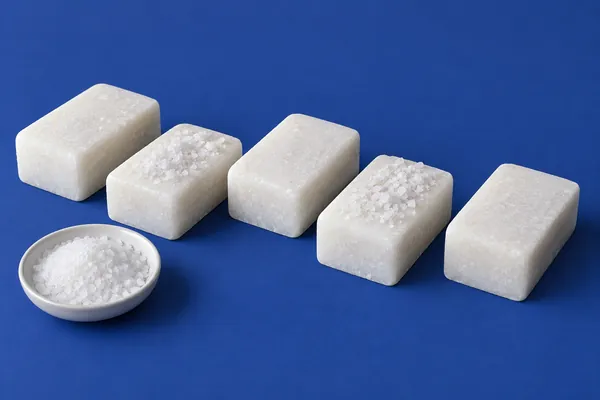
Salt bars: spa soap with sea salt
Why salt bars are mostly coconut oil at a 15 to 20 % superfat, how much salt to use and which to avoid, when to cut them, and how brine bars differ.
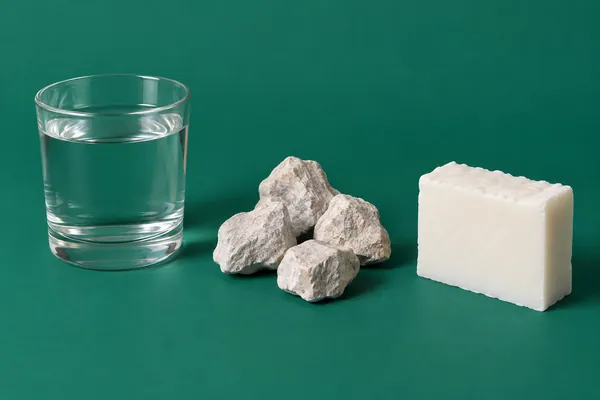
Soap in hard water: scum, chelators and rinse
Why soap turns to scum in hard water, how much soap each litre wastes, what a chelator in the bar can and cannot do, and why coconut soap copes best.
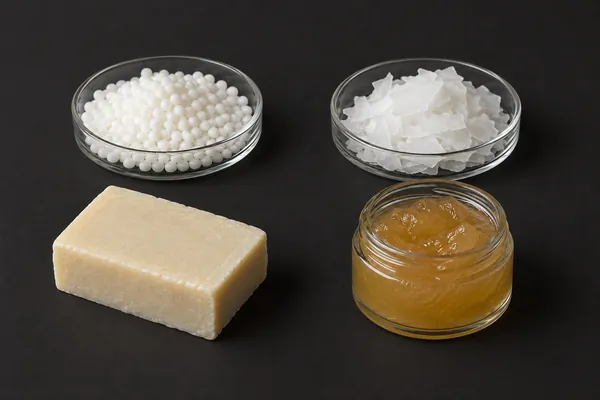
Sodium hydroxide, potassium hydroxide and dual lye explained
Why NaOH makes bars and KOH makes soft soap, converting between them, KOH purity, dual-lye recipes, and the calculator slip that turns a bar caustic.
Where these proportions come from
Our own formulation, on the lead of two soaps in Simmons and Appleton's Handbook of Soap Manufacture: their cold-process coconut soap, which they found smoother and milder with a little caustic potash beside the soda, and their marine soap, made of coconut or palm kernel oil because those soaps stay dissolved in brine and so lather in sea water. Here coconut oil is 90 % of the fats, with a little olive and castor oil, potassium hydroxide does a tenth of the saponification, and the superfat is 18 %, inside the craft's usual 15 to 20 % for bars this rich in coconut, where their own lye works out at about 11 %. The water is salted to the strength of the sea.
Formulation adapted from The Handbook of Soap Manufacture by W. H. Simmons and H. A. Appleton (Scott, Greenwood & Son, 1908). The method and notes are ours.