Spirulina and turmeric layered bar
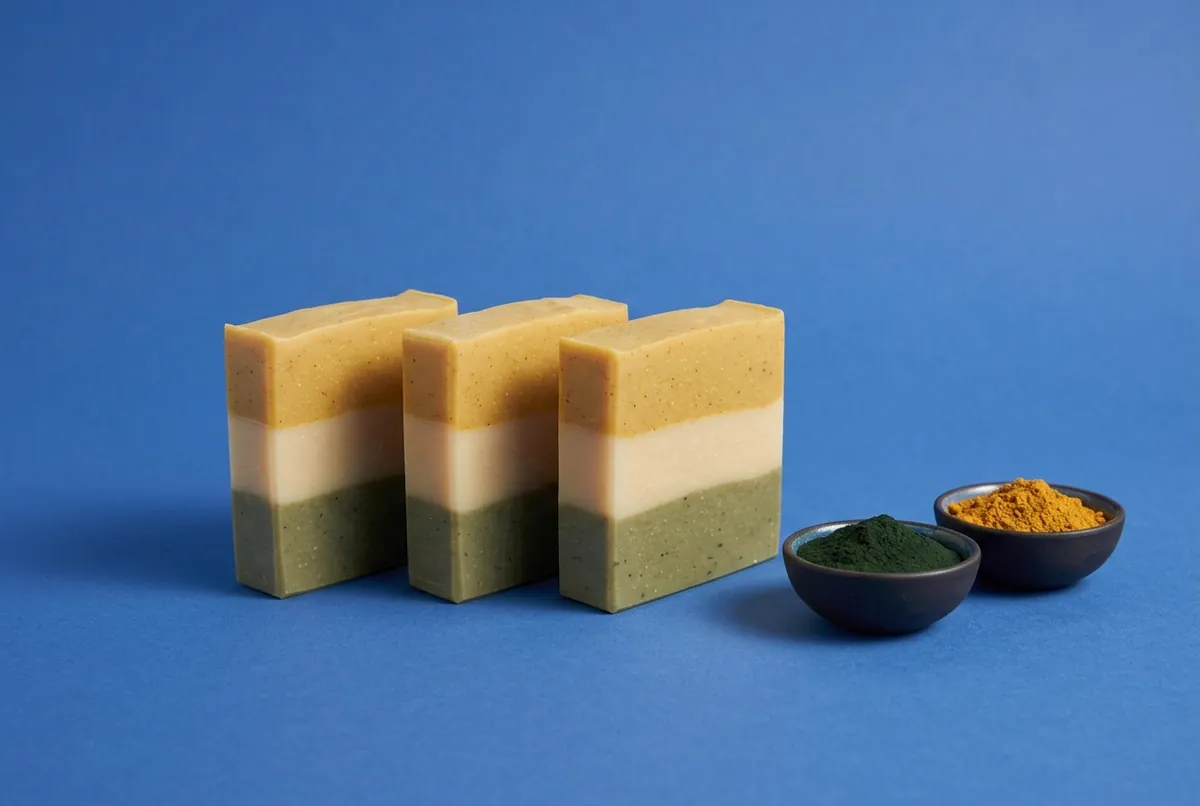
Spirulina green, plain cream and turmeric gold in three layers, made cool and cured in the dark. Both plant colours move after the cut, bright green to olive in a week and orange to gold overnight, and this recipe tells you what to expect.
- Skill
- Intermediate
- Method
- Cold process
- Batch
- 900 g of oils about 1305 g of batter
- Hands-on
- 1 h 30 min
- Cure
- 6 weeks
- Gel phase
- No keep it cool
What you need
For 900 g of oils, which fills a 25 × 9 cm loaf mould filled 6 cm deep (about 1.4 litres). Weigh everything, liquids included.
| Olive Oil · 45.0 % | 405 g | 14.29 oz |
| Coconut Oil · 25.0 % | 225 g | 7.94 oz |
| Shea Butter · 15.0 % | 135 g | 4.76 oz |
| Rice Bran Oil · 10.0 % | 90 g | 3.17 oz |
| Castor Oil · 5.0 % | 45 g | 1.59 oz |
| Sodium hydroxide (NaOH) · the lye, 100 % pure | 124.9 g | 4.41 oz |
| Distilled water · for a 33 % lye solution | 253.7 g | 8.95 oz |
| Spirulina powder · 1 tsp, bottom layer, dispersed in 14 g of the recipe's olive oil | 2.3 g | 0.08 oz |
| Turmeric powder · 0.5 tsp, top layer, dispersed in 14 g of the recipe's olive oil | 1.5 g | 0.05 oz |
| Lemongrass oil · 1.5 % of the oils, at trace | 13.5 g | 0.48 oz |
| Peppermint oil · 1.0 % of the oils, at trace | 9 g | 0.32 oz |
- Superfat
- 5 %
- Temperatures
- Oils and lye solution at 32 to 35 °C (90 to 95 °F)
Method
-
Get ready
Put on goggles, gloves and long sleeves and open a window. Line the mould and set it on a surface you know is level, with two jugs and a spatula in reach. -
Disperse the colours
Weigh the olive oil and take 42 g of it. Stir the spirulina into 14 g in one jug and the turmeric into 14 g in the other until smooth, keeping your gloves on because turmeric stains, and set the last 14 g aside plain. -
Make the lye solution
Where the air moves, pour the 124.9 g of sodium hydroxide slowly into the 253.7 g of water, never the reverse, and stir until clear. Leave it labelled and out of reach to cool to 32 to 35 °C (90 to 95 °F). -
Melt and scent the oils
Melt the coconut oil and shea butter gently, add the rest of the olive oil with the rice bran and castor oils, and let them cool to 32 to 35 °C (90 to 95 °F) while they stay clear. Stir in the lemongrass and peppermint oils. -
Blend to light trace
Pour the lye solution in down the blender shaft, tap out trapped air, and blend in short pulses with stirring between until light trace: thin custard that holds a faint line for a few seconds. -
Split into thirds
Weigh 420 g of batter into each jug and whisk each until the colour is even. Stir the 14 g of plain olive oil into the batter left in the pot, about 420 g, so all three layers carry the same share of oil. -
Pour the green layer
Pulse the green jug with the blender until it reaches medium trace, like pudding, pour it into the mould and level it with the spatula. Tap the mould, then wait 3 to 5 minutes, until a light touch leaves a mark that does not close. -
Pour the cream layer
Bring the plain batter in the pot to medium trace and pour it slowly onto the back of a spatula held just above the green, moving from one end of the mould to the other. Tap gently and wait again until it holds a mark. -
Pour the gold layer
Bring the gold to medium trace and pour it the same way. Smooth the top, or lift it into soft peaks with the back of a spoon; it will look orange now and settle to gold by tomorrow. -
Keep it out of gel
Leave the mould uncovered for 30 minutes, then cover it and chill it overnight in a fridge kept apart from food. Heat dulls spirulina's green, so this loaf stays cool. -
Unmould and cut
Let the loaf come back to room temperature and unmould it with gloves on after about 2 days, once firm. Cut bars about 2.5 cm (1 in) thick so each shows all three layers. -
Cure in the dark
Stand the bars on edge with air between them for 6 weeks, turning them every few days, in a dark cupboard or a box: light fades plant colours.
Tips
- Expect the colours to move. Spirulina is bright green out of the mould and olive within a week, and turmeric that looks orange at trace is gold the next day and paler still after some months. Photograph and describe the bars as they will be when sold.
- For a gold that fades less and doesn't speckle, infuse the turmeric instead: warm 1 teaspoon of it in 40 g of extra olive oil in a water bath, strain it through a coffee filter, and use 14 g of that oil in place of the 14 g of olive oil and powder.
- If you sell in the US, turmeric and spirulina are listed as colour additives for food only, so they cannot colour a soap sold with cosmetic claims; a bar sold only as soap is outside those rules.
The oils
| Oil | Share |
|---|---|
| Olive Oil (virgin / refined / olive oil) | 45.0 % |
| Coconut Oil | 25.0 % |
| Shea Butter | 15.0 % |
| Rice Bran Oil | 10.0 % |
| Castor Oil | 5.0 % |
How it is made
| Process | Cold process |
| Alkali | NaOH |
| Superfat | 5 % |
| Water | lye water at 33 % |
| Iodine value | 63 |
| INS | 142 |
Why make it
A palm-free everyday bar, cleansing 17 and conditioning 60 on our scale, that people make for its colours and for the pleasure of layering with plant powders instead of pigments. Spirulina, a blue-green alga sold as a food supplement, gives the green, and turmeric, a spice with a history of use going back some four thousand years in Asia (Prasad and Aggarwal 2011), gives the gold. Both fade: spirulina to olive within a week and turmeric to a paler gold over months, which is the honest trade of natural colour. Any benefit claimed for either on the skin rests on tradition, not evidence about soap, where both are rinsed away. Lemongrass and peppermint give a bright, fresh scent. Cure it in the dark, and show it as it will look, not as it looks at the cut.
Sources
- Turmeric, the Golden Spice: From Traditional Medicine to Modern Medicine · Herbal Medicine: Biomolecular and Clinical Aspects, 2nd edition, CRC Press, 2011
What tradition, makers' experience and research say about soaps like this, each labelled for what it is. It is not medical advice, and no soap treats a skin condition: if you have one, ask a doctor or pharmacist.
What the numbers say
- Lauric acid 12.3 %
- Myristic acid 4.8 %
- Palmitic acid 10.9 %
- Stearic acid 8.6 %
- Ricinoleic acid 4.4 %
- Oleic acid 44.5 %
- Linoleic acid 10.3 %
- Other 5.1 %
Saturated : unsaturated 40 : 60
Computed from the fatty acids of the fats above. The bands are what the craft has settled on, not chemistry — a bar outside one is not wrong.
From the guides
All guides
Natural colourants: what herbs, clays and spices really do in soap
Clays, charcoal and plant colours in cold-process soap: doses per 500 g of oils, infused oil, powder or lye, and the colour each one actually turns.
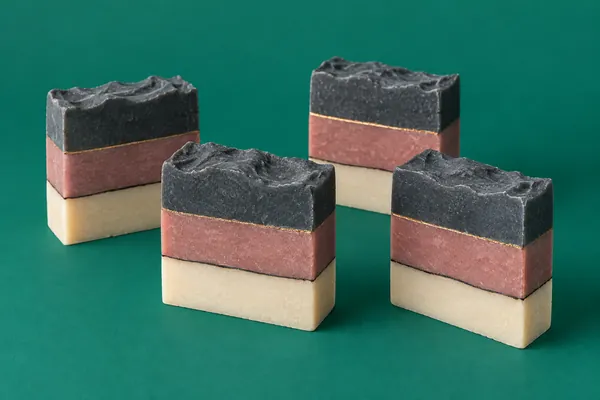
Layers, mica lines and pencil lines
Layered cold-process soap: batter thickness, pouring over a spatula, working out each layer from the mould, and pencil lines that don't split the bar.
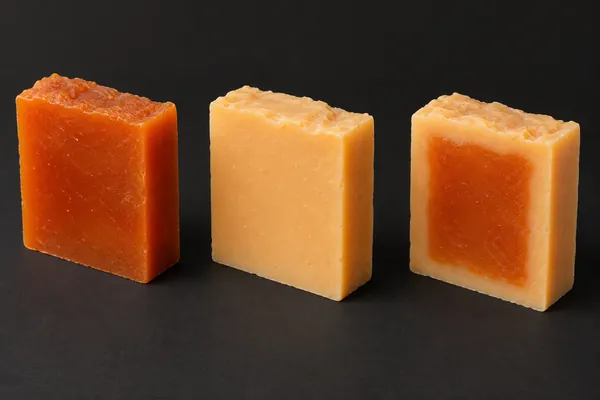
Gel phase: to insulate or keep it cool
What gel phase is, why a loaf turns dark and translucent, how gelled and ungelled bars differ, why partial gel is cosmetic, and how to cause or prevent it.
Where these proportions come from
Our own palm-free blend at a 33 % lye solution, soaped cool and kept out of gel for the spirulina's sake; the green and gold, and how each one fades, follow Kelly Cable's notes, and the one-batch layering is hers.
Formulation adapted from The Natural Soap Making Book for Beginners by Kelly Cable (Althea Press, 2017). The method and notes are ours.