Whipped cream soap
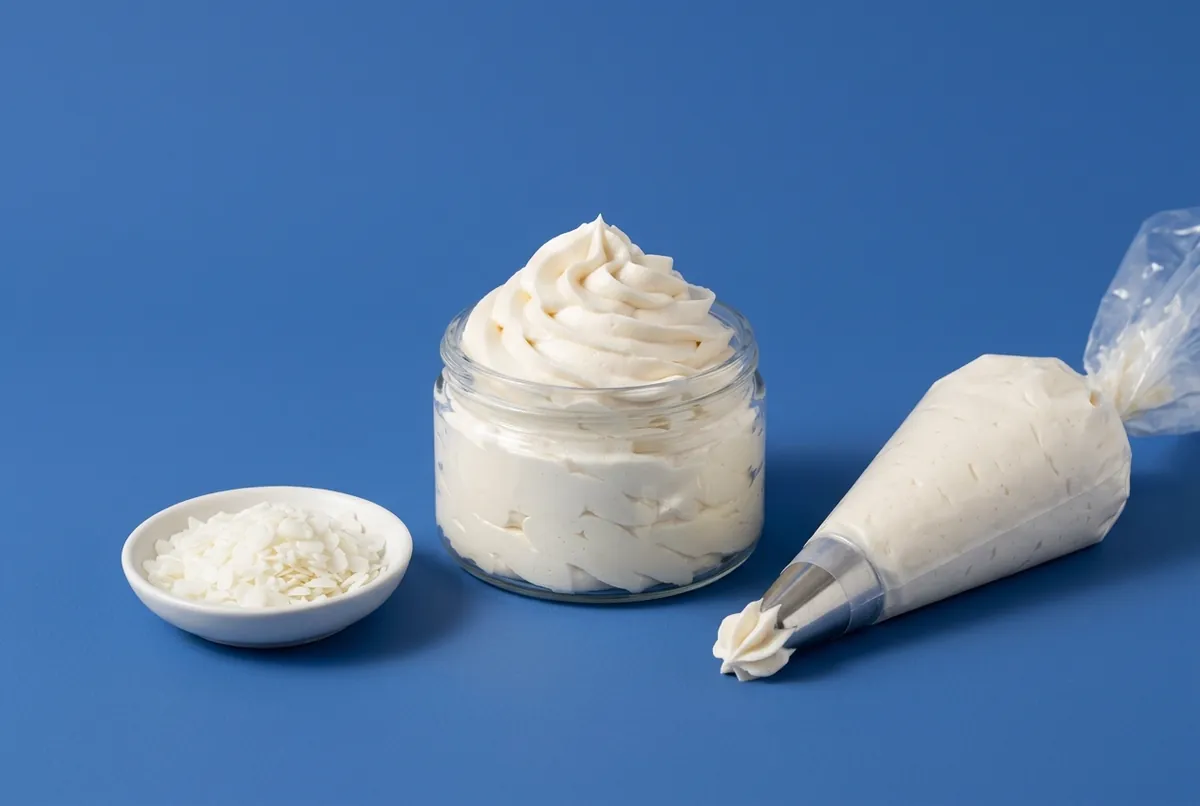
A soft, pearly soap to scoop from a jar: stearic acid and coconut oil cooked with mostly potassium hydroxide, rested overnight and beaten with hot water until light and fluffy. Use it as a body wash or a shaving cream; it turns pearlier over a week or two of rest.
- Skill
- Advanced
- Method
- Hot process
- Batch
- 500 g of oils about 935 g of batter
- Hands-on
- 2 hours
- Cure
- 2 weeks
- Gel phase
- In the pot it gels as it cooks
What you need
For 500 g of oils, which fills several lidded jars or tubes once whipped. Weigh everything, liquids included.
| Coconut Oil · 31.0 % | 155 g | 5.47 oz |
| Stearic Acid · 25.0 % | 125 g | 4.41 oz |
| Olive Oil · 19.0 % | 95 g | 3.35 oz |
| Sunflowerseed Oil - High Oleic Acid · 12.5 % | 63 g | 2.20 oz |
| Castor Oil · 12.5 % | 63 g | 2.20 oz |
| Sodium hydroxide (NaOH) · the lye, 100 % pure | 18.5 g | 0.65 oz |
| Potassium hydroxide (KOH) · the lye, 90 % pure; if your label says otherwise, weigh 91.5 g at 85 % or 81.8 g at 95 % | 86.4 g | 3.05 oz |
| Distilled water · for a 26 % lye solution | 300.0 g | 10.58 oz |
| Glycerin · weighed into the cooker with the oils; stearic acid makes none of its own | 30 g | 1.06 oz |
| Distilled water, hot, for the whip · up to this much, beaten in a little at a time after the overnight rest; it is not lye water and does not change the lye | 350 g | 12.35 oz |
| Phenolphthalein indicator solution (optional) · a drop on a smear of soap to check the cook is done | 5 ml |
- Superfat
- 3 %
- Temperatures
- Fats held at 70 to 75 °C (158 to 167 °F) so the stearic acid stays melted, lye solution cooled below 82 °C (180 °F), cooked on low
Method
-
Get ready
Put on sealed goggles, gloves and long sleeves, and keep them on until the cream is in its jars. Weigh 155 g coconut oil, 125 g stearic acid, 95 g olive oil, 62.5 g high-oleic sunflower oil, 62.5 g castor oil and 30 g glycerin into a slow cooker of 3.5 litres or more, 300 g distilled water into a heat-proof jug, and 18.5 g sodium hydroxide and 86.4 g potassium hydroxide flakes into two dry containers; close the flake tub at once. -
Melt the fats hot
Melt the stearic acid and coconut oil on high and stir in the liquid oils, then turn the cooker to low and hold the fats at 70 to 75 °C (158 to 167 °F). Stearic acid sets at about 55 °C (131 °F), so keep well clear of that; the glycerin will not blend into the oils yet, and does not need to. -
Make the lye solution
At an open window, stir the sodium hydroxide and then the potassium hydroxide into the water a little at a time, never the water onto the lye. It fizzes and gets hotter than a sodium hydroxide solution; let it cool below 82 °C (180 °F), and keep it away from aluminium, which it attacks. -
Add the lye
Pour the lye solution into the fats in a thin stream, stirring with a spatula as it goes in. The batter turns milky white and may look grainy: that is the stearic acid becoming soap the moment the lye meets it. -
Blend until it holds together
Stick blend in short bursts until smooth, then leave it for five minutes. If it has separated, blend again, and repeat until it stays smooth; it thickens from a lumpy mash towards a smooth, heavy cream. -
Cover and cook
Put the lid on and cook on low for 3 to 4 hours, folding the soap over every 20 to 30 minutes so it cooks evenly, and stirring it down if it rises. After about an hour it is too stiff to stir: cut into it with the spatula and turn it over in chunks. -
Cook until translucent
It is done when the whole mass is golden and translucent, like petroleum jelly, with no opaque patches when you turn it. If you have phenolphthalein, a drop on a smear should turn only a faint pink that creeps in; an instant, vivid magenta means another 30 minutes. -
Rest it overnight
Turn off the cooker and leave the soap covered in the pot overnight, or for up to a day, to cool and firm. -
Whip it
Break the soap into lumps and put it in the bowl of a stand mixer with the flat paddle, in two or three batches if the bowl is small, adding about 50 g of the hot distilled water to each. Beat on the slowest speed until smooth, then faster, until it turns light and fluffy, like meringue. -
Beat in water to soften it
If it is firmer than you want, keep beating in hot water 25 g at a time, letting each addition disappear before the next. Up to 350 g in all brings it to about half water, like Grosso's and Fisher's cream soaps; stop sooner if you like it thicker, since water can go in later but never comes out. -
Let it settle
Pack the whipped soap into a tub with a tight lid, stir it once a day for a week, then leave it a second week before you judge it. Much of the air escapes and it settles into a denser, pearlier cream; if it turns runny, leave the lid off for a day so some water evaporates. -
Fill the jars
Fill jars, tubes or airless pumps from a piping bag, or from a strong food bag with one corner snipped off. Fill by volume, since the air in it changes the weight, and fill it cool: warming cream soap only stiffens it. -
Keep it clean
Take it out with a clean, dry spoon rather than fingers, and keep the lid on or the surface dries out. Cream soap is about half water, so to keep it long, or to sell it, it needs a preservative that works at pH 9 to 10.
Tips
- The lye assumes potassium hydroxide flakes of 90 % purity. Potassium does three-quarters of the saponification here, so its purity matters: with 95 % flakes the same weight takes the superfat from 3 % to about −1 %, so enter the figure on your label in the calculator before you weigh.
- Boric acid, which some cream soaps are whipped with, is prohibited in cosmetics in the EU and Great Britain, and this one needs none. For a firmer, pearlier cream, stir 10 to 15 g of melted stearic acid into the hot soap as soon as the cook is done: with no lye left to meet it, it stays in the cream as free acid, as in Thomssen's shaving creams.
- It is left unscented so each jar can be scented on its own. Stir essential oil into a portion of the rested cream at 0.5 to 1 % of its weight, as for liquid soap, and check any oil with an IFRA limit in the calculator first.
- For a softer cream next time, raise the KOH share in the calculator; for a firmer one, lower it. Both lyes change when you do.
The oils
| Oil | Share |
|---|---|
| Coconut Oil | 31.0 % |
| Stearic Acid (triple-pressed, ~50:50 C16/C18) | 25.0 % |
| Olive Oil (virgin / refined / olive oil) | 19.0 % |
| Sunflowerseed Oil - High Oleic Acid | 12.5 % |
| Castor Oil | 12.5 % |
How it is made
| Process | Hot process |
| Alkali | NaOH + KOH |
| Superfat | 3 % |
| Water | 60 % of the oils |
| Iodine value | 40 |
| INS | 174 |
Why make it
A soft, scoopable soap for people who like a rich body wash or a shaving cream that needs no brush. Stearic acid and coconut oil cooked mostly with potassium hydroxide make a pearly cream, creamy 44 and bubbly 33 on our scale, that still lathers well after it is whipped with water. David Fisher recommends cream soap as a body wash or a shaving soap, and makers value it for a dense lather from a jar. It is a craft project rather than an everyday bar: the cook is long and the whip takes patience. The honest caveat is water. Whipped to about half water, it is somewhere microbes can grow, so to keep it for months or to sell it you need a preservative that works at soap's pH, and a clean spoon every time.
Sources
- David Fisher, The Complete Photo Guide to Soap Making · Creative Publishing International, 2018
What tradition, makers' experience and research say about soaps like this, each labelled for what it is. It is not medical advice, and no soap treats a skin condition: if you have one, ask a doctor or pharmacist.
What the numbers say
- Lauric acid 15.2 %
- Myristic acid 6.4 %
- Palmitic acid 17.8 %
- Stearic acid 15.3 %
- Ricinoleic acid 11.1 %
- Oleic acid 26.4 %
- Linoleic acid 5.0 %
- Other 5.3 %
Saturated : unsaturated 58 : 42
Computed from the fatty acids of the fats above. The bands are what the craft has settled on, not chemistry — a bar outside one is not wrong.
From the guides
All guides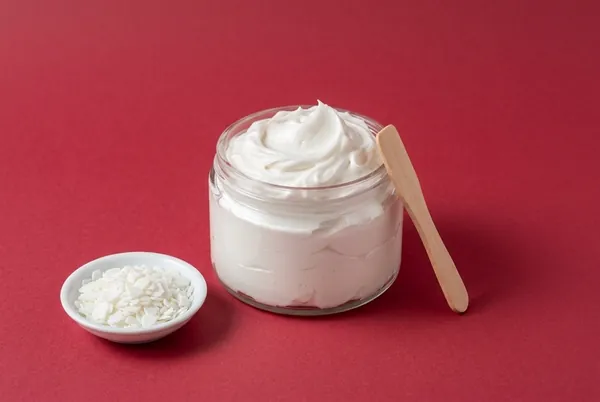
Cream soap and soft soaps
Cream soap explained: stearic acid, mostly potassium lye, a long cook and a whip, and why it turns pearly as it rests. Plus savon noir and the old potash soft soaps.
Sodium hydroxide, potassium hydroxide and dual lye explained
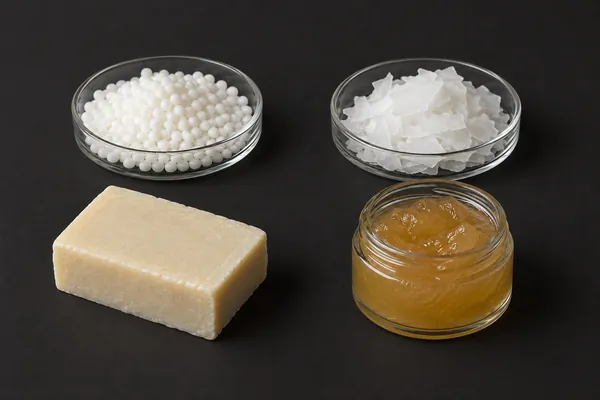
Why NaOH makes bars and KOH makes soft soap, converting between them, KOH purity, dual-lye recipes, and the calculator slip that turns a bar caustic.
Hot process soap, step by step
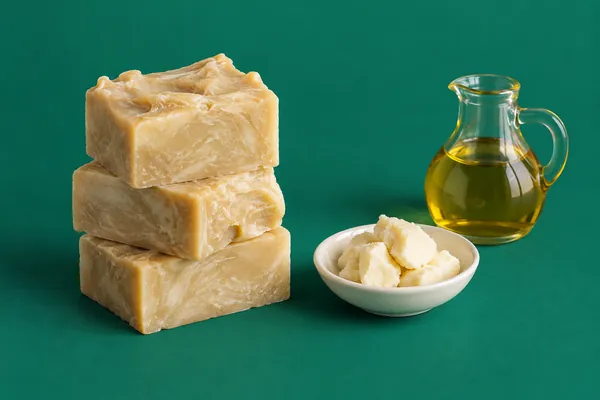
Cook soap batter in a slow cooker until the lye is spent, then stir in the superfat oil, fragrance and colour. A full recipe with the calculator's numbers.
Where these proportions come from
Adapted from Alicia Grosso's cream soap in the slow cooker: her stearic acid, coconut, olive and castor oils in her proportions, with high-oleic sunflower oil in place of her soy oil, which goes rancid sooner, and glycerin at about her rate of an ounce to a pound of fats, weighed in with the oils as Thomssen did rather than into the lye water. Her printed lye puts about 89 % of the saponification on the potassium; ours puts three-quarters there, the balance of David Fisher's cream soap and of our cream soap guide, at a 3 % superfat, the lowest in half-point steps at which the published saponification ranges cannot leave it lye-heavy. The cook takes water at 60 % of the oils, far less than her 25 oz to 16 oz of fats, and the rest is beaten in at the whip.
Formulation adapted from The Everything Soapmaking Book, 3rd edition by Alicia Grosso (Adams Media, 2013). The method and notes are ours.