Creamy tallow and olive bar
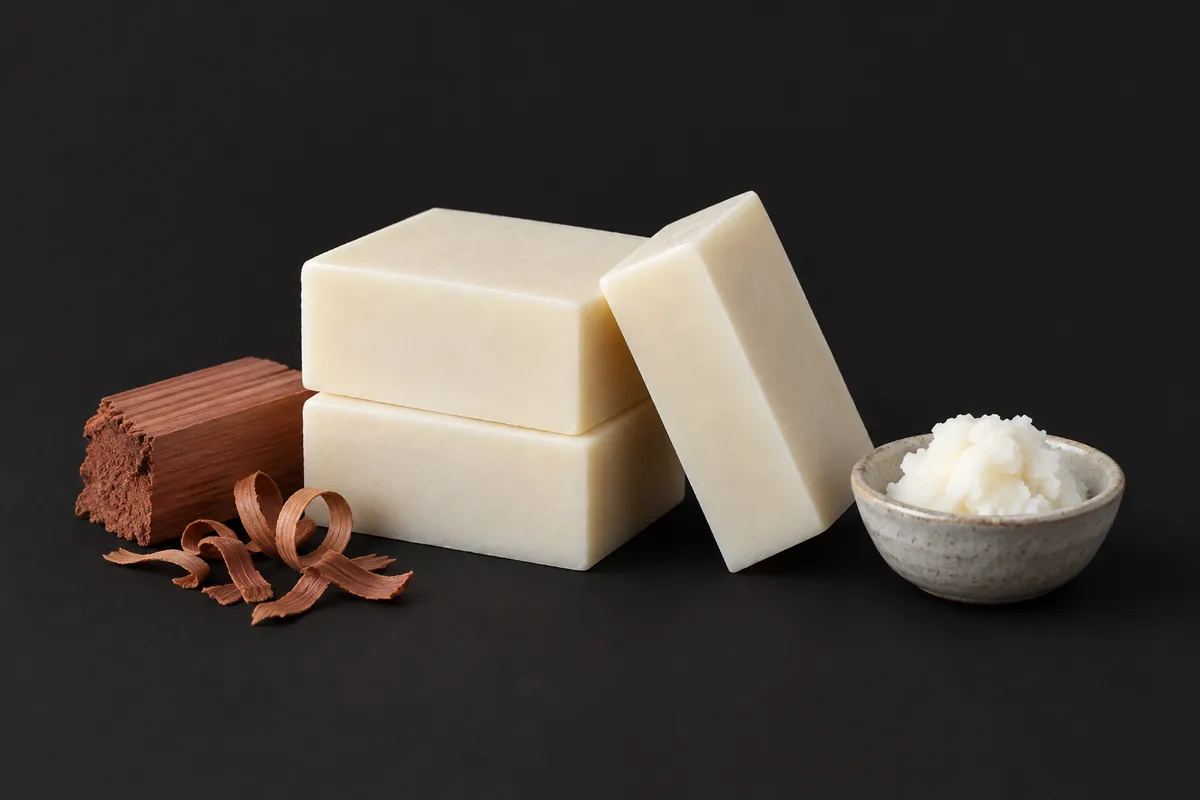
Half beef tallow, a third olive oil and just enough coconut and castor for lather: a hard, white, slow-wearing bar with a dense, creamy lather that stays mild. Atlas cedarwood gives it a soft, woody scent, or leave it unscented.
- Skill
- Beginner
- Method
- Cold process
- Batch
- 1000 g of oils about 1435 g of batter
- Hands-on
- 1 hour
- Cure
- 4 weeks
- Gel phase
- Either way gel or not, both work
What you need
For 1000 g of oils, which fills a 1.5 litre loaf mould. Weigh everything, liquids included.
| Edible Tallow · 50.0 % | 500 g | 17.64 oz |
| Olive Oil · 30.0 % | 300 g | 10.58 oz |
| Coconut Oil · 15.0 % | 150 g | 5.29 oz |
| Castor Oil · 5.0 % | 50 g | 1.76 oz |
| Sodium hydroxide (NaOH) · the lye, 100 % pure | 137.1 g | 4.84 oz |
| Distilled water · for a 33 % lye solution | 278.3 g | 9.82 oz |
| Atlas cedarwood oil (optional) · 2.0 % of the oils, at trace | 20 g | 0.71 oz |
- Superfat
- 5 %
- Temperatures
- Oils and lye solution each between 38 and 43 °C (100 and 110 °F)
Method
-
Get ready
Put on splash goggles, nitrile gloves and long sleeves, open a window or turn on the extractor fan, and keep children and pets out of the room. Set the mould out level where it can stay for a day. -
Weigh the oils and the scent
Weigh 500 g tallow and 150 g coconut oil into the pot, and 300 g olive oil and 50 g castor oil into a jug. If you are scenting it, weigh 20 g Atlas cedarwood oil into a small glass cup. -
Make the lye solution
Weigh 278.3 g distilled water into a heat-safe jug and 137.1 g sodium hydroxide into a dry container. In a well-ventilated spot, pour the lye slowly into the water, never the water onto the lye, and stir until clear; leave it to cool, labelled and out of reach. -
Melt the tallow
Melt the tallow and coconut oil together on low heat until completely clear, since tallow needs more warmth than most fats, then pour in the olive and castor oils. -
Check the temperatures
Carry on when both the oils and the lye solution are between 38 and 43 °C (100 and 110 °F). Tallow sets quickly as it cools, and oils below that range thicken before any real trace. -
Combine
Pour the lye solution into the oils down the shaft of the stick blender, tap the blender to let trapped air out, and keep the blade under the surface while it runs. -
Blend to light trace
Pulse for a few seconds at a time, stirring between bursts. Tallow brings trace on fairly quickly, so check after every burst and stop when a drizzle leaves a faint line on the surface. -
Add the cedarwood
Stir the cedarwood oil through by hand with the spatula, or leave it out for an unscented bar. -
Pour and cover
Pour into the mould, tap it on the worktop to raise air bubbles, and cover it with a lid or board and a folded towel for a day. -
Unmould and cut
Tallow-rich loaves set firm, and most come out cleanly after 24 hours. Unmould it with gloves on and cut it into bars about 2.5 cm (1 in) thick the same day. -
Cure
Stand the bars on edge in a dry, airy room for four to six weeks, turning them now and then.
Tips
- Tallow rendered from suet, the hard fat around the kidneys, and rendered in water gives the whitest bar with the least smell. Any clean, well-rendered beef fat will do.
- Cut the loaf soon after you unmould it: tallow-rich soap gets harder to cut cleanly with every day it waits.
- Leaving the cedarwood out changes nothing else in the recipe, since the lye is worked out on the oils alone. Well-rendered tallow has almost no smell of its own, so the unscented bar smells simply clean.
The oils
| Oil | Share |
|---|---|
| Edible Tallow (beef/mutton dripping) | 50.0 % |
| Olive Oil (virgin / refined / olive oil) | 30.0 % |
| Coconut Oil | 15.0 % |
| Castor Oil | 5.0 % |
How it is made
| Process | Cold process |
| Alkali | NaOH |
| Superfat | 5 % |
| Water | lye water at 33 % |
| Iodine value | 54 |
| INS | 148 |
Why make it
A hard, slow-wearing everyday bar with a dense, creamy lather. It is half tallow, which Simmons and Appleton's 1908 soap manual describes as making a very hard soap, with olive oil for mildness and just enough coconut and castor for bubbles, cleansing 12 and conditioning 52 on our scale. Tallow was a staple soap fat for centuries, and people who use tallow bars often say they feel gentle and outlast soft vegetable bars; that is experience rather than tested fact. On its own tallow lathers poorly, which is why the coconut and castor are there. It is also a good use for a by-product of beef farming. The caveats: it is not vegan, and badly rendered tallow smells of meat, so start with clean, white fat.
Sources
- The Handbook of Soap Manufacture · Scott, Greenwood & Son, 1908
- The Natural Soap Book · Storey Publishing, 1995
What tradition, makers' experience and research say about soaps like this, each labelled for what it is. It is not medical advice, and no soap treats a skin condition: if you have one, ask a doctor or pharmacist.
What the numbers say
- Lauric acid 7.4 %
- Myristic acid 4.8 %
- Palmitic acid 18.1 %
- Stearic acid 12.6 %
- Ricinoleic acid 4.4 %
- Oleic acid 40.8 %
- Linoleic acid 5.9 %
- Other 5.0 %
Saturated : unsaturated 45 : 55
Computed from the fatty acids of the fats above. The bands are what the craft has settled on, not chemistry — a bar outside one is not wrong.
From the guides
All guides
Lard and tallow: soaping with animal fats
Why lard and tallow make hard, mild, creamy soap, how to render and store them at home, how beef, mutton and pork fat differ, and classic recipes.

Scenting soap: essential oils and fragrance oils
How much essential or fragrance oil to use in soap, what ounces per pound mean in percent, the IFRA limits for common essential oils, and EU allergen labelling.
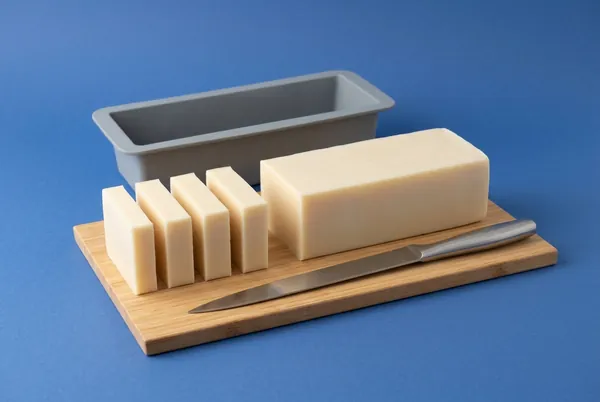
Unmoulding and cutting soap
When cold process soap is ready to come out of the mould, how to release it from silicone, lined and cavity moulds, and how to cut, bevel and stamp even bars.
Guides with this recipe
Where these proportions come from
Adapted from Kelly Cable's tallow, olive and coconut tutorial bar: tallow raised to half the oils and coconut cut to 15 % for a milder bar, with 5 % castor oil added to keep the lather.
Formulation adapted from The Natural Soap Making Book for Beginners by Kelly Cable (Althea Press, 2017). The method and notes are ours.