Supermarket oils bar
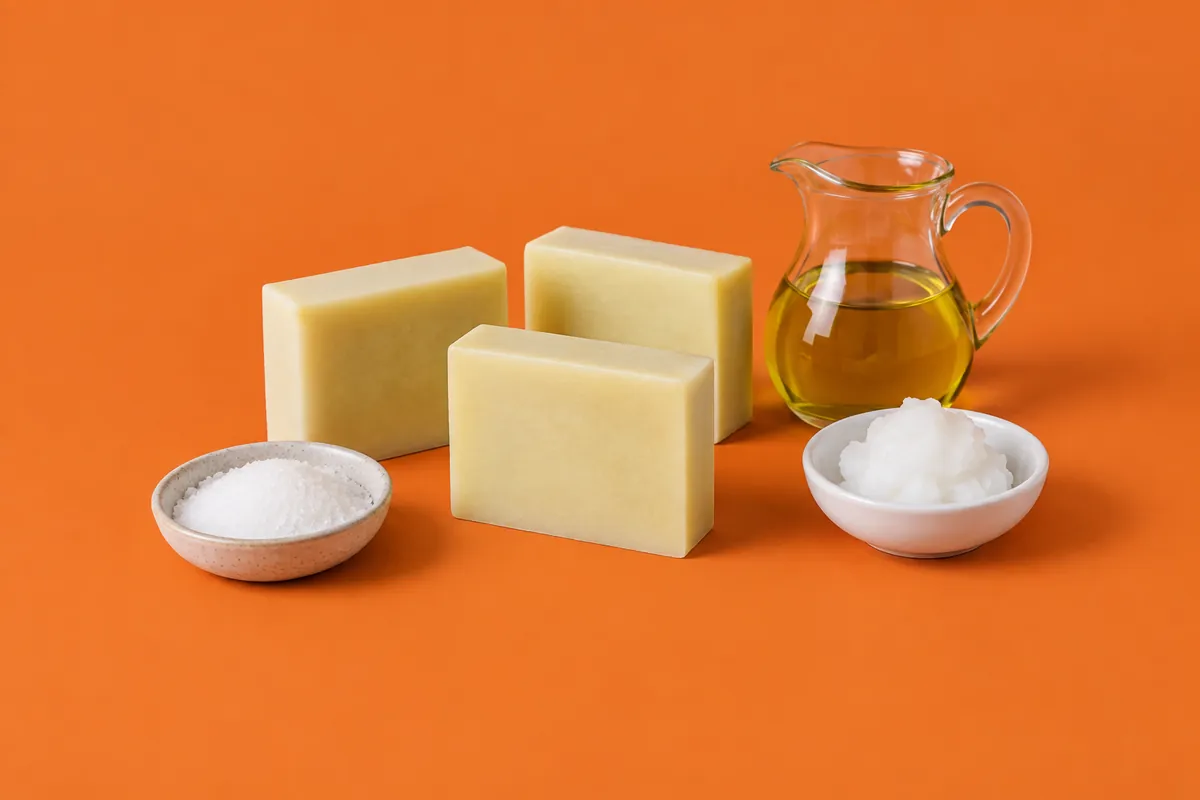
Everything in it comes from a supermarket: olive, coconut and rapeseed oils, with a spoonful each of salt and sugar from the kitchen cupboard. No palm, no animal fat and no shortening, and one of the cheapest bars you can make that still feels good to use.
- Skill
- Beginner
- Method
- Cold process
- Batch
- 1000 g of oils about 1447 g of batter
- Hands-on
- 1 hour
- Cure
- 6 weeks
- Gel phase
- Either way gel or not, both work
What you need
For 1000 g of oils, which fills a 1.5 litre loaf mould. Weigh everything, liquids included.
| Olive Oil · 55.0 % | 550 g | 19.40 oz |
| Coconut Oil · 30.0 % | 300 g | 10.58 oz |
| Rapeseed Oil - Low Erucic Acid · 15.0 % | 150 g | 5.29 oz |
| Sodium hydroxide (NaOH) · the lye, 100 % pure | 141.9 g | 5.01 oz |
| Distilled water · for a 33 % lye solution | 288.2 g | 10.16 oz |
| Fine salt · dissolved in the water before the lye, for a harder bar | 7 g | 0.25 oz |
| Sugar · dissolved in the water before the lye, for more lather | 10 g | 0.35 oz |
- Superfat
- 5 %
- Temperatures
- Oils and lye solution each between 32 and 43 °C (90 and 110 °F)
Method
-
Get ready
Put on splash goggles, nitrile gloves and long sleeves, open a window or turn on the extractor fan, and keep children and pets out of the room. Set the mould out level where it can stay for two days. -
Weigh the oils
Weigh 300 g coconut oil into the pot, and 550 g olive oil and 150 g rapeseed oil into a jug. -
Dissolve the salt and sugar
Weigh 288.2 g distilled water into a heat-safe jug and stir in 7 g of fine salt and 10 g of sugar, a little over a teaspoon and about two and a half teaspoons, until both have dissolved completely. -
Make the lye solution
Weigh 141.9 g sodium hydroxide into a dry container. By an open window, pour it slowly into the salt and sugar water, never the water onto the lye, and stir until clear; a pale yellow tinge from the sugar is normal. Leave it to cool, labelled and out of reach. -
Melt the coconut oil
Melt the coconut oil on low heat, then pour in the olive and rapeseed oils. -
Check the temperatures
Go ahead when the oils are clear and both they and the lye solution are between 32 and 43 °C (90 and 110 °F). -
Combine and blend to light trace
Pour the lye solution into the oils down the shaft of the stick blender, then pulse for a few seconds and stir, over and over. With this much liquid oil the batter is slow to thicken, so keep going, for ten minutes if need be, until a drizzle leaves a faint line on the surface. -
Pour and cover
Pour into the mould, tap it on the worktop to raise air bubbles, and cover it with a lid or board and a folded towel for a day. Sugar makes soap run a little warmer, so if the top starts to crack, take the towel off. -
Clean up
With your gloves still on, wipe the batter off the pot and tools with paper towels into the bin, then wash them in hot soapy water. -
Unmould and cut
After about 48 hours, when the loaf is firm, unmould it with gloves on and cut it into bars about 2.5 cm (1 in) thick. If it is still soft, leave it another day or two. -
Cure
Stand the bars on edge in a dry, airy room for six weeks, turning them every few days. A bar made mostly from liquid oils needs the full cure to harden.
Tips
- Rapeseed oil is often sold simply as vegetable oil in British supermarkets, so check the label says rapeseed. Sunflower oil can take its place, but swap it in the calculator so the lye is worked out again.
- Ordinary or light olive oil makes much the same soap as extra virgin for a lot less money. Avoid olive-pomace oil unless you change it in the calculator: it is a different oil with its own lye figure.
- For a harder bar that is not vegetarian, swap 20 % of the olive oil for lard and let the calculator work out the new lye.
The oils
| Oil | Share |
|---|---|
| Olive Oil (virgin / refined / olive oil) | 55.0 % |
| Coconut Oil | 30.0 % |
| Rapeseed Oil - Low Erucic Acid (Canola Oil) | 15.0 % |
How it is made
| Process | Cold process |
| Alkali | NaOH |
| Superfat | 5 % |
| Water | lye water at 33 % |
| Iodine value | 66 |
| INS | 143 |
Why make it
For a first batch on a budget, or for anyone who likes knowing that every ingredient came off a supermarket shelf. Olive and coconut oil, in roughly the proportions Anne Watson uses for her all-vegetable grocery-store soap, make a proper everyday bar, cleansing 20 and conditioning 62 on our scale, and swapping some olive for rapeseed oil brings the cost down without changing its character. A little salt helps it firm up and a little sugar livens the lather, both old kitchen-cupboard tricks. It is palm-free, free of animal fats and unscented, which suits most skins and most households. The honest limits: with no butters its lather is thin rather than creamy, 14 on our scale, and it stays soft for a while, so give it the full six weeks.
Sources
- Smart Soapmaking · Shepard Publications, 2013
What tradition, makers' experience and research say about soaps like this, each labelled for what it is. It is not medical advice, and no soap treats a skin condition: if you have one, ask a doctor or pharmacist.
What the numbers say
- Lauric acid 14.7 %
- Myristic acid 5.7 %
- Palmitic acid 10.9 %
- Stearic acid 2.7 %
- Oleic acid 49.3 %
- Linoleic acid 10.6 %
- α-Linolenic acid 1.8 %
- Other 6.4 %
Saturated : unsaturated 38 : 62
Computed from the fatty acids of the fats above. The bands are what the craft has settled on, not chemistry — a bar outside one is not wrong.
From the guides
All guides
Choosing the oils for your first soap
Hard and soft oils, what olive, coconut, palm, the butters and castor each bring, a first blend with real numbers, and why every oil swap needs recalculating.

Soap additives: salt, sugar, sodium lactate, clays, oats, silk and more
What common soap additives do, how much to use and when they go in: sourced doses for sodium lactate, salt, sugar, honey, citric acid, clays, oats and silk.
The soaping oils: what each one brings to a bar
Twenty-five soaping oils, butters and waxes: what each does in a bar and why, the share makers give it, and what to watch for, with figures from our records.
Guides with this recipe
Where these proportions come from
Adapted from Anne L. Watson's all-vegetable grocery store soap, olive and coconut oil at 70:30: the coconut stays at 30 %, and 15 % of the olive becomes rapeseed oil to cut the cost. Salt and sugar from the kitchen cupboard, at the usual soapmaking doses, help the bar firm up and lather.
Formulation adapted from Smart Soapmaking by Anne L. Watson (Shepard Publications, 2013). The method and notes are ours.