In short
- Hard oils (coconut, palm, the butters, lard) make a bar firm; soft oils (olive, sunflower, castor) make it mild. A good bar needs both.
- Three or four common oils are enough. Olive 60 %, coconut 25 %, shea 10 % and castor 5 % is a sound first blend, and it is the one the calculator opens with.
- Much above 30 % coconut, a bar leaves the conventional cleansing range; castor goes in at about 5 %, rarely above 10 %.
- Any grade of olive oil makes soap. Supermarket oils are fine, as long as they are fresh.
- Never swap one oil for another without recalculating. Replace the coconut in a classic recipe with olive oil and the bar ends up lye-heavy.
On this page
- Hard oils and soft oils
- What the usual five bring
- Olive oil
- Coconut oil
- Palm oil, and what replaces it
- Shea butter and cocoa butter
- Castor oil
- Why three or four oils are enough
- A sensible first blend
- How far to push coconut and castor
- Why 100 % olive oil is slow
- Buying the oils
- Never swap an oil without recalculating
- Looking up an oil
Every fat in a soap recipe is there to do a job: make the bar hard, make it lather, or make it gentle. No single common oil does all three, which is why nearly every recipe is a blend. This guide explains what the usual soaping oils bring, gives a first blend with the numbers from our calculator, and covers buying the oils without paying for grades that make no difference to soap.
Hard oils and soft oils
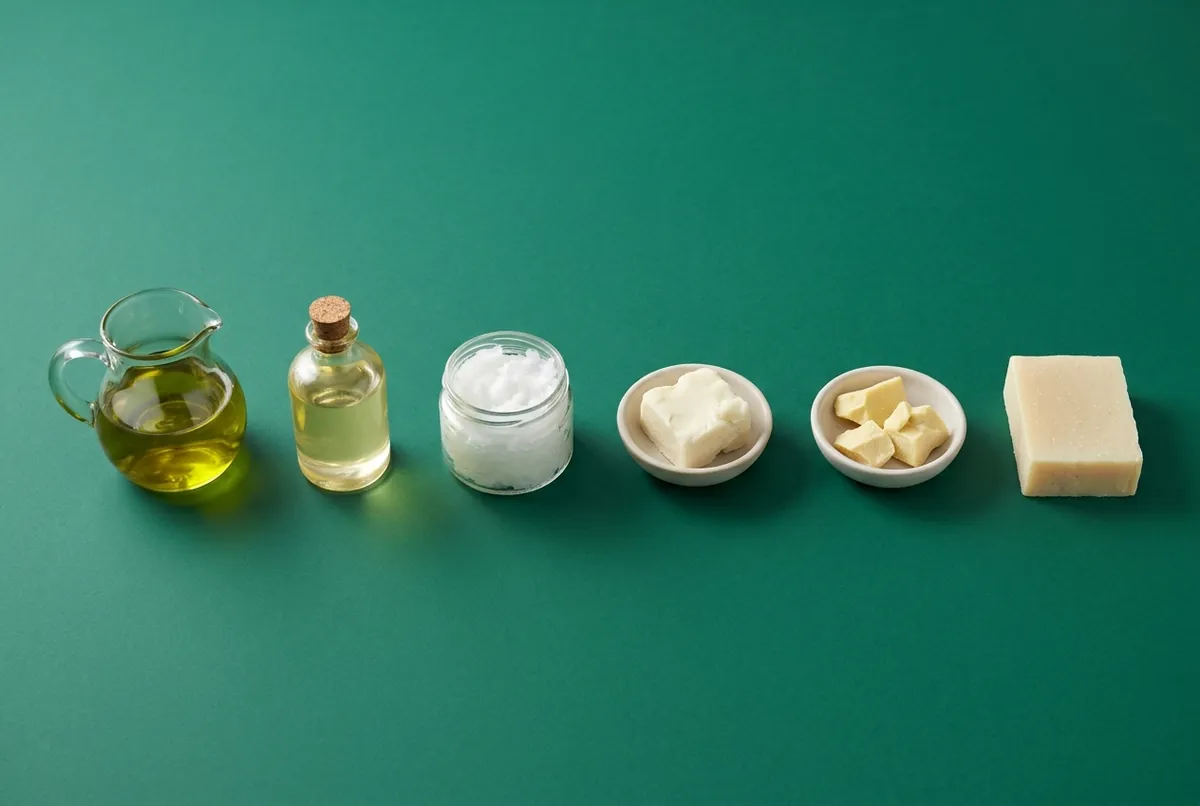
Soapmakers sort fats by how they sit on the shelf. Hard oils are solid at room temperature: coconut oil, palm oil, shea and cocoa butter, lard and tallow. Soft oils are liquid: olive, sunflower, rapeseed (canola), sweet almond and castor.
The difference is in their fatty acids, the chains that become soap (the how soap is made guide explains that part). Saturated chains are straight and pack tightly, so fats rich in them are solid, and the soap they make is hard and long-lasting. Unsaturated chains carry one or more bends, so their fats are liquid, and their soaps are milder, softer at first and slower to firm up.
Here is what each common oil does on its own, as the calculator scores it:
| Oil, 100 % of the recipe | Hardness | Cleansing | Conditioning | Bubbly lather | Creamy lather |
|---|---|---|---|---|---|
| Olive | 17 | 0 | 82 | 0 | 17 |
| Coconut | 80 | 68 | 9 | 68 | 12 |
| Palm | 50 | 2 | 51 | 2 | 48 |
| Shea butter | 45 | 0 | 54 | 0 | 45 |
| Cocoa butter | 61 | 0 | 38 | 0 | 61 |
| Castor | 5 | 0 | 99 | 89 | 93 |
| Conventional range | 29–54 | 12–22 | 44–69 | 14–46 | 16–48 |
Soap qualities of single-oil soaps, from our calculator. The ranges are a community convention for an everyday bar, not a measurement.
On its own, olive oil makes a gentle, soft bar and coconut oil a rock-hard one that is harsh on skin. Castor scores brilliantly on paper and would make a soft, sticky bar in practice, which is the reason to treat these numbers as a guide rather than a verdict. The fatty acids guide explains what they measure and what they miss.
What the usual five bring
Olive oil
Mostly oleic acid, about 69 % in the middle of its published range. It makes a very mild, conditioning soap with a small, creamy lather. It also traces slowly and hardens slowly, which gives a beginner time to work. Most first recipes use 40 to 60 % olive oil.
Coconut oil
Lauric and myristic acids, about 49 % and 19 %, short chains that make a very hard bar with big, fast bubbles. The same chains make coconut the most cleansing oil in the kit, too cleansing for some skins at high levels. Its short chains also mean more fat molecules to the gram, so it needs about 35 % more lye per gram than olive oil. Ordinary coconut oil melts at about 24 °C (76 °F), so it may be solid or liquid depending on the day. Recipes usually hold it at 20 to 30 %.
Palm oil, and what replaces it
Palmitic and oleic acids in roughly equal parts, about 43 % and 40 %. Palm gives a hard, long-lasting bar with a steady, creamy lather and little cleansing power. Recipes that use it usually put it at 25 to 30 %. Palm farming has been linked to deforestation, so many makers buy only certified sustainable palm or leave it out. Lard and tallow do the same job from animal fat (our old-fashioned lard bar is four-fifths lard), and shea and cocoa butter do it for a vegan bar; the palm-free soap guide covers the swaps. If you do use palm, melt the whole tub and stir it before weighing, because it separates into harder and softer parts as it sits.
Shea butter and cocoa butter
Both are rich in stearic acid, about 42 % in shea and 34 % in cocoa butter (which also carries about 27 % palmitic). Stearic acid gives a firm bar and a dense, creamy lather. Shea usually goes in at 10 to 20 %. Cocoa butter is harder, and above about 15 % it can make a brittle bar that cracks. Unrefined cocoa butter smells of chocolate and the smell carries into the soap; deodorised cocoa butter does not.
Castor oil
About 89 % ricinoleic acid, a fatty acid no other common oil has. Its soap dissolves easily, so a little castor makes the lather come faster and last longer. Five per cent is the usual amount and 10 % is about the top of the useful range; above that, bars tend to feel soft and tacky. Castor also speeds up trace.
| Oil | Main fatty acids | What it brings | Usual share of a recipe | SAP value, mg KOH/g |
|---|---|---|---|---|
| Olive | oleic 69 % | mildness, conditioning, time to work | 40–60 %, up to 100 % | 184–196 |
| Coconut | lauric 49 %, myristic 19 % | hardness, big bubbles, cleansing | 20–30 % | 248–265 |
| Palm | palmitic 43 %, oleic 40 % | hardness, steady creamy lather | 25–30 % | 190–209 |
| Shea butter | oleic 47 %, stearic 42 % | firmness, creamy lather | 10–20 % | 179–190, typical 183 |
| Cocoa butter | oleic 35 %, stearic 34 %, palmitic 27 % | hardness, creamy lather | up to 15 % | 188–198 |
| Castor | ricinoleic 89 % | more and steadier lather | about 5 %, rarely over 10 % | 176–182 |
Fatty acids are the middle of each oil’s published ranges, from the documents named on each oil’s page. The usual shares are craft conventions, not rules.
Why three or four oils are enough
Every extra oil is another bottle going stale in the cupboard and another published range feeding into the uncertainty of the lye. Four oils already cover hardness, lather and mildness. Watch what each one adds, starting from pure olive oil:
| Blend | Hardness | Cleansing | Conditioning | Bubbly lather | Creamy lather |
|---|---|---|---|---|---|
| Olive 100 % | 17 | 0 | 82 | 0 | 17 |
| Olive 75, coconut 25 | 32 | 17 | 64 | 17 | 15 |
| Olive 65, coconut 25, shea 10 | 35 | 17 | 61 | 17 | 18 |
| Olive 60, coconut 25, shea 10, castor 5 | 35 | 17 | 62 | 21 | 22 |
From our calculator. Coconut brings the hardness and the lather, shea firms the bar and adds creaminess, and castor adds lather at almost no cost in hardness.
A sensible first blend
That last line is the blend the lye calculator opens with: olive oil 60 %, coconut oil 25 %, shea butter 10 % and castor oil 5 %. Its oils are easy to find (olive and coconut in any supermarket, shea butter and castor oil from a chemist, a health shop or any soap supplier), it has no palm and no animal fat, and it sits inside the conventional range on every quality. At 1000 g of oils it takes 139.1 g of sodium hydroxide and 282.4 g of water, for 1421.5 g of batter. It is our first-batch palm-free bar.
Start from the calculator's own blend. 1000 g of olive, coconut, shea and castor at 60/25/10/5 % needs 139.1 g of sodium hydroxide at a 5 % superfat.
Open it in the calculatorReplace the shea and some of the olive oil with palm or lard and you get a harder bar that firms up sooner:
| Blend (1000 g of oils, 5 % superfat) | NaOH | Hardness | Cleansing | Conditioning | Bubbly | Creamy |
|---|---|---|---|---|---|---|
| Olive 60, coconut 25, shea 10, castor 5 | 139.1 g | 35 | 17 | 62 | 21 | 22 |
| Olive 40, coconut 25, palm 30, castor 5 | 141.5 g | 42 | 17 | 55 | 22 | 29 |
| Olive 45, coconut 25, lard 25, castor 5 | 140.8 g | 38 | 17 | 58 | 22 | 25 |
| Olive 40, coconut 30, palm 30 | 144.1 g | 45 | 21 | 51 | 21 | 25 |
From our calculator. The palm row is our classic olive, coconut and palm bar. The last row is the classic beginner recipe, the everyday bar: a good bar, and a slightly drying one.
Each of these changes the lye, which is why each has its own figure. German-language books and courses often start beginners on a different blend, the 25er: a quarter each of olive, rapeseed, coconut and palm oil. The first batch guide takes a recipe like these through from weighing to cutting.
How far to push coconut and castor
Holding the shea at 10 % and the castor at 5 %, and letting olive oil take up the difference, here is what coconut does as it rises:
| Coconut | 15 % | 20 % | 25 % | 30 % | 35 % | 40 % |
|---|---|---|---|---|---|---|
| Hardness | 28 | 31 | 35 | 38 | 41 | 44 |
| Cleansing | 10 | 14 | 17 | 20 | 24 | 27 |
| Bubbly lather | 15 | 18 | 21 | 25 | 28 | 32 |
From our calculator. The conventional cleansing range is 12 to 22.
The cleansing number leaves its conventional range a little above 30 % coconut, which matches makers’ experience: past that, many people find the bar drying. The number cannot see the superfat, though, and extra unsaponified oil softens the effect, which is why salt bars made with 70 to 100 % coconut are made at a 15 to 20 % superfat. The salt bars guide covers that exception.
Faiola makes the same point in Pure Soapmaking with three olive, coconut and palm bars, all at a 5 % superfat, and describes how each one washes:
| Olive / coconut / palm | NaOH per 1000 g of oils | Hardness | Cleansing | Conditioning | Faiola’s verdict |
|---|---|---|---|---|---|
| 33 / 33 / 34 | 145.7 g | 49 | 23 | 47 | hard, big bubbles, may feel drying |
| 50 / 25 / 25 | 141.5 g | 41 | 17 | 56 | lasting bubbles, clean but not dry |
| 90 / 5 / 5 | 131.2 g | 21 | 4 | 77 | small, slick bubbles; gooey where it sits wet |
Lye and qualities from our calculator; the verdicts are hers.
Castor behaves differently. In the same blend, raising it from 5 % to 20 % lifts bubbly lather from 21 to 35 and creamy lather from 22 to 34, and hardness hardly moves. By the numbers castor only gets better. In the mould it does not: well above 10 % the bars feel soft and tacky however long they cure. The quality numbers are sums of fatty acids and have no way to see stickiness, so keep castor at about 5 % until you have made a few batches.
Why 100 % olive oil is slow
Pure olive oil soap is castile, one of the oldest soaps there is. By the quality table it is too soft (hardness 17) and does not clean at all (cleansing 0). In practice it makes a very mild, long-lasting bar, but it takes a long time to reach trace, stays soft for weeks, and its lather feels slimy until it has had a long cure. That makes it a slow first batch. The castile guide and our castile recipe are the place to start when you want to make it.
Buying the oils
Food grade is fine. Supermarket cooking oils and fats make excellent soap and are what most makers use; our supermarket oils bar needs nothing else. Freshness matters more than grade: oil that has gone rancid makes soap that smells rancid. Buy what you will use within a few months and keep it cool and dark.
Olive oil grades are defined in the Codex food standard. Virgin and extra virgin olive oil are pressed and extracted by physical means only. Refined olive oil is virgin oil that has been refined. What is sold simply as olive oil is a blend of refined and virgin. Olive-pomace oil is extracted, usually with solvents, from the pulp left after pressing, then refined and blended. All of them make soap, with nearly the same lye: the saponification value is 184 to 196 mg KOH/g for olive oils and 182 to 193 for pomace. Pomace oil may carry up to twice the unsaponifiable matter (30 g/kg against 15), and it traces faster: Cavitch’s hand-stirred olive soaps took anywhere from 7 to 40 minutes to trace depending on the grade, pomace quickest, extra virgin slowest. Extra virgin oil costs more and can tint the bar green, with no clear benefit in soap; for a white bar, Cavitch chose a refined oil that looks bright yellow in the bottle. In the calculator, choose Olive Oil for virgin, refined or blended oil and Olive-Pomace Oil for pomace.
Coconut oil comes in three forms that are easy to confuse. “76-degree” coconut oil is ordinary coconut oil, named for its melting point of about 76 °F (24 °C). “92-degree” coconut oil has been hydrogenated to melt higher, around 30 to 38 °C; the calculator lists it as Hydrogenated Coconut Oil. Fractionated coconut oil, sold as MCT oil or caprylic/capric triglyceride, is a different oil altogether: a liquid made almost entirely of caprylic and capric acids, without the lauric acid that makes coconut soap hard, and it needs about 30 % more lye per gram than ordinary coconut oil. In the calculator it is Medium-Chain Triglycerides.
Butters come refined or unrefined, and both work. The calculator has both shea butter and refined shea butter; pick the one you bought.
Never swap an oil without recalculating
Every oil has its own saponification value, so every change of oil changes the lye. Some swaps barely matter and some make a caustic bar, and you cannot tell which by looking. Here is our everyday bar (olive 40, coconut 30, palm 30, 1000 g of oils), which needs 144.1 g of sodium hydroxide at a 5 % superfat, with one oil swapped and the old lye figure kept:
| Swap | Lye the new blend needs | Superfat with the old 144.1 g |
|---|---|---|
| Palm for lard | 143.7 g | 4.7 % |
| Olive for high-oleic sunflower | 143.6 g | 4.7 % |
| Palm for shea butter | 140.8 g | 2.7 % |
| Coconut for olive oil | 130.6 g | −4.8 %, lye-heavy |
| Palm for coconut oil | 155.7 g | 12.1 %, far more free oil than intended |
| Coconut for fractionated coconut | 160.1 g | 14.5 %, far more free oil than intended |
From our calculator, same weights, 5 % superfat intended.
Swapping the coconut for olive oil, the most innocent-looking change on the list, turns a 5 % superfat into free lye. So every change, however small, goes back through the lye calculator before anything is weighed. Faiola’s rule of thumb keeps the bar itself close to the original: swap solid fats for solid ones and liquid oils for liquid ones, then recalculate (Pure Soapmaking).
Looking up an oil
Each oil in our oils reference has its own page with its saponification range, fatty acids, iodine value and the document every figure came from. Compare oils puts up to six side by side and lets you try a blend of them. When you have chosen yours, the next step is using the lye calculator, field by field.
Recipes to try
All recipesSources
- Standard for Named Vegetable Oils (CXS 210-1999) . Codex Alimentarius Commission (FAO/WHO) . Saponification value and fatty-acid ranges for coconut, palm, sunflower and rapeseed oils.
- Standard for Olive Oils and Olive Pomace Oils (CXS 33-1981) . Codex Alimentarius Commission (FAO/WHO) , 2015. Definitions of virgin, refined, blended and pomace olive oils; saponification value 184-196 (olive oils) and 182-193 (pomace oils); unsaponifiable matter up to 15 and 30 g/kg.
- Standard for Named Animal Fats (CXS 211-1999) . Codex Alimentarius Commission (FAO/WHO) . Saponification value and fatty acids of lard and tallow.
- USP-NF monographs: Castor Oil, Cocoa Butter, Medium-Chain Triglycerides, Hydrogenated Coconut Oil . United States Pharmacopeial Convention . Castor oil saponification value 176-182; cocoa butter 188-198 and melting point 31-35 °C; medium-chain triglycerides 310-360, at least 95 % caprylic and capric acids; hydrogenated coconut oil melting range 30-38 °C.
- Japanese Pharmacopoeia, 18th edition: Coconut Oil . Ministry of Health, Labour and Welfare, Japan , 2021. Coconut oil melting point 20-28 °C, around the 76 °F (24 °C) that gives ordinary coconut oil its trade name.
- Regional Standard for Unrefined Shea Butter (Africa), CXS 325R-2017 . Codex Alimentarius Commission (FAO/WHO) , 2022. Saponification value 160-195 mg KOH/g and unsaponifiable matter 1-19 %; the limits are broad because they cover shea butter from all production areas.
- Triterpene alcohol and fatty acid composition of shea nuts from seven African countries . Akihisa T. et al., Journal of Oleo Science 59(7) , 2010. Shea fatty acids: oleic 34.0-60.7 %, stearic 27.7-55.7 % across 36 samples.
- Soap Crafting . Anne-Marie Faiola, Storey Publishing , 2013. Usage levels: coconut drying above about 25-35 %, castor softening above 10 %, cocoa butter cracking above 15 %; pomace speeding trace; stirring melted palm before weighing.
- Pure Soapmaking . Anne-Marie Faiola, Storey Publishing , 2016. Three olive, coconut and palm bars (33/33/34, 50/25/25, 90/5/5) at a 5 % superfat and how each feels; swapping solid oils for solid and liquid for liquid.
- The Natural Soap Book . Susan Miller Cavitch, Storey Publishing , 1995. Olive oil grades: hand-stirred trace in 7 to 40 minutes by grade, pomace fastest; bright yellow refined olive oil for a white bar.
- The Complete Photo Guide to Soap Making . David Fisher, Creative Publishing International , 2018. Coconut kept to about 30 % unless the superfat is raised; castor at 3-8 %; olive grades, pomace and trace; freshness mattering more than grade.