Mocha swirl bar
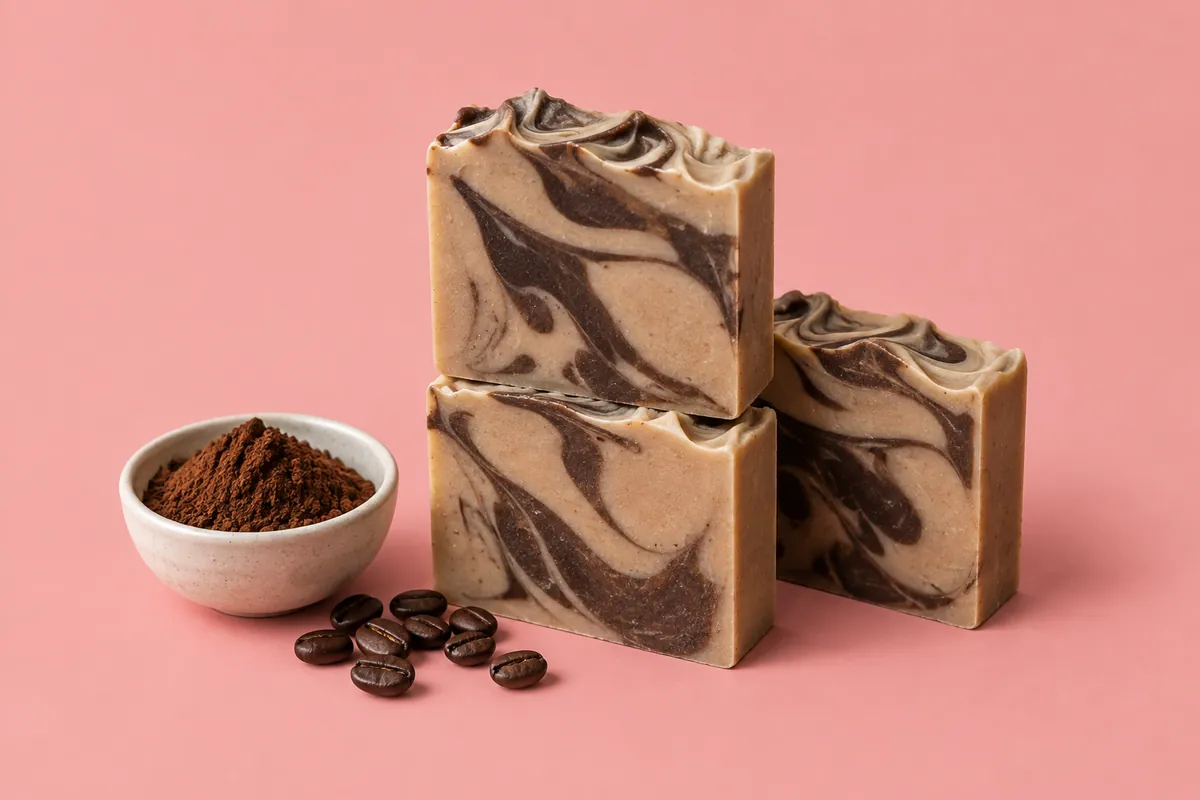
A firm, cocoa-butter-rich bar made with strong coffee as all its liquid, with a dark cocoa powder swirl through the pale coffee-tan base and a clean peppermint scent. No vanilla, so it stays two-toned.
- Skill
- Intermediate
- Method
- Cold process
- Batch
- 1000 g of oils about 1485 g of batter
- Hands-on
- 1 h 15 min
- Cure
- 6 weeks
- Gel phase
- No keep it cool
What you need
For 1000 g of oils, which fills a 1.5 litre loaf mould. Weigh everything, liquids included.
| Olive Oil · 30.0 % | 300 g | 10.58 oz |
| Coconut Oil · 25.0 % | 250 g | 8.82 oz |
| Cocoa Butter · 25.0 % | 250 g | 8.82 oz |
| Sunflowerseed Oil - High Oleic Acid · 20.0 % | 200 g | 7.05 oz |
| Sodium hydroxide (NaOH) · the lye, 100 % pure | 140.2 g | 4.94 oz |
| Strong brewed coffee, chilled · all of the liquid; the lye goes into it cold | 314 g | 11.08 oz |
| Cocoa powder, unsweetened · 2 tbsp, sifted, then whisked into a third of the batter for the swirl | 10.8 g | 0.38 oz |
| Peppermint essential oil · 2.0 % of the oils, at trace | 20 g | 0.71 oz |
- Superfat
- 5 %
- Temperatures
- Coffee lye and oils both at 38 to 40 °C (100 to 104 °F)
Method
-
Brew the coffee a day ahead
Brew about 400 g of coffee at twice your usual strength with distilled water, strain it through a paper filter so no grounds are left, and chill it overnight in a covered jug. -
Get ready
Put on goggles, gloves and long sleeves, open a window, weigh every ingredient and line the mould. Sift the cocoa powder into a 1 litre jug so there are no hard lumps, and keep a whisk and a spatula beside it. -
Melt the oils
Melt the cocoa butter and coconut oil gently, stir in the olive and sunflower oils, and keep them at 38 to 40 °C (100 to 104 °F). This much cocoa butter starts to set below about 35 °C (95 °F) and would thicken the batter too early. -
Add the lye to the coffee
Weigh 314 g of the cold coffee into a heat-safe jug standing in cold water and sprinkle in the 140.2 g of sodium hydroxide a spoonful at a time, stirring until each dissolves; never pour the coffee onto the lye. It turns green, then brown; let it cool to 38 to 40 °C (100 to 104 °F). -
Blend only to light trace
Pour the coffee lye into the oils down the blender shaft and blend in short bursts until the batter is smooth and just thickening, like thin custard. Stop there: the swirl needs thin batter. -
Add the peppermint
Stir the peppermint oil in by hand with the spatula. -
Colour a third
Pour a little of the batter onto the cocoa and whisk it to a smooth paste, then add more until the jug holds about 500 g, a third of the batch, and whisk until it is an even dark brown. Colouring the batter itself, rather than a spoonful of the oils, keeps the superfat the same all through the bar. -
Pour it back
Pour the cocoa batter back into the pot in three or four places, some from high up so it plunges to the bottom and some from low down so it stays near the top. -
Swirl once
Draw the spatula once or twice round the pot and stop; more passes blur the two colours into one. -
Pour into the mould
Pour into the mould from one end, moving slowly along it, tap it on the bench, and draw a chopstick through the top centimetre in loops for a finish. -
Keep it cool
Leave the mould uncovered in a cool room, or in the fridge overnight, so the loaf doesn't gel in the middle only and turn the centre of every bar darker than its edges. -
Unmould and cut
Let the loaf come back to room temperature, then unmould and cut it once firm, usually after 48 hours; this batter has more water than most and sets slowly. -
Cure
Cure the bars on a rack with air around them for six weeks, turning them now and then.
Tips
- Keep vanilla and chocolate fragrance oils out of this one: most contain vanillin, which turns soap brown over a few weeks and would bury the swirl.
- Ungelled coffee soap is a pale tan, which is what makes the cocoa show. Let the loaf gel and the base darkens towards the swirl.
- If the batter thickens before you can pour the cocoa back, switch to a spoon swirl: dollop plain and cocoa batter into the mould in turn and drag a chopstick through the top.
The oils
| Oil | Share |
|---|---|
| Olive Oil (virgin / refined / olive oil) | 30.0 % |
| Coconut Oil | 25.0 % |
| Cocoa Butter (Theobroma Oil) | 25.0 % |
| Sunflowerseed Oil - High Oleic Acid | 20.0 % |
How it is made
| Process | Cold process |
| Alkali | NaOH |
| Superfat | 5 % |
| Water | lye water at 31 % |
| Iodine value | 54 |
| INS | 153 |
Why make it
A bar for coffee lovers and a friendly first swirl. Strong brewed coffee is all of the liquid, which tints the bar a pale tan, and cocoa powder draws a darker swirl through it. There are no grounds, so it is smooth rather than scrubby. A quarter cocoa butter makes it firm, hardness 42 on our scale, and the rest of the formula keeps it mild enough for daily washing, cleansing 17. Coffee soaps have a loyal following, and plenty of makers keep one by the kitchen sink; that habit rests on experience, not on tests. Little of the coffee's smell survives the lye and the weeks of drying, so peppermint gives it a clean scent. Coffee and cocoa colour the bar and give it a story; in a soap that is rinsed off, neither does anything more for skin.
What tradition, makers' experience and research say about soaps like this, each labelled for what it is. It is not medical advice, and no soap treats a skin condition: if you have one, ask a doctor or pharmacist.
What the numbers say
- Lauric acid 12.3 %
- Myristic acid 4.7 %
- Palmitic acid 13.7 %
- Stearic acid 11.0 %
- Oleic acid 47.8 %
- Linoleic acid 6.8 %
- Other 5.0 %
Saturated : unsaturated 45 : 55
Computed from the fatty acids of the fats above. The bands are what the craft has settled on, not chemistry — a bar outside one is not wrong.
From the guides
All guides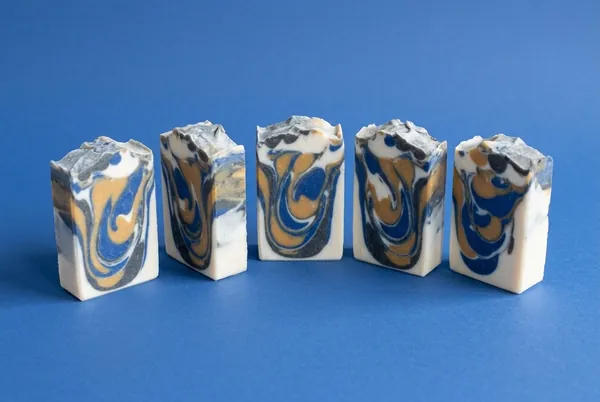
Swirl techniques: in the pot, drop, hanger, spoon and Taiwan
Seven cold-process swirls step by step, with the batter, recipe and temperatures that keep soap fluid, and why swirls turn muddy or lumpy.
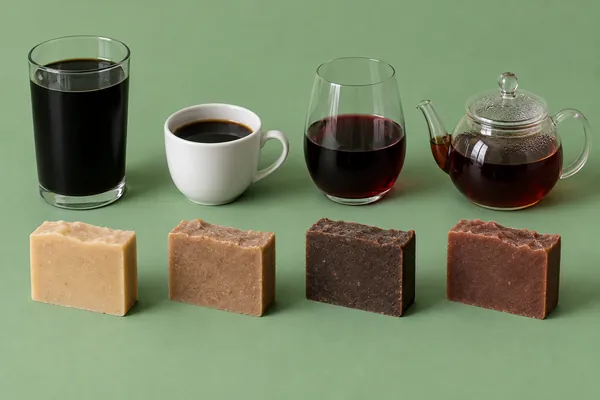
Beer, wine, coffee, tea and juice in soap
Using beer, wine, coffee, tea or juice in place of soap's water: how to prepare each one, add the lye safely, and what the calculator does with the liquid.

Natural colourants: what herbs, clays and spices really do in soap
Clays, charcoal and plant colours in cold-process soap: doses per 500 g of oils, infused oil, powder or lye, and the colour each one actually turns.
Where these proportions come from
Kelly Cable's mocha-coffee bar: her quarter of cocoa butter and quarter of coconut oil with coffee as all the liquid, with high-oleic sunflower oil in place of her macadamia nut oil and more water, a 31 % lye solution, to give the swirl time.
Formulation adapted from The Natural Soap Making Book for Beginners by Kelly Cable (Althea Press, 2017). The method and notes are ours.