Five-layer blue ombre bar
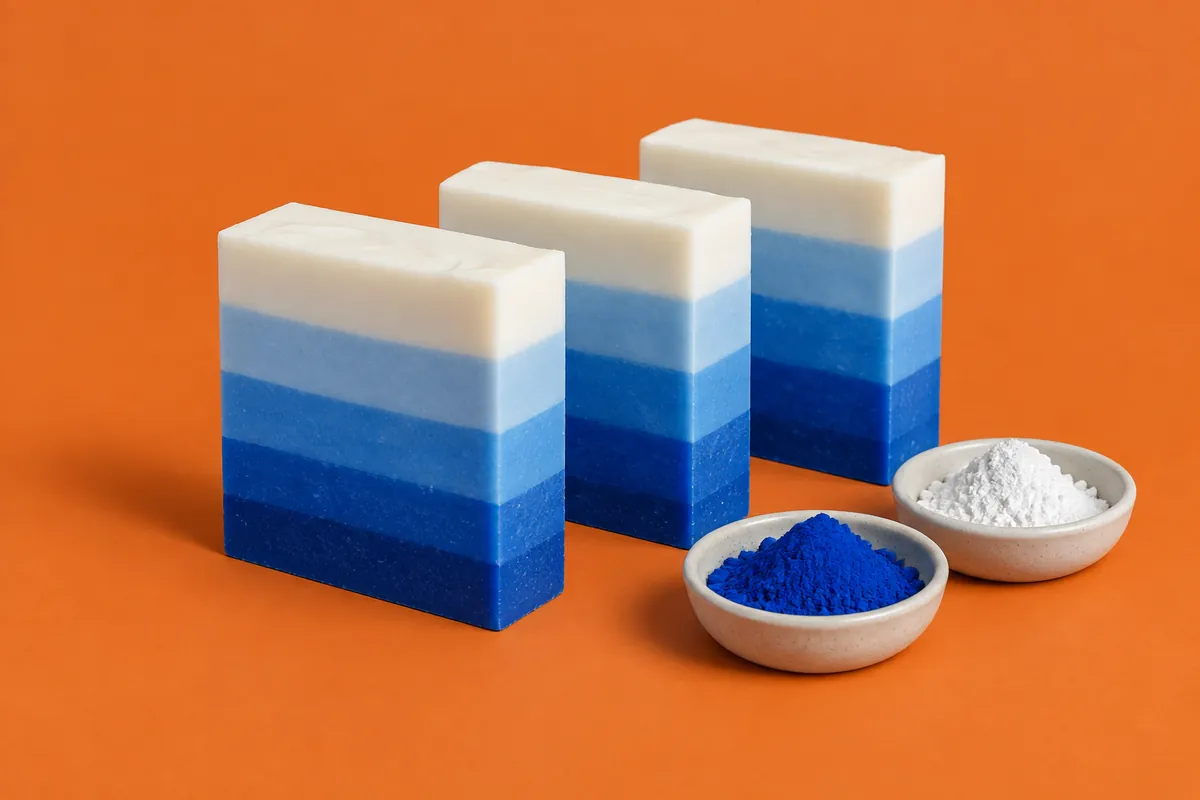
Five layers stepping from deep ultramarine blue to white, made by blending one blue oil and one white oil in set proportions. Every jug gets the same weight of oil, so each layer has the same superfat as the next.
- Skill
- Advanced
- Method
- Cold process
- Batch
- 900 g of oils about 1323 g of batter
- Hands-on
- 1 h 40 min
- Cure
- 6 weeks
- Gel phase
- Yes insulate the mould
What you need
For 900 g of oils, which fills a 25 × 9 cm loaf mould filled 6 cm deep (about 1.4 litres). Weigh everything, liquids included.
| Olive Oil · 30.0 % | 270 g | 9.52 oz |
| Coconut Oil · 25.0 % | 225 g | 7.94 oz |
| Sunflowerseed Oil - High Oleic Acid · 15.0 % | 135 g | 4.76 oz |
| Edible Tallow · 10.0 % | 90 g | 3.17 oz |
| Lard · 10.0 % | 90 g | 3.17 oz |
| Rapeseed Oil - Low Erucic Acid · 10.0 % | 90 g | 3.17 oz |
| Sodium hydroxide (NaOH) · the lye, 100 % pure | 126.4 g | 4.46 oz |
| Distilled water · for a 33 % lye solution | 256.7 g | 9.05 oz |
| Ultramarine blue · 1.5 tsp, made up to 30 g with the recipe's olive oil, the blue oil | 6.3 g | 0.22 oz |
| Titanium dioxide · 1.5 tsp, made up to 30 g with the recipe's olive oil, the white oil | 7 g | 0.25 oz |
| Sweet orange oil, 5-fold · 2.0 % of the oils, at trace | 18 g | 0.63 oz |
| Atlas cedarwood oil · 1.0 % of the oils, at trace | 9 g | 0.32 oz |
- Superfat
- 5 %
- Temperatures
- Oils and lye solution at 38 to 41 °C (100 to 105 °F), warm enough to keep the tallow and lard melted
Method
-
Get ready
Put on goggles, gloves and long sleeves and open a window. Line the mould and set it on a level surface where it can stay for a day, with five jugs numbered 1 to 5, two small cups and a spatula in reach. -
Make the blue oil and the white oil
Weigh the olive oil. Tare a small cup on the scale, put the ultramarine in it and add olive oil from the recipe until the cup holds 30 g in all; do the same with the titanium dioxide in the other cup. Stir each smooth, until a smear on a white plate shows no grains. -
Dose the five jugs
Weigh into the jugs: jug 1, 12 g of blue oil; jug 2, 9 g of blue and 3 g of white; jug 3, 6 g of each; jug 4, 3 g of blue and 9 g of white; jug 5, 12 g of white. Every jug now holds the same 12 g, so every layer gets the same share of oil. -
Make the lye solution
Where the air moves, pour the 126.4 g of sodium hydroxide slowly into the 256.7 g of water, never the reverse, and stir until clear. Leave it labelled and out of reach to cool to 38 to 41 °C (100 to 105 °F). -
Melt and scent the fats
Melt the tallow, lard and coconut oil, add the rest of the olive oil with the sunflower and canola oils, and let them cool to 38 to 41 °C (100 to 105 °F) while they stay clear. Stir in the orange and cedarwood oils. -
Blend to light trace
Pour the lye solution in down the blender shaft, tap out trapped air, and blend in short pulses with stirring between until light trace: thin custard that holds a faint line for a few seconds. -
Fill the jugs
Weigh 250 g of batter into each jug and whisk until the colour is even, with no streaks. The recipe is slow, so the jugs waiting their turn stay pourable. -
Pour the darkest layer
Pulse jug 1 with the blender until it reaches medium trace, like pudding, pour it into the mould and level it with the spatula; tap the mould. Wait 3 to 5 minutes, until a light touch leaves a mark that does not close. -
Pour the middle layers
Bring jug 2 to medium trace and pour it slowly onto the back of a spatula held just above the blue, moving along the mould, and tap gently. Repeat with jugs 3 and 4, waiting each time until the layer below holds a mark; later jugs need fewer pulses, as they thicken while they wait. -
Finish with white
Pour jug 5 over the spatula the same way and smooth the top, or lift it into soft peaks with the back of a spoon. -
Cover so it gels
Cover the mould with a board or lid and wrap it in a towel for a day, two towels in a room below about 24 °C (75 °F). A full gel deepens the blue, and at a 33 % lye solution the white stays clear of glycerin rivers. -
Unmould and cut
Unmould with gloves on after about 2 days, once firm, and cut bars about 2.5 cm (1 in) thick so each face shows all five bands. -
Cure
Stand the bars on edge with air between them, out of direct sun, for 6 weeks, turning them every few days.
Tips
- Weighing the colour oils is what keeps the superfat even: a jug given extra oil makes a softer layer, and a jug given none makes a harsher one.
- For a cream-to-blue ombre without titanium dioxide, make the second 30 g of plain olive oil. The jugs still get equal oil, and the top layer is the soap's own ivory.
- Each layer is only about 1.2 cm, so a level mould and a spatula held low matter more than usual. If a waiting jug gets too thick to pour, spoon it on and smooth it.
- Ultramarine stays put in soap, which is why the lines stay sharp; a dye would bleed across them.
The oils
| Oil | Share |
|---|---|
| Olive Oil (virgin / refined / olive oil) | 30.0 % |
| Coconut Oil | 25.0 % |
| Sunflowerseed Oil - High Oleic Acid | 15.0 % |
| Edible Tallow (beef/mutton dripping) | 10.0 % |
| Lard (pure rendered pork fat) | 10.0 % |
| Rapeseed Oil - Low Erucic Acid (Canola Oil) | 10.0 % |
How it is made
| Process | Cold process |
| Alkali | NaOH |
| Superfat | 5 % |
| Water | lye water at 33 % |
| Iodine value | 62 |
| INS | 145 |
Why make it
Five bands of blue in one bar: a showpiece, and one of the best exercises there is in reading trace. Blending one colour oil with one white oil in set proportions gives even steps from dark to light, and every layer the same superfat. The blue is ultramarine, once ground from lapis lazuli at great cost; the synthetic pigment for which Jean-Baptiste Guimet won a French prize in 1828 made it cheap (Hamerton et al.), and it stays put in soap, so the lines stay sharp. The formula, with tallow, lard and plenty of soft oils, traces slowly, which is what makes five pours possible, and it gives a mild everyday bar, cleansing 18 and conditioning 60 on our scale. The colour is purely for looks. It is not a vegetarian soap, and it takes patience and a level mould.
Sources
- A systematic examination of colour development in synthetic ultramarine according to historical methods · Hamerton I., Tedaldi L. and Eastaugh N., PLOS ONE 8(2), 2013
What tradition, makers' experience and research say about soaps like this, each labelled for what it is. It is not medical advice, and no soap treats a skin condition: if you have one, ask a doctor or pharmacist.
What the numbers say
- Lauric acid 12.3 %
- Myristic acid 5.3 %
- Palmitic acid 12.4 %
- Stearic acid 6.2 %
- Oleic acid 49.3 %
- Linoleic acid 8.9 %
- α-Linolenic acid 1.5 %
- Other 6.2 %
Saturated : unsaturated 40 : 60
Computed from the fatty acids of the fats above. The bands are what the craft has settled on, not chemistry — a bar outside one is not wrong.
From the guides
All guides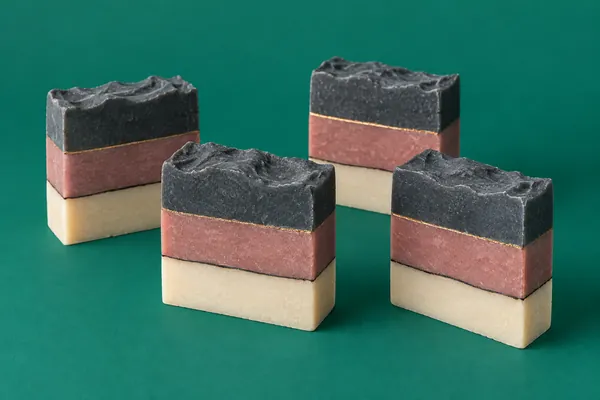
Layers, mica lines and pencil lines
Layered cold-process soap: batter thickness, pouring over a spatula, working out each layer from the mould, and pencil lines that don't split the bar.
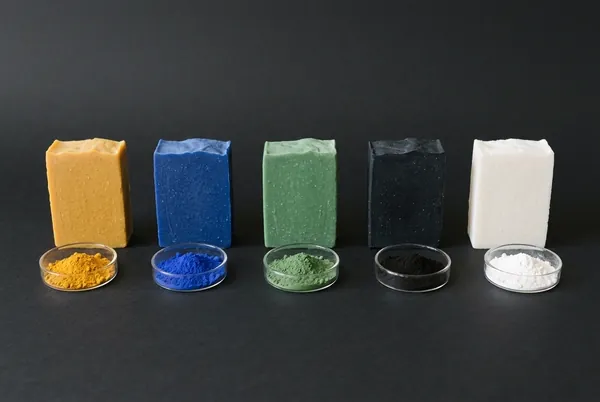
Colouring soap: micas, oxides, ultramarines and pigments
Which colourants survive cold-process soap, how much to use per 500 g of oils, how to disperse and split colour, and what the EU, UK and US rules ask.
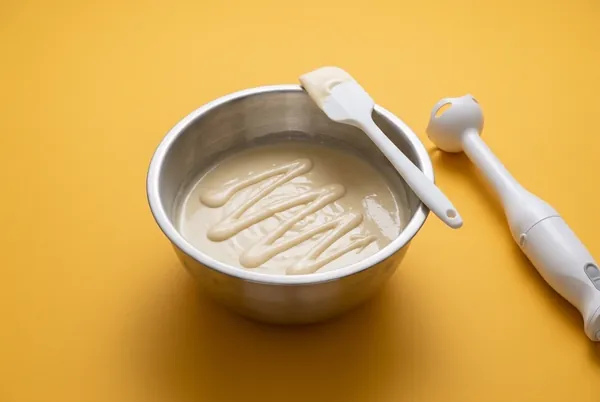
Trace: how to tell when soap batter is ready
What trace is, how to read emulsion, light, medium and thick trace, how to spot false trace, and what makes soap batter thicken faster or slower.
Where these proportions come from
Adapted from David Fisher's slow mover, the recipe he builds his double ombré on, with high-oleic sunflower oil in place of ordinary sunflower for a longer shelf life; the five-jug blend of a colour oil and a white oil is his method, with ultramarine blue in place of alkanet.
Formulation adapted from The Complete Photo Guide to Soap Making by David Fisher (Creative Publishing International, 2018). The method and notes are ours.