Pink salt spa bar
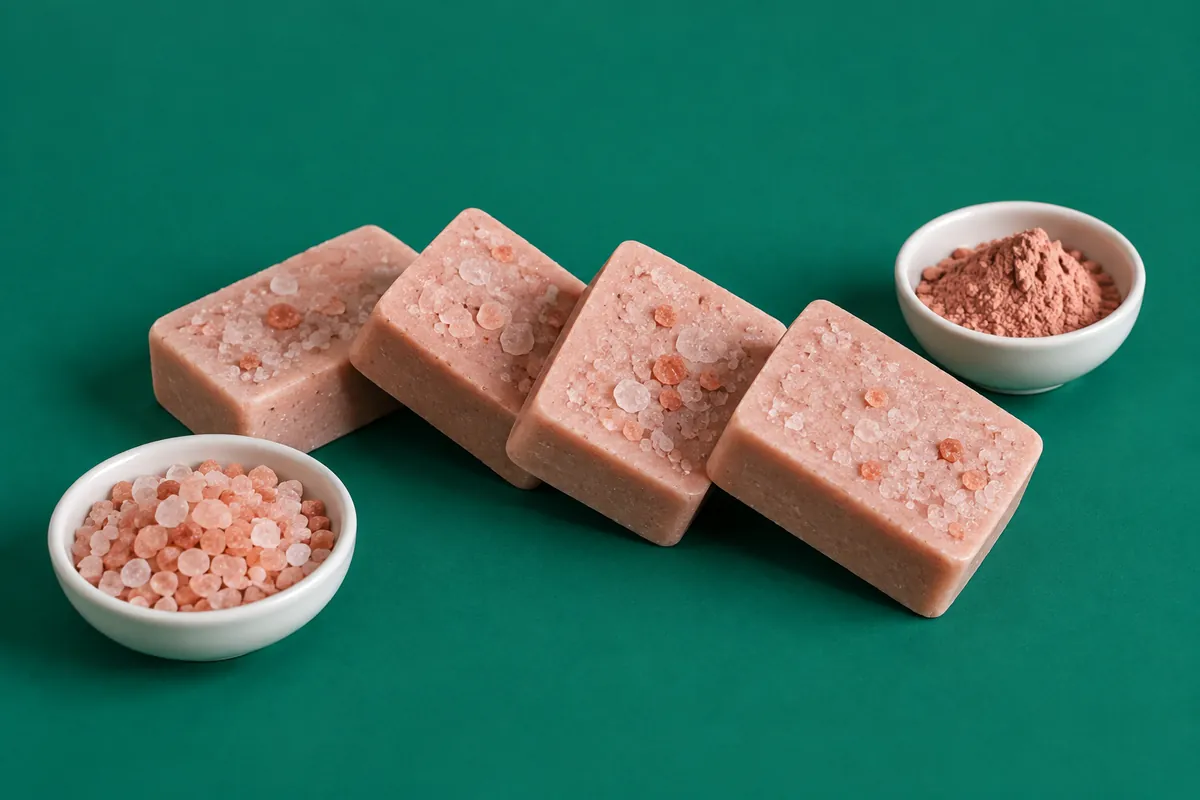
A classic salt bar: 70 % coconut oil at an 18 % superfat, with fine pink Himalayan salt at three quarters of the oil weight and a little rose clay for a dusty pink. It sets as hard as stone and gives a low, creamy lather, and cavity moulds mean no race to cut it.
- Skill
- Intermediate
- Method
- Cold process
- Batch
- 500 g of oils about 1112 g of batter
- Hands-on
- 1 hour
- Cure
- 8 weeks
- Gel phase
- Either way gel or not, both work
What you need
For 500 g of oils, which fills two 6-cavity silicone moulds, 1.2 litres in all, with cavities of about 100 ml; salt batter is dense, so it fills about nine. Weigh everything, liquids included.
| Coconut Oil · 70.0 % | 350 g | 12.35 oz |
| Olive Oil · 20.0 % | 100 g | 3.53 oz |
| Shea Butter · 5.0 % | 25 g | 0.88 oz |
| Castor Oil · 5.0 % | 25 g | 0.88 oz |
| Sodium hydroxide (NaOH) · the lye, 100 % pure | 68.9 g | 2.43 oz |
| Distilled water · for a 33 % lye solution | 139.8 g | 4.93 oz |
| Rose clay · 1 tsp, stirred into the warm lye solution for a deeper pink | 3.2 g | 0.11 oz |
| Fine pink Himalayan salt · finely ground, folded in by hand; 75 % of the oils | 375 g | 13.23 oz |
| Coarse pink Himalayan salt · a few crystals scattered into the bottom of each cavity | 10 g | 0.35 oz |
| Geranium essential oil · 2.0 % of the oils, at trace | 10 g | 0.35 oz |
| Sweet orange essential oil · 1.0 % of the oils, at trace | 5 g | 0.18 oz |
- Superfat
- 18 %
- Temperatures
- Oils and lye solution each at 38 to 43 °C (100 to 110 °F)
Method
-
Get ready
Open a window, put on splash goggles, nitrile gloves and long sleeves, and set two 6-cavity silicone moulds on a tray; the batch fills about nine cavities of 100 ml. Scatter 10 g coarse pink salt into the bottoms of nine cavities, a few crystals in each: they end up on the face of the bars. -
Weigh everything
Weigh 350 g coconut oil and 25 g shea butter into the pot, and 100 g olive oil and 25 g castor oil into a jug. Weigh 375 g fine pink salt into its own bowl and 10 g geranium and 5 g sweet orange essential oil into a small glass, then 139.8 g distilled water into the lye jug and 68.9 g sodium hydroxide last, into a dry container. -
Make and colour the lye solution
At an open window or under the extractor fan, pour the sodium hydroxide slowly into the water, never the water onto the lye, and stir until clear. While it is still warm, stir in 1 tsp (3.2 g) rose clay until no lumps remain, then leave it to cool, labelled and out of reach. -
Melt the oils
Melt the coconut oil and shea butter on the lowest heat and pour in the olive and castor oils. Soap warm: bring the oils and the lye solution each to 38 to 43 °C (100 to 110 °F), which keeps this coconut-rich batter fluid long enough to take the salt. -
Blend to light trace only
Stir the lye solution to lift any clay that has settled, pour it into the oils down the shaft of the stick blender and pulse briefly. Stop at light trace, when the batter is like thin custard; this recipe usually gets there within a minute or two. -
Add the scent
Stir in the geranium and sweet orange essential oils with a spatula. -
Fold in the salt
Tip in the 375 g of salt and fold it through by hand with the spatula, not the blender, until no dry salt remains. The batter turns thick and grainy at once, like stiff porridge. -
Fill the cavities
Spoon the batter into the cavities over the coarse salt, press it down firmly with the back of the spoon and tap the moulds on the worktop to settle it. Smooth the backs level. -
Leave uncovered
Leave the moulds uncovered and uninsulated, level and out of reach: salt bars heat up well enough on their own. Wipe the pot and tools into the bin with paper towels straight away, before the salty batter sets hard on them, then wash them. -
Turn them out
After 4 to 8 hours, when the bars are warm and firm, put your gloves back on and press one out from the back; if it holds its shape, turn out the rest. There is nothing to cut. -
Cure
Stand the bars on a rack with air around them for at least eight weeks, turning them now and then. Salt bars go on hardening for months, and a longer cure only improves them.
Tips
- In a loaf mould this recipe must be cut 2 to 4 hours after pouring, as soon as it holds a clean edge; left overnight, a salt loaf shatters under the knife. Cavities take the race out of it.
- The quality numbers read harsh, with cleansing near 50, because they are worked out from the fatty acids alone and cannot see the 18 % superfat. The superfat is what makes this much coconut soap mild.
- In the batter, use only fine rock salt, sea salt or table salt. Dead Sea salt and Epsom salt are rich in magnesium and make a soft, wet bar.
- Keep the bar on a dish that drains, out of the shower spray: even plain salt draws water from very humid air, above about 75 %.
The oils
| Oil | Share |
|---|---|
| Coconut Oil | 70.0 % |
| Olive Oil (virgin / refined / olive oil) | 20.0 % |
| Shea Butter | 5.0 % |
| Castor Oil | 5.0 % |
How it is made
| Process | Cold process |
| Alkali | NaOH |
| Superfat | 18 % |
| Water | lye water at 33 % |
| Iodine value | 30 |
| INS | 206 |
Why make it
Salt bars are a maker's favourite: dense, stone-hard bars with a low, creamy lather and a smooth, almost silky feel in use, a reputation built on makers' experience rather than on tests. Seventy per cent coconut oil would be harsh on its own, 48 for cleansing on our scale, which is why the superfat is 18 %: that spare oil is what makes it gentle enough for the body. Pink Himalayan salt is almost all sodium chloride, its colour coming from traces of iron oxide, and an analysis of 31 pink salts found the other minerals in it only in small amounts (Fayet-Moore et al.), so choose it for its colour rather than for minerals. The patience is the catch: it needs eight weeks on the drying rack and keeps improving for months. Keep it out of the shower spray, as salt draws damp.
Sources
- An analysis of the mineral composition of pink salt available in Australia · Fayet-Moore F. et al., Foods 9(10):1490, 2020
What tradition, makers' experience and research say about soaps like this, each labelled for what it is. It is not medical advice, and no soap treats a skin condition: if you have one, ask a doctor or pharmacist.
What the numbers say
- Lauric acid 34.4 %
- Myristic acid 13.2 %
- Palmitic acid 9.2 %
- Stearic acid 4.9 %
- Ricinoleic acid 4.4 %
- Oleic acid 21.6 %
- Linoleic acid 4.2 %
- Other 10.7 %
Saturated : unsaturated 70 : 30
Computed from the fatty acids of the fats above. The bands are what the craft has settled on, not chemistry — a bar outside one is not wrong.
From the guides
All guides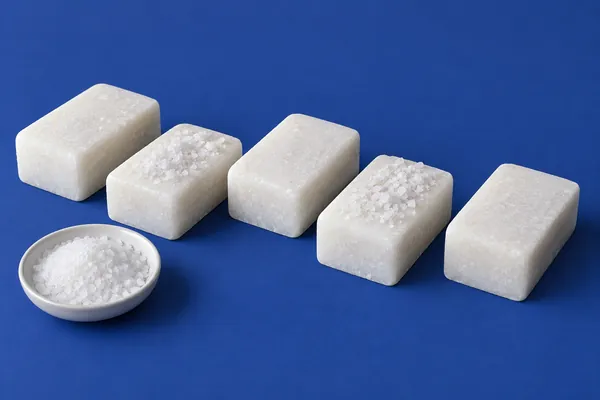
Salt bars: spa soap with sea salt
Why salt bars are mostly coconut oil at a 15 to 20 % superfat, how much salt to use and which to avoid, when to cut them, and how brine bars differ.
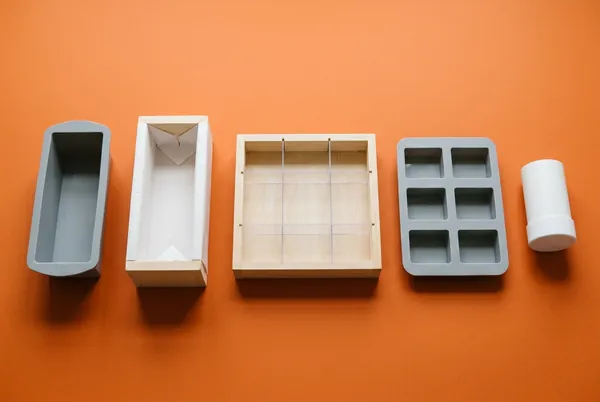
Soap moulds: choosing one and sizing a recipe to fit
Silicone, wood, slab, cavity, tube and improvised soap moulds; lining with freezer paper; and how to size a recipe to a mould, with a worked example.
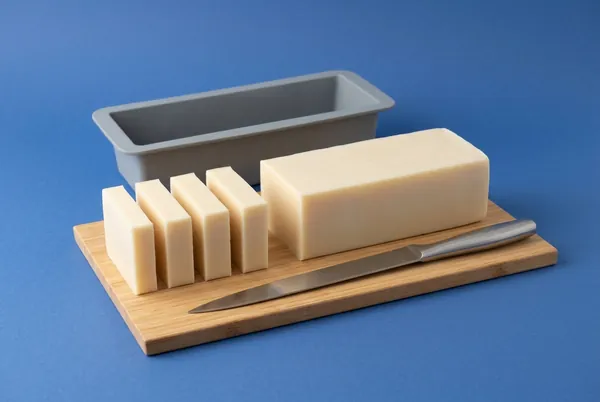
Unmoulding and cutting soap
When cold process soap is ready to come out of the mould, how to release it from silicone, lined and cavity moulds, and how to cut, bevel and stamp even bars.
Guides with this recipe
Where these proportions come from
Adapted from Kelly Cable's salt soaps: 70 % coconut oil with olive and castor oils, a little shea butter in place of some of the olive oil, and an 18 % superfat where she uses 20 %, both inside the craft's usual 15 to 20 % for salt bars. Salt at three quarters of the oil weight follows David Fisher's preferred balance of hardness and lather.
Formulation adapted from The Natural Soap Making Book for Beginners by Kelly Cable (Althea Press, 2017); The Complete Photo Guide to Soap Making by David Fisher (Creative Publishing International, 2018). The method and notes are ours.