Piped soap cupcakes
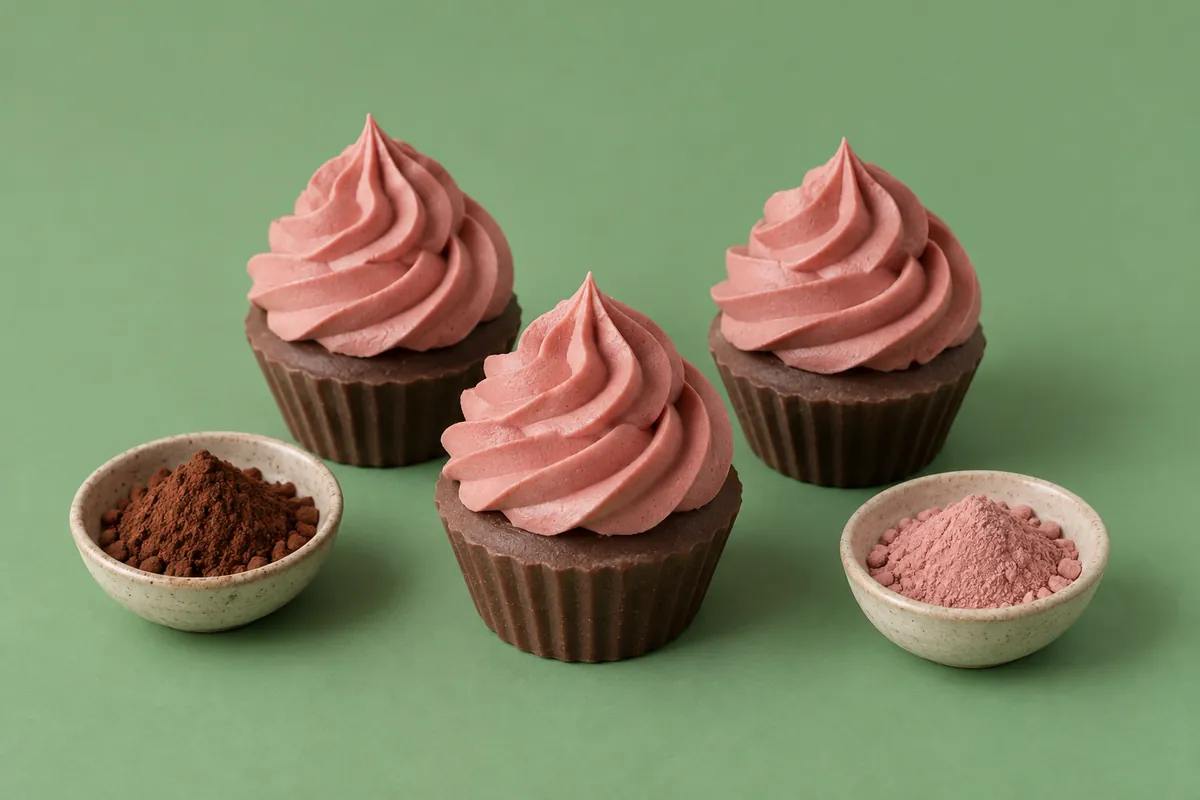
Twelve chocolate-brown soap cupcakes with rose-pink frosting piped in swirls. A hard, stiff recipe made as two batches from one weighing list: the cakes first, then a frosting blended until it holds a peak and piped at once.
- Skill
- Advanced
- Method
- Cold process
- Batch
- 1000 g of oils about 1482 g of batter
- Hands-on
- 2 hours
- Cure
- 6 weeks
- Gel phase
- No keep it cool
What you need
For 1000 g of oils, which fills a 12-cavity silicone cupcake mould, cavities about 7 cm across and 4 cm deep, and a piping bag with a large open-star tip. Weigh everything, liquids included.
| Palm Oil · 60.0 % | 600 g | 21.16 oz |
| Coconut Oil · 30.0 % | 300 g | 10.58 oz |
| Olive Oil · 10.0 % | 100 g | 3.53 oz |
| Sodium hydroxide (NaOH) · the lye, 100 % pure | 144.5 g | 5.10 oz |
| Distilled water · 274 g for a 34 % lye solution, 19 g set aside | 293.4 g | 10.35 oz |
| Cocoa powder · 1.5 tbsp, cake batch only, stirred into its warm oils | 8.1 g | 0.29 oz |
| Rose clay · 2 tsp, frosting batch only, stirred into 19 g of the recipe's water | 6.3 g | 0.22 oz |
| Isopropyl alcohol, 91 % or stronger, in a spray bottle · misted over the frosting two or three times in the first 90 minutes against soda ash, well away from any flame | 30 ml | |
| Sweet orange oil, 5-fold · 2.0 % of the oils, at trace | 20 g | 0.71 oz |
| Geranium oil · 1.0 % of the oils, at trace | 10 g | 0.35 oz |
- Superfat
- 6 %
- Temperatures
- Oils at 40 to 43 °C (104 to 110 °F) so the palm oil stays melted; lye solution at 30 to 38 °C (86 to 100 °F)
Method
-
Plan the two batches
The cakes use 60 % of every weight on the weighing list and the frosting the other 40 %. Weigh 360 g palm oil, 180 g coconut oil and 60 g olive oil into one pot for the cakes, and 240 g palm, 120 g coconut and 40 g olive into another for the frosting. -
Get ready
Put on goggles, gloves and long sleeves and open a window. Stand the cupcake mould on a tray, and fit a piping bag with a large open-star tip, about 1 cm across, standing it open in a tall glass. -
Make one lye solution for both
Weigh the 293.4 g of water and take 19 g of it out into a cup for the clay. Where the air moves, pour the 144.5 g of sodium hydroxide slowly into the remaining 274.4 g of water, never the reverse, stir until clear and let it cool to 30 to 38 °C (86 to 100 °F). -
Melt both pots and colour the cakes
Melt the oils in both pots and hold them at 40 to 43 °C (104 to 110 °F), so the palm oil stays clear. Stir the 1½ tablespoons of cocoa powder into the cake pot until smooth, with 12 g of orange oil and 6 g of geranium oil. -
Blend the cakes
Weigh the whole lye solution and pour 60 % of its weight into the cake pot, down the blender shaft. Blend in short pulses until thick but still pourable. -
Pour the cakes
Pour about 72 g into each of the 12 cavities, aiming at the centre so each forms a slight mound, and tap the mould on the worktop. -
Start the frosting
Stir 8 g of orange oil and 4 g of geranium oil into the frosting pot, check it is still at 40 to 43 °C (104 to 110 °F), and blend in the rest of the lye solution to light trace. Stir the rose clay into the 19 g in the cup and whisk it in. -
Blend to a standing peak
Keep blending in short bursts, stirring between, until a spoonful lifted out leaves a peak that stands without slumping, like whipped cream. Test every minute or so; the cakes firm up while you wait. -
Fill the bag
Spoon the frosting into the piping bag, no more than half full, and twist the top closed. Keep your gloves and goggles on: this is raw soap. -
Pipe the frosting
Start in the middle of each cake, pipe outwards in a circle to the edge, come back in on top of that ring, then pause in the centre while squeezing and lift away to leave a peak. Work quickly, because soap frosting sets in the bag. -
Mist against soda ash
Mist the frosting lightly with 91 % or stronger isopropyl alcohol two or three times over the first 90 minutes, well away from any flame. Leave the cupcakes uncovered at room temperature; small cavities stay out of gel. -
Clear away safely
Put the pots, blender, bag and tip somewhere labelled and out of reach for a day. The raw batter on them turns to soap and then washes off in hot water. -
Unmould
After 2 to 4 days, with gloves on, push each cupcake up from the bottom of its cavity, holding it by the cake rather than the frosting. -
Cure
Cure the cupcakes for 6 weeks on a rack, so air reaches the bottoms, handling them by the cake.
Tips
- If the frosting slumps as you pipe, blend another minute and test again. If it turns stiff and crumbly in the bag, it has gone too far: spoon it onto the cakes and ruffle it with a fork instead.
- Choose RSPO-certified palm oil. A palm-free frosting needs a similar share of fats that are solid at room temperature; try any swap in a small batch before piping a dozen.
- Never squeeze a bag of stiff frosting hard enough to burst it. If it won't flow, it is too thick to pipe; spoon it on instead.
The oils
| Oil | Share |
|---|---|
| Palm Oil | 60.0 % |
| Coconut Oil | 30.0 % |
| Olive Oil (virgin / refined / olive oil) | 10.0 % |
How it is made
| Process | Cold process |
| Alkali | NaOH |
| Superfat | 6 % |
| Water | lye water at 33 % |
| Iodine value | 42 |
| INS | 173 |
Why make it
Made for giving and for the fun of piping: soap cupcakes are a classic of the craft and a good lesson in controlling trace. Sixty per cent palm oil makes a stiff, hard soap, hardness 55 on our scale, that holds a piped peak, and the finished cupcake is a sound everyday soap, cleansing 21 at a 6 % superfat. The catch is that they look like food. UK law forbids supplying products that people, children in particular, are likely to mistake for food and put in their mouths where that could cause injury (Food Imitations (Safety) Regulations 1989), and EU product safety law weighs the same risk. If you sell them, take advice on how they are presented and labelled, and at home keep them out of reach of small children. Choose RSPO-certified palm oil, and allow six weeks before anyone uses them.
Sources
- The Food Imitations (Safety) Regulations 1989 (SI 1989/1291), regulation 2 · UK legislation, 1989
- Regulation (EU) 2023/988 on general product safety · European Union, 2023
What tradition, makers' experience and research say about soaps like this, each labelled for what it is. It is not medical advice, and no soap treats a skin condition: if you have one, ask a doctor or pharmacist.
What the numbers say
- Lauric acid 14.9 %
- Myristic acid 6.4 %
- Palmitic acid 30.1 %
- Stearic acid 4.0 %
- Oleic acid 33.2 %
- Linoleic acid 8.1 %
- Other 5.2 %
Saturated : unsaturated 59 : 41
Computed from the fatty acids of the fats above. The bands are what the craft has settled on, not chemistry — a bar outside one is not wrong.
From the guides
All guides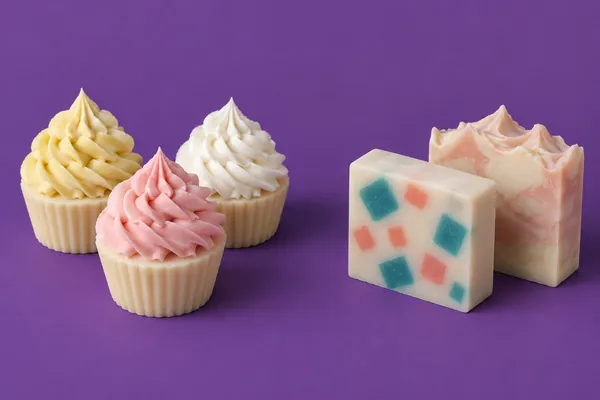
Embeds, textured tops and piping
Soap embeds that stay put and don't bleed, textured and botanical tops, piped frosting and soap cupcakes, and how to keep soda ash off the top.
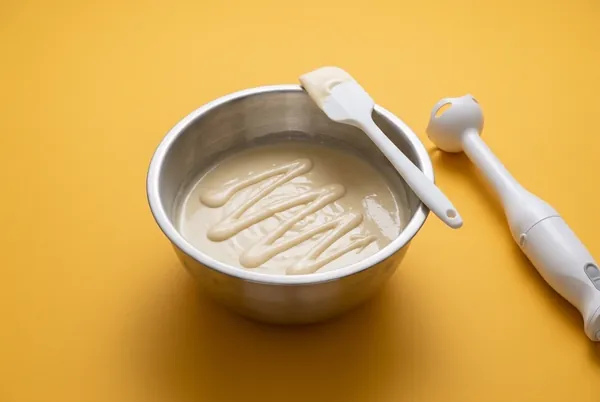
Trace: how to tell when soap batter is ready
What trace is, how to read emulsion, light, medium and thick trace, how to spot false trace, and what makes soap batter thicken faster or slower.
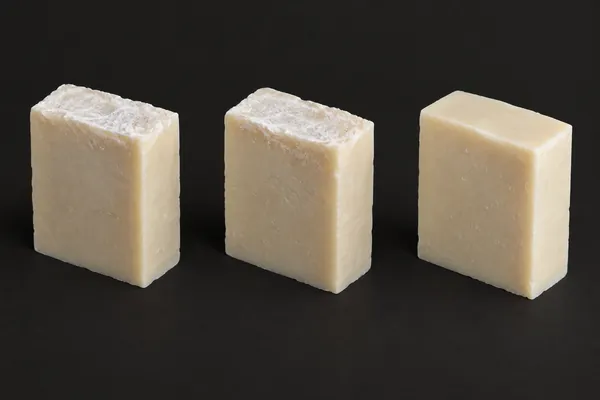
Soda ash: why it forms and how to stop it
Soda ash is sodium carbonate, made where lye still at the surface of fresh soap meets carbon dioxide in the air. Why it forms, how to prevent it and how to remove it.
Where these proportions come from
Anne-Marie Faiola's piping frosting, about 60 % palm, 30 % coconut and 10 % olive oil, a blend rich in fats that are solid at room temperature so the piped shape holds; we use it for the cake as well, so one weighing list serves both batches, and set the superfat at 6 %.
Formulation adapted from Soap Crafting by Anne-Marie Faiola (Storey Publishing, 2013). The method and notes are ours.