Pumpkin spice bar
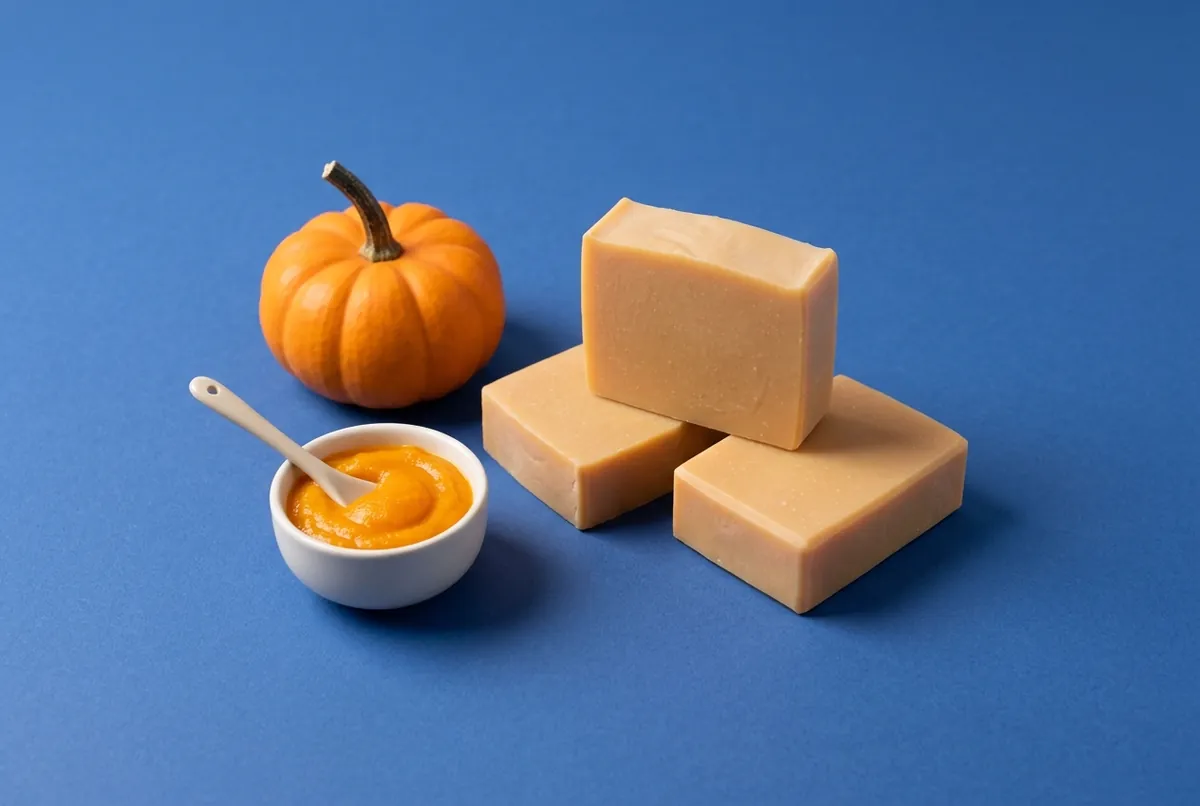
A hard, bubbly lard and coconut bar tinted a soft apricot with real pumpkin purée at trace and scented with sweet orange and a little ginger. Kept cool and uninsulated, so the pumpkin's sugar doesn't overheat the loaf.
- Skill
- Intermediate
- Method
- Cold process
- Batch
- 1000 g of oils about 1505 g of batter
- Hands-on
- 1 hour
- Cure
- 6 weeks
- Gel phase
- No keep it cool
What you need
For 1000 g of oils, which fills a 1.5 litre loaf mould. Weigh everything, liquids included.
| Lard · 26.0 % | 260 g | 9.17 oz |
| Coconut Oil · 26.0 % | 260 g | 9.17 oz |
| Olive Oil · 24.0 % | 240 g | 8.47 oz |
| Shea Butter · 9.0 % | 90 g | 3.17 oz |
| Castor Oil · 9.0 % | 90 g | 3.17 oz |
| Sunflowerseed Oil - High Oleic Acid · 6.0 % | 60 g | 2.12 oz |
| Sodium hydroxide (NaOH) · the lye, 100 % pure | 140.5 g | 4.96 oz |
| Distilled water · for a 34 % lye solution | 272.1 g | 9.60 oz |
| Pumpkin purée, plain canned · blended smooth and chilled; not pie filling | 62 g | 2.19 oz |
| Sweet orange essential oil · 2.0 % of the oils, at trace | 20 g | 0.71 oz |
| Ginger essential oil · 1.0 % of the oils, at trace | 10 g | 0.35 oz |
- Superfat
- 5 %
- Temperatures
- Lye solution and oils both at about 32 °C (90 °F)
Method
-
Blend the pumpkin
Stick blend 62 g of plain canned pumpkin, not pie filling, until completely smooth, and keep it in the fridge until you need it. -
Get ready
Put on goggles, gloves and long sleeves, open a window or run the extractor, weigh every ingredient and line the mould. -
Make the lye solution
Sprinkle the 140.5 g of sodium hydroxide into 272.1 g of cold distilled water, never the water onto the lye, and stir until clear. Leave it to cool where no one will knock it. -
Melt the fats
Melt the lard, coconut oil and shea butter gently, then stir in the olive, castor and sunflower oils and let them cool. -
Soap it cool
When the oils and the lye solution are both at about 32 °C (90 °F), pour the lye into the oils down the shaft of the stick blender. -
Blend to light trace
Blend in short bursts, stirring between them, until the batter looks like thin custard. -
Add the pumpkin and scent
Pulse in the pumpkin until the colour is even with no streaks, then stir in the orange and ginger oils by hand. -
Pour
Pour into the mould, tap it on the bench to release air, and smooth the top. -
Don't insulate
Leave the mould uncovered in a cool room, or in the fridge for the first few hours if your kitchen is warm: the pumpkin's sugar adds heat of its own, and a wrapped loaf can crack. -
Unmould and cut
Unmould with gloves on after one to two days, when the loaf is firm, and cut it into bars. -
Cure
Cure the bars on a rack with air around them for six weeks, turning them now and then.
Tips
- Expect a pale apricot bar that mellows over the cure: pumpkin tints soap rather than dyeing it. For a stronger orange, infuse a teaspoon or two of annatto seed in some of the olive oil and strain it.
- More pumpkin doesn't mean more colour, only a softer, wetter bar that is likelier to spoil; lumps spoil too, so blend it until there is nothing left to see.
- For a vegan bar, use shea butter in place of the lard and run the recipe through the calculator again: the lye changes with the fat.
The oils
| Oil | Share |
|---|---|
| Lard (pure rendered pork fat) | 26.0 % |
| Coconut Oil | 26.0 % |
| Olive Oil (virgin / refined / olive oil) | 24.0 % |
| Shea Butter | 9.0 % |
| Castor Oil | 9.0 % |
| Sunflowerseed Oil - High Oleic Acid | 6.0 % |
How it is made
| Process | Cold process |
| Alkali | NaOH |
| Superfat | 5 % |
| Water | lye water at 30 % |
| Iodine value | 56 |
| INS | 152 |
Why make it
An autumn soap for anyone who likes to make something seasonal, and a gentle introduction to purées. Real pumpkin tints the bar a soft apricot and its sugars add a little to the lather, which is already generous from the lard, coconut and castor oils, 26 bubbly and 30 creamy on our scale, in a bar hard enough, 41, to last. Pumpkin's carotenoids come through saponification intact (Rodriguez-Amaya et al.), which is why the colour holds, but in a soap that is rinsed off they are colour and nothing more. Sweet orange and a little ginger stand in for the spice, giving a warm smell that suits the season. As written it is not vegetarian; the tips give a lard-free swap.
Sources
- Assessment of provitamin A determination by open column chromatography/visible absorption spectrophotometry · D. B. Rodriguez-Amaya, M. Kimura, H. T. Godoy and H. K. Arima, Journal of Chromatographic Science 26(12), 1988
What tradition, makers' experience and research say about soaps like this, each labelled for what it is. It is not medical advice, and no soap treats a skin condition: if you have one, ask a doctor or pharmacist.
What the numbers say
- Lauric acid 12.8 %
- Myristic acid 5.4 %
- Palmitic acid 12.8 %
- Stearic acid 9.6 %
- Ricinoleic acid 8.0 %
- Oleic acid 39.8 %
- Linoleic acid 7.0 %
- Other 6.2 %
Saturated : unsaturated 44 : 56
Computed from the fatty acids of the fats above. The bands are what the craft has settled on, not chemistry — a bar outside one is not wrong.
From the guides
All guides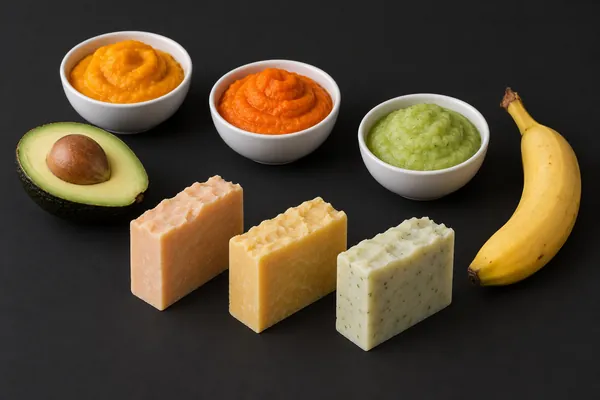
Fruit and vegetable purées in soap
How much pumpkin, carrot, cucumber, avocado or banana to put in soap, when to add it, why purées overheat and spoil, what each really adds, and a recipe.
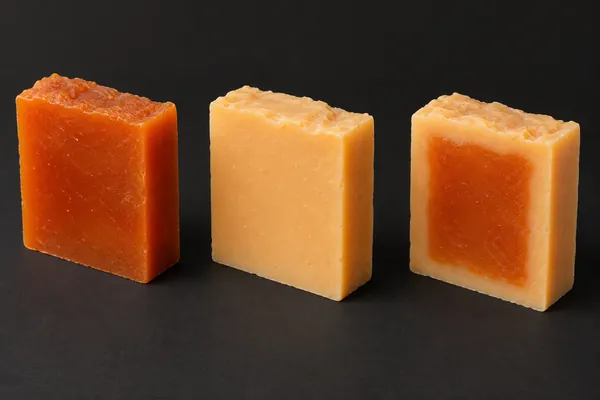
Gel phase: to insulate or keep it cool
What gel phase is, why a loaf turns dark and translucent, how gelled and ungelled bars differ, why partial gel is cosmetic, and how to cause or prevent it.

Scenting soap: essential oils and fragrance oils
How much essential or fragrance oil to use in soap, what ounces per pound mean in percent, the IFRA limits for common essential oils, and EU allergen labelling.
Where these proportions come from
Kelly Cable's pumpkin spice soap: her lard, coconut, olive, shea and castor proportions, with high-oleic sunflower oil in place of her sweet almond oil and a 5 % superfat rather than her 10 % lye discount. The water is set at a 30 % lye solution so the lye you mix stays near 34 % once the pumpkin's water is counted.
Formulation adapted from The Natural Soap Making Book for Beginners by Kelly Cable (Althea Press, 2017). The method and notes are ours.