Turmeric and honey bar
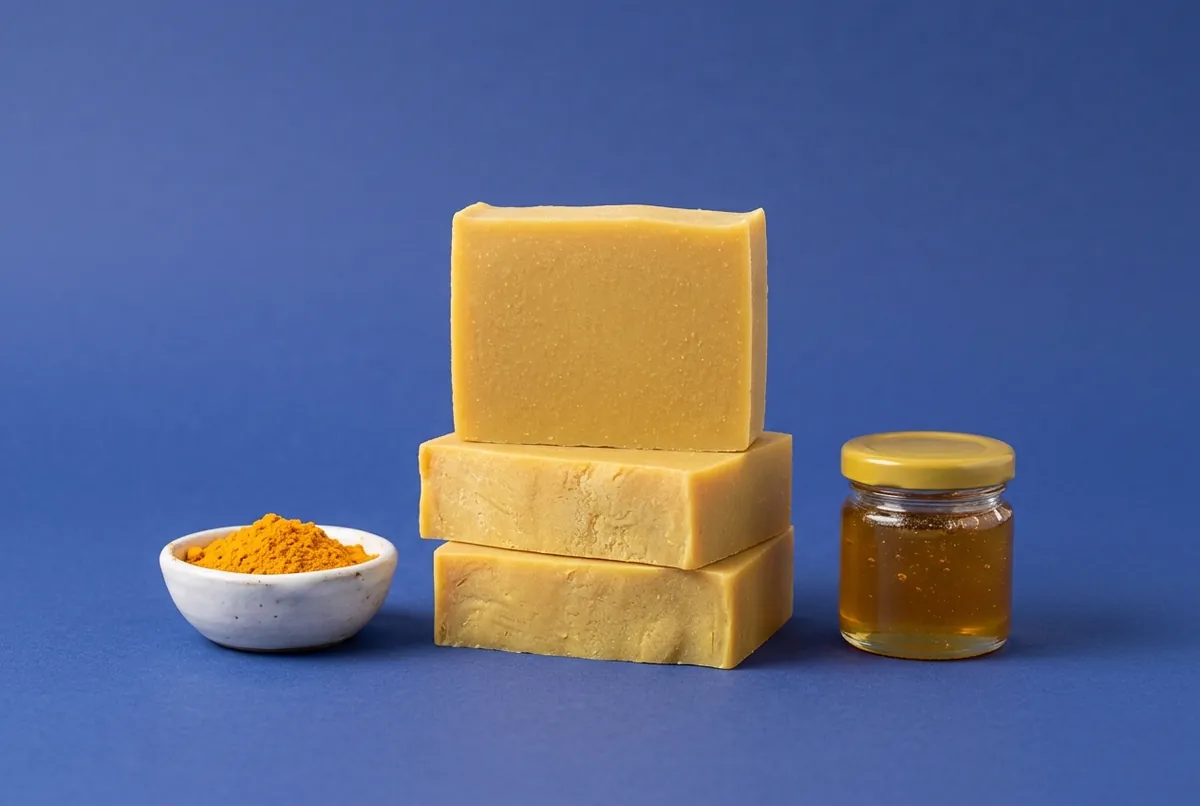
A warm golden bar coloured with turmeric-infused olive oil, with a spoonful of honey for lather and a scent of sweet orange, ginger and cardamom. Tallow, mango butter and coconut make it hard and creamy, and infusing the turmeric gives an even colour without specks.
- Skill
- Beginner
- Method
- Cold process
- Batch
- 1000 g of oils about 1486 g of batter
- Hands-on
- 1 h 20 min
- Cure
- 4 weeks
- Gel phase
- No keep it cool
What you need
For 1000 g of oils, which fills a 1.5 litre loaf mould. Weigh everything, liquids included.
| Edible Tallow · 30.0 % | 300 g | 10.58 oz |
| Olive Oil · 30.0 % | 300 g | 10.58 oz |
| Coconut Oil · 20.0 % | 200 g | 7.05 oz |
| Mango Butter · 15.0 % | 150 g | 5.29 oz |
| Castor Oil · 5.0 % | 50 g | 1.76 oz |
| Sodium hydroxide (NaOH) · the lye, 100 % pure | 138.7 g | 4.89 oz |
| Distilled water · for a 34 % lye solution | 274.4 g | 9.68 oz |
| Turmeric powder · 2 tsp, infused in 100 g of the recipe's olive oil and strained out | 6 g | 0.21 oz |
| Honey · 2 tbsp, warmed and loosened with 1 tbsp of the warm oils | 42 g | 1.48 oz |
| Sweet orange essential oil · 1.5 % of the oils, at trace | 15 g | 0.53 oz |
| Ginger essential oil · 0.5 % of the oils, at trace | 5 g | 0.18 oz |
| Cardamom essential oil · 0.5 % of the oils, at trace | 5 g | 0.18 oz |
- Superfat
- 5 %
- Temperatures
- Turmeric infused in a warm water bath, the oil at about 49 °C (120 °F); oils and lye solution each at 35 to 38 °C (95 to 100 °F)
Method
-
Infuse the turmeric
Stir 2 tsp (6.0 g) turmeric into 100 g of the olive oil in a heatproof glass jar, stand the jar in a pan of hot water for 1 to 2 hours, keeping the oil at about 49 °C (120 °F) and below 54 °C (130 °F), stirring now and then, and never leave it unattended. Let it settle, strain it through a paper coffee filter, and top the golden oil back up to 100 g with fresh olive oil. -
Get ready
Open a window, put on splash goggles, nitrile gloves and long sleeves, and line or set out a 1.5 litre loaf mould. Turmeric stains, so keep the golden oil off pale worktops and cloths, and clear a shelf in the fridge in case the loaf runs hot. -
Weigh everything
Weigh 300 g tallow, 200 g coconut oil and 150 g mango butter into the pot, and the 100 g of golden oil, 200 g plain olive oil and 50 g castor oil into a jug. Weigh 42 g (2 tbsp) honey into a small heatproof cup, and 15 g sweet orange, 5 g ginger and 5 g cardamom essential oil into a small glass. -
Make the lye solution
Weigh 274.4 g distilled water into the lye jug and 138.7 g sodium hydroxide into a dry container. At an open window or under the extractor fan, pour the lye slowly into the water, never the reverse, stir until clear and leave it to cool, labelled and out of reach; the honey never goes in here. -
Melt the fats
Melt the tallow, coconut oil and mango butter on the lowest heat, then pour in the golden oil, the plain olive oil and the castor oil. Let the oils and the lye solution each come to 35 to 38 °C (95 to 100 °F), cool enough to leave room for the honey's heat. -
Loosen the honey
Stir a tablespoon of the warm oils into the cup of honey so that it pours easily. -
Blend to light trace
Pour the lye solution into the oils down the shaft of the stick blender, then pulse for a few seconds at a time, stirring between pulses. Stop at light trace, when the batter looks like thin custard and a drizzle leaves a faint line that sinks back within seconds. -
Add the scent and honey
Stir in the essential oils, then the honey, and give one or two short pulses to spread them. The batter turns a bright orange; it settles to gold within a day. -
Pour and keep cool
Pour into the mould, tap it on the worktop and smooth the top. Leave it uncovered, with no towel, in a cool room; if the top starts to crack or dome in the first few hours, move the mould into the fridge overnight. -
Clean up
With your gloves still on, wipe the batter off the pot and tools with paper towels into the bin, then wash everything in hot soapy water straight away, before the turmeric sets into the spatula and mould. -
Unmould and cut
After 24 to 48 hours, when the loaf is firm and back at room temperature, put your gloves back on, unmould it and cut it into bars about 2.5 cm (1 in) thick. -
Cure
Stand the bars on edge on a rack with air around them, out of the sun, for four to six weeks, turning them every few days.
Tips
- Turmeric turns orange-red in fresh soap and settles to gold overnight, so judge the colour the next day, not in the pot, and don't add more: a stronger dose tints washcloths.
- Honey warms the colour a little too. Orange-brown streaks through the gold mean the loaf got too hot; soap it cooler next time.
- The golden oil is part of the recipe's olive oil, not extra. Added on top, it would be oil with no lye to meet it, and a softer bar.
The oils
| Oil | Share |
|---|---|
| Edible Tallow (beef/mutton dripping) | 30.0 % |
| Olive Oil (virgin / refined / olive oil) | 30.0 % |
| Coconut Oil | 20.0 % |
| Mango Butter | 15.0 % |
| Castor Oil | 5.0 % |
How it is made
| Process | Cold process |
| Alkali | NaOH |
| Superfat | 5 % |
| Water | lye water at 33 % |
| Iodine value | 52 |
| INS | 153 |
Why make it
A hard, creamy bar from tallow, mango butter and coconut oil, hardness 44 and creamy 33 on our scale with a gentle cleansing 15: a good everyday bar for most skin. The honey's sugars give a bigger, bubblier lather, as makers find (Anne-Marie Faiola), and infusing the turmeric gives an even, warm gold without specks. Turmeric has a history of use going back some four thousand years in Asia (Prasad and Aggarwal 2011). In soap, though, both it and the honey are rinsed away within a minute, so any benefit people hope for rests on tradition rather than on evidence about soap. Sweet orange, ginger and cardamom give a warm, spiced scent. Tallow makes it unsuitable for vegans.
Sources
- Anne-Marie Faiola, Pure Soapmaking · Storey Publishing, 2016
- Turmeric, the Golden Spice: From Traditional Medicine to Modern Medicine · Herbal Medicine: Biomolecular and Clinical Aspects, 2nd edition, CRC Press, 2011
What tradition, makers' experience and research say about soaps like this, each labelled for what it is. It is not medical advice, and no soap treats a skin condition: if you have one, ask a doctor or pharmacist.
What the numbers say
- Lauric acid 9.8 %
- Myristic acid 5.0 %
- Palmitic acid 14.4 %
- Stearic acid 14.7 %
- Ricinoleic acid 4.4 %
- Oleic acid 40.0 %
- Linoleic acid 5.8 %
- Other 5.5 %
Saturated : unsaturated 48 : 52
Computed from the fatty acids of the fats above. The bands are what the craft has settled on, not chemistry — a bar outside one is not wrong.
From the guides
All guides
Natural colourants: what herbs, clays and spices really do in soap
Clays, charcoal and plant colours in cold-process soap: doses per 500 g of oils, infused oil, powder or lye, and the colour each one actually turns.

Soap additives: salt, sugar, sodium lactate, clays, oats, silk and more
What common soap additives do, how much to use and when they go in: sourced doses for sodium lactate, salt, sugar, honey, citric acid, clays, oats and silk.
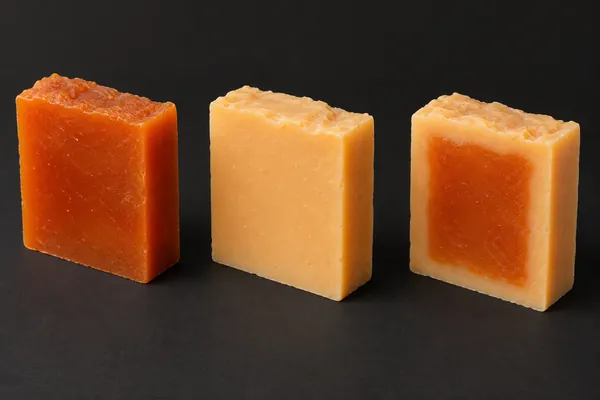
Gel phase: to insulate or keep it cool
What gel phase is, why a loaf turns dark and translucent, how gelled and ungelled bars differ, why partial gel is cosmetic, and how to cause or prevent it.
Where these proportions come from
Adapted from the turmeric-coloured frankincense and myrrh soap in Kelly Cable's book: her tallow, olive, coconut, mango butter and castor blend at a 5 % superfat, with the turmeric infused in part of the olive oil and strained out, 2 teaspoons where she stirs in 2 tablespoons of powder, and honey added for lather.
Formulation adapted from The Natural Soap Making Book for Beginners by Kelly Cable (Althea Press, 2017). The method and notes are ours.