Castile brine bar
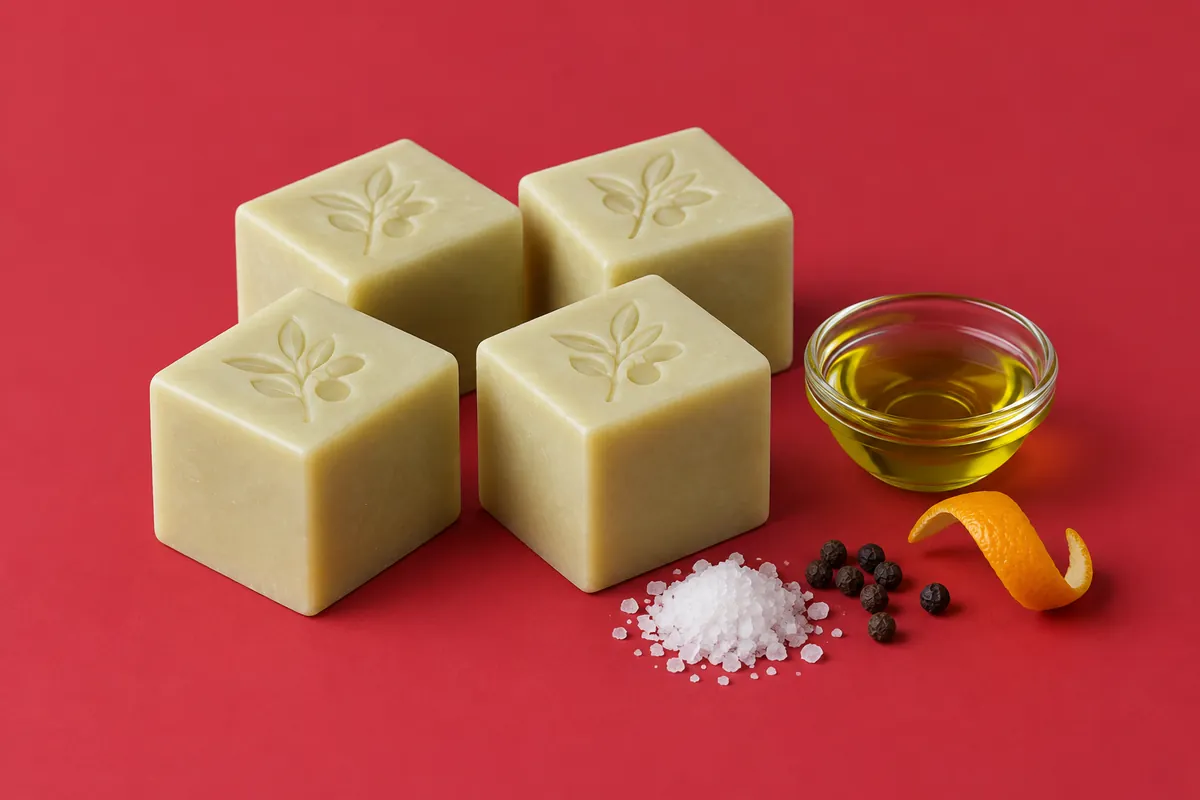
Pure olive oil soap made with a light brine: fine sea salt dissolved in the water before the lye, which helps the soft castile batter set into firm cubes for stamping. Sweet orange and black pepper scent it, and like all castile it rewards a long cure with a hard, mild bar and a low, creamy lather.
- Skill
- Beginner
- Method
- Cold process
- Batch
- 1000 g of oils about 1432 g of batter
- Hands-on
- 1 hour
- Cure
- 26 weeks
- Gel phase
- Either way gel or not, both work
What you need
For 1000 g of oils, which fills a 9-cavity silicone cube mould holding about 1.5 litres in all. Weigh everything, liquids included.
| Olive Oil · 100.0 % | 1000 g | 35.27 oz |
| Sodium hydroxide (NaOH) · the lye, 100 % pure | 128.7 g | 4.54 oz |
| Distilled water · for a 33 % lye solution | 261.2 g | 9.22 oz |
| Sea salt, fine · dissolved in the water before the lye goes in | 12 g | 0.42 oz |
| Sweet orange essential oil · 2.0 % of the oils, at trace | 20 g | 0.71 oz |
| Black pepper essential oil · 1.0 % of the oils, at trace | 10 g | 0.35 oz |
- Superfat
- 5 %
- Temperatures
- Olive oil warmed to about 35 °C (95 °F), lye solution cooled to 35 to 45 °C (95 to 113 °F)
Method
-
Get ready
Put on splash goggles, nitrile gloves and long sleeves, open a window or turn on the extractor fan, and keep children and pets out of the room. Set the cube mould on a tray on a level surface where it can stay for three days. -
Weigh everything
Weigh 1000 g olive oil into the soaping pot, 261.2 g distilled water into a heat-safe jug, 12 g fine sea salt into a small bowl and 128.7 g sodium hydroxide into a dry container. Weigh 20 g sweet orange and 10 g black pepper essential oil into a small glass. -
Make the brine
Stir the salt into the water until no grains are left and the water is clear. Salt dissolves readily in plain water but far less once the lye is in, so it always goes in first. -
Add the lye
At the open window or under the fan, pour the sodium hydroxide slowly into the brine, never the brine onto the lye, and stir until clear. Leave it to cool, labelled and out of reach. -
Warm the oil
Warm the olive oil gently to about 35 °C (95 °F): warm oil traces sooner, and pure olive oil is slow. Carry on when the lye solution has cooled to 35 to 45 °C (95 to 113 °F). -
Blend to thin trace
Pour the lye solution into the oil down the shaft of the stick blender, tap out trapped air and keep the blade under the surface. Pulse for a few seconds, stir with the blender off and repeat, for ten minutes or more if need be, until a drizzle leaves a faint trail on the surface before it sinks. -
Add the scent
Whisk in the sweet orange and black pepper oils by hand until the batter is even again. -
Fill the cavities
Pour the batter into the nine cavities, filling each nearly to the top, and tap the tray on the worktop to bring up air bubbles. Lay a sheet of cling film over the filled cavities so it touches the batter, keeping air off the tops, which helps prevent a white bloom of soda ash. -
Let them set
Leave the mould somewhere quiet, with no towel or insulation, for two to three days. Castile stays soft and a little sticky for longer than most soaps; the salt helps it firm, but don't hurry it. -
Unmould
With gloves on, press each cube out from the back once the tops feel firm. If they stick or tear, freeze the whole mould for about four hours, turn them out while cold, and let them come back to room temperature and dry off before stamping. -
Stamp the cubes
Set a soap stamp squarely on top of each cube and give it one or two firm taps with a rubber mallet, pressing about 1 mm (1/16 in) into the soap. Stamp within a day or two of unmoulding, while the soap is soft enough to take a clean impression. -
Cure for six months
Stand the cubes with air all round, somewhere cool, dry and dark, and turn them every week or so. You can use one from about eight weeks, when it is mild but still soft and slippery; by six months the cubes are hard and long-lasting, and castile keeps improving for a year.
Tips
- The salt stops at 12 g because a lye solution holds very little of it: at 33 %, this batch's solution keeps about 13.6 g dissolved, and any more would come back out as fine white crystals as the lye went in. Faiola's weaker solution held a full tablespoon, about 16 g, at the cost of more water to dry out.
- The calculator gives this bar hardness 17 and cleansing 0, the figures for pure olive oil. They count only saturated fatty acids and cannot see a cure: a six-month castile cube is hard in the hand and very mild, with a low, creamy lather rather than big bubbles.
- Sweet orange is the first scent to fade over a long cure. A folded orange oil, five-fold or the ten-fold Faiola used, lasts far longer at the same weight; or leave the scent out, since castile is often made unscented.
- Any grade of olive oil works. Extra virgin gives a greener cube and refined oil a paler one; pomace oil traces faster but takes slightly less lye, so choose it in the calculator if that is what you have.
The oils
| Oil | Share |
|---|---|
| Olive Oil (virgin / refined / olive oil) | 100.0 % |
How it is made
| Process | Cold process |
| Alkali | NaOH |
| Superfat | 5 % |
| Water | lye water at 33 % |
| Iodine value | 85 |
| INS | 106 |
Why make it
Castile is the classic mild soap: pure olive oil, cleansing 0 and conditioning 82 on our scale, and made for centuries in the olive-growing lands of Spain and the Mediterranean. Susan Miller Cavitch notes that pure olive oil soaps are generally gentle enough for sensitive skin and for babies, and that long reputation, rather than any trial, is why people choose one. The salt is a maker's device: dissolved in the lye water, it helps the soft batter set firm enough to unmould and stamp, and it does not make this a salt bar. Sweet orange and black pepper give a light scent that fades over the long cure, and anyone who wants the mildest version can leave it out. The catch is time and texture: castile has a slippery, low lather and needs about six months to harden.
Sources
- The Natural Soap Book · Storey Publishing, 1995
What tradition, makers' experience and research say about soaps like this, each labelled for what it is. It is not medical advice, and no soap treats a skin condition: if you have one, ask a doctor or pharmacist.
What the numbers say
- Palmitic acid 13.8 %
- Stearic acid 2.8 %
- Oleic acid 69.0 %
- Linoleic acid 12.3 %
- Other 2.6 %
Saturated : unsaturated 17 : 83
Computed from the fatty acids of the fats above. The bands are what the craft has settled on, not chemistry — a bar outside one is not wrong.
From the guides
All guides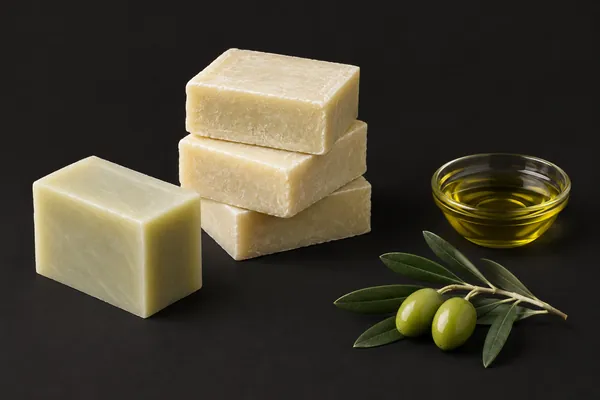
Castile soap: pure olive oil, and why it's worth the wait
What castile soap really is, why pure olive oil traces slowly and starts soft and slippery, how long to cure it, and a recipe with the calculator's numbers.
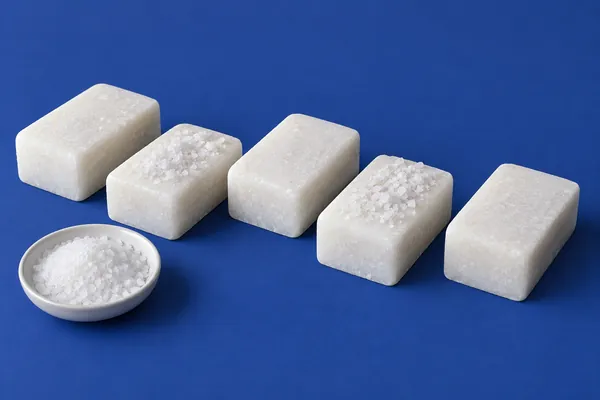
Salt bars: spa soap with sea salt
Why salt bars are mostly coconut oil at a 15 to 20 % superfat, how much salt to use and which to avoid, when to cut them, and how brine bars differ.
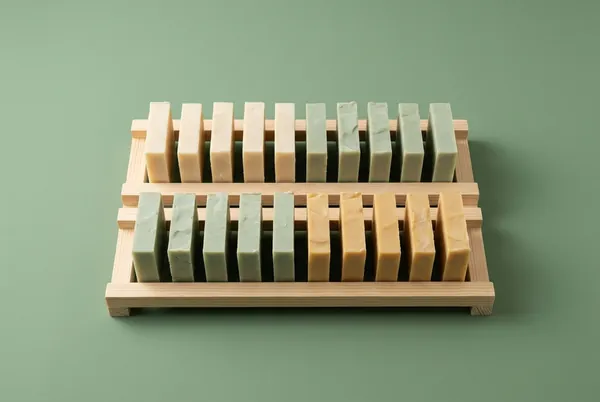
Curing and storing handmade soap
What curing does to cold process soap and what it doesn't, how long it takes, how to set bars up to cure, how to tell when they're done, and how to store them.
Guides with this recipe
Where these proportions come from
Adapted from Anne-Marie Faiola's castile brine cubes: pure olive oil at a 5 % superfat, with fine sea salt dissolved in the water before the lye and each cube stamped in the style of a Marseille soap. Her lye solution is a weak 27.8 %; ours is 33 %, so the soft cubes set sooner, and that limits the salt to 12 g per 1000 g of oil, within what a 33 % solution keeps dissolved. Her orange and black pepper blend is cut from 4.5 % of the oils to 3 %.
Formulation adapted from Pure Soapmaking by Anne-Marie Faiola (Storey Publishing, 2016). The method and notes are ours.