In short
- Savon de Marseille is made in a cauldron: vegetable oils boiled with lye, salted out with sea salt, washed, then poured into floor basins to set before it is cut and stamped.
- The 72 % on the cube is its share of oil, 72 % vegetable oils and 28 % moisture in one maker's words. It is not 72 % olive oil in a recipe.
- By that measure our cold process recipe is 70.8 % oil the day it is cut and passes 72 % as it dries. The figure says nothing about which oils.
- The name is not protected. INPI refused all three applications for a French geographical indication, and appeals against two of the refusals failed, in 2022 and 2025. Soap sold under the name may be made anywhere.
- A home bar is a homage: it keeps its glycerin and its superfat, where cauldron soap is washed and drained. Our recipe, 72 % olive oil with coconut and palm, takes 135.9 g of sodium hydroxide per kilogram of oils and twelve weeks of cure.
- For the laundry it is grated or bought as flakes and dissolved in hot water. It is still soap: it forms scum in hard water and is not a detergent for high-efficiency machines.
On this page
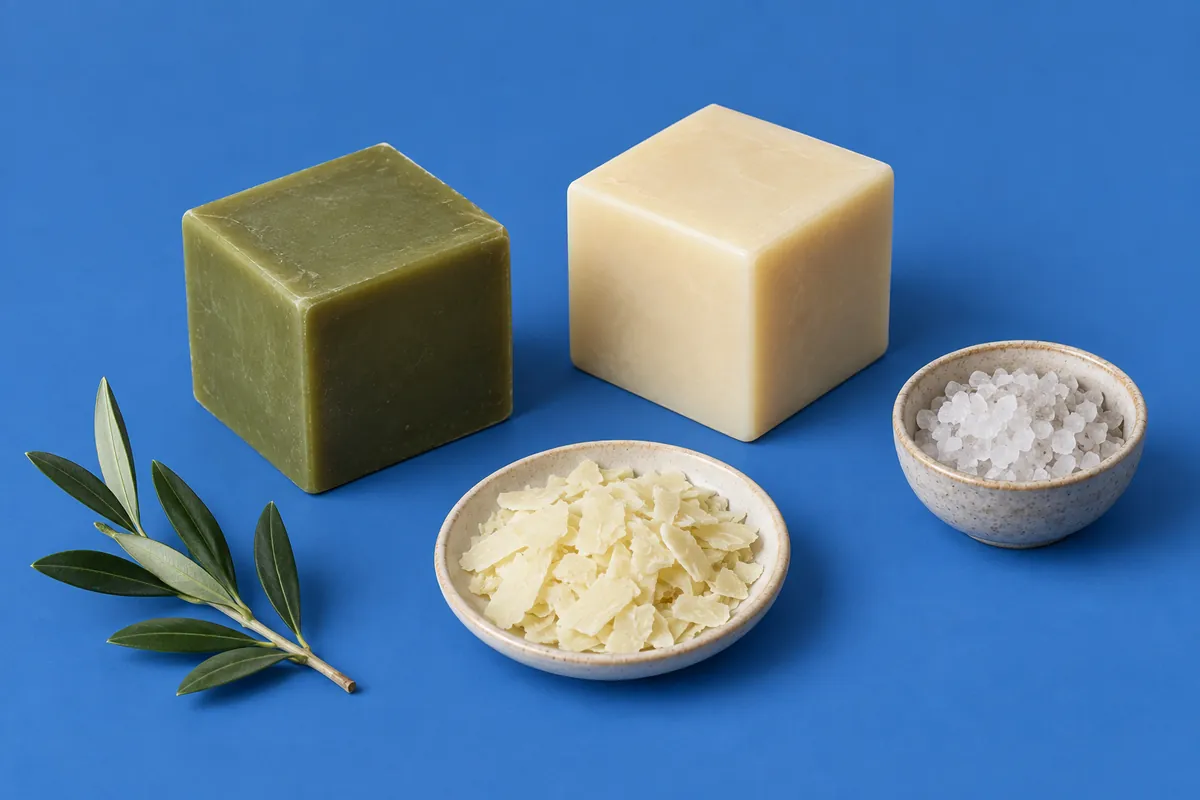
The cube of savon de Marseille, green or white and stamped on its faces, is often misread. Its 72 % is taken for a recipe and its name for a place of origin, and it is neither. This guide covers how the soap is made in the cauldrons of Provence, what the old rules required of it, what the 72 % actually measures, where the name stands in French law, a home version with the calculator’s numbers, palm-free included, and what the soap can and cannot do in the laundry.
What savon de Marseille is
Marseille has made olive oil soap since the Middle Ages. Simmons and Appleton’s 1908 handbook has soapmaking flourishing in Italy and Spain in the eighth century and reaching France some five hundred years later, when soap works were set up at Marseille for olive oil soap. For centuries the soap was olive oil and soda, the soda burnt from seaside plants: Watt’s handbook of 1884 records that French soap was made from nothing else until the start of the nineteenth century, when palm and coconut oil came in. By 1908 groundnut oil “enters largely into the composition of Marseilles White Soaps” (Simmons and Appleton).
The cauldron makers who applied to have the name protected use vegetable oils only, and recognise two colours, which come from the oils and nothing else: green soap, from olive and coconut oil, sometimes with palm, and white or beige soap, from coconut and palm (UPSM). The olive oil is olive-pomace oil, recovered from the pulp and stones left once the olives are pressed (UPSM; Marius Fabre). One maker sells its green soap for face and body and its white soap for the laundry, and has replaced the palm oil in its white soap with high-oleic sunflower oil (Marius Fabre). In Watt’s day the choice was white or marbled, with grey and red veins of iron soap drawn through the white.
The edict of 1688
The oldest known regulation of the trade is a royal one of 5 October 1688, for the soap works of all Provence, not Marseille alone. Its preamble says the king had been told that the poor quality of the soap now made in Provence had cut its sales, once very great, and that short weight and careless preparation had let foreigners take up the trade at home (Julliany; Fournier). The articles on the soap itself required that:
- no soap be made in June, July or August, on pain of confiscation;
- no oil of the new season be used before 1 May;
- nothing go into the soap with the barilla, soda or ashes, “no fat, butter or other matter, but only pure olive oils without admixture of fat”;
- the soap be “cooked to perfection” and go straight from the cauldron into the usual drying basins, the mises.
The towns with soap works named two merchants every year to see it obeyed (Julliany). A century later Marseille’s soap makers credited the summer ban and the olive oil rule with the favour their soap enjoyed. The ban was lifted in 1754 and brought back in 1760, after six years of complaints about soap made in the heat (Fournier).
The makers call it Colbert’s edict (UPSM; AFSM), although Jean-Baptiste Colbert had died in 1683 (Château de Versailles). An exhibition booklet of the Musée de Salon et de la Crau, quoted in the makers’ application, credits it to “Colbert marquis de Seignelay”, his eldest son, who had succeeded to his offices (Universalis).
Marks came later. From 1754 each maker had to stamp his soap with a mark of his own, registered with the court, and decrees of 1811 and 1812 required every brick to carry the name of its fat, olive oil, seed oil, tallow or grease, and gave Marseille a mark of its own for olive oil soap: a pentagon with the maker’s name and the city (Julliany).
How it is made in the cauldron
Four soap works in the Bouches-du-Rhône, the département of Marseille, set out their method in the specification they sent to INPI, France’s intellectual property office, in 2015 and revised in 2022 (UPSM). They call it the procédé marseillais, the Marseille process, in five steps:
- Empâtage, making the paste. Oils and caustic soda lye are boiled together in the cauldron, today a metal one, at 100 to 120 °C for at least six hours, until the mass becomes an emulsion.
- Relargage, salting out. Soap does not dissolve in salt water. Sea salt is added, the soap separates, and the salty lye underneath, carrying the glycerin, is drawn off.
- Cuisson, the boil. The soap is boiled on until all the fat has become soap. In Watt’s account it is boiled with strong lye, drawn off and renewed, until the lye stays caustic.
- Lavage, washing. Washes of salted lye carry off the rest of the glycerin, impurities and any fatty acids not yet turned to soap (UPSM; AFSM). The boil and the washes take at least twenty hours together.
- Liquidation. Water is worked in and the grainy soap turns smooth. Left to rest, any darker soap, the nigre, settles below the clean soap (Watt).
The hot soap is then poured into the mises, cement basins on the floor, to set in the air, and is cut into bars and cubes and stamped on several faces with the maker’s mark, the weight, “huile d’olive” or “72 % d’huile”. Some makers dry the soap under vacuum into pellets, which are extruded into bars, or dry it into flakes on a chilled drum (UPSM). One maker cuts its bars at 2.5 kg and dries them on racks for a month or more before they are sold (Marius Fabre). Aleppo soap is also boiled in cauldrons, with laurel berry oil in it; the Aleppo guide covers it.
The same specification allows no animal fat, perfume, colour or additive: the only raw materials are vegetable oils, caustic soda, salt and water. The finished soap must hold at least 63 % fatty acids by weight, no more than 0.8 % salt and no more than 0.2 % free caustic soda.
What “72 %” means
The number on the cube describes the finished soap. One of the makers puts it plainly: savon de Marseille is “composed of 72 % vegetable oils (hence the 72 % stamp) and 28 % moisture. The more it dries, the more the water evaporates and the higher its oil content” (Marius Fabre). The makers’ application put the vegetable fats at 72 % of everything charged into the process, “about” 72 % in one place and “at least” in another, and tested the finished soap for fatty acids, a chemist’s version of the same measure: 63 % or more (UPSM). The other group of Provence makers who applied asked for 68 %, and required only 5 % olive or olive-pomace oil among the fats (AFSM).
None of it is a recipe. Home recipes often read the stamp as 72 % olive oil and 28 % other oils, but the stamp weighs all the oil against the water and says nothing about which oils. Our recipe keeps 72 % olive oil as a nod to the stamp, because that is how it is usually read, not because the stamp asks for it.
The measure is old, and it has always been about water. In 1789 Marseille’s soap makers reckoned that 144 livres of oil made 225 livres of good soap, and complained of rivals who worked extra water into their white soap to add about a third to its weight (Fournier). Watt found in 1884 that three pounds of olive oil made five pounds of marbled Marseilles soap but only four pounds four ounces of white, the marbled holding more water, and that ordinary commercial Marseilles soap held 62 to 65 % fatty acids.
The same sum for a home bar
The calculator can do the same sum for a cold process bar. Our Marseille recipe puts 1000 g of oils, 135.9 g of sodium hydroxide and 275.9 g of water in the pot: 1411.8 g of soap, of which 70.8 % is oil, 19.5 % water and 9.6 % sodium hydroxide. As the bar cures the oil stays and the water leaves, so the share of oil rises:
| Soap | Weight | Oil in it |
|---|---|---|
| White Marseilles soap in 1884, from 3 lb of olive oil | 4 lb 4 oz | 70.6 % |
| Our Marseille recipe, the day it is cut | 1411.8 g | 70.8 % |
| The same, with 70 % of its water left | 1329.0 g | 75.2 % |
| The same, with half its water left | 1273.8 g | 78.5 % |
| Our castile, all olive oil, the day it is cut | 1389.9 g | 71.9 % |
1000 g of oils at a 5 % superfat and a 33 % lye solution, from our calculator. Classic Bells finds that after four to eight weeks a bar may hold 50 to 70 % of the water it was cut with. The 1884 figure is Watt’s.
By the stamp’s own measure, then, our bar is a 72 % soap once it has lost its first 22.9 g of water, 1.6 % of its weight, and our castile once it has lost a single gram. The figure says how much of a bar is oil, and nothing about which oil.
The name: no protected designation
Since a consumer law of 2014, French makers of manufactured and craft goods can apply for a geographical indication, and savon de Marseille drew three applications with three different ideas of what the name should mean (Localtis):
- the Association des fabricants de savon de Marseille, soap works in Provence, in June 2015 (IG 15-002), for soap made in the Bouches-du-Rhône;
- the Union des professionnels du savon de Marseille (UPSM), the four cauldron soap works above, in December 2015 (IG 15-003), for soap made by the Marseille process in the Bouches-du-Rhône;
- the Association savon de Marseille France, set up by a soap works near Nantes with other makers and the French detergent industry’s association, whose members claimed 95 % of the savon de Marseille made in France, for the whole country.
INPI refused all three. The France-wide application was refused first, in May 2018, and the Cour de cassation upheld the refusal in March 2022: a specification for a name that “manifestly designates a single town in France” could not claim the whole national territory without delimiting any area.
The UPSM’s application went through public enquiries in 2016 and 2022 and was refused by INPI’s director general on 13 March 2023. The association appealed, and on 3 March 2025 the Aix-en-Provence court of appeal dismissed the appeal on two grounds. The UPSM had not shown how representative it was of the trade: the only production figure it gave was its own members’ total output, all products together. And its specification left the product and the process unclear. It spoke of “vegetable oils only” in one place and of “fats of vegetable origin”, a wider term, in another; of a cube “composed of 72 % oil” beside fats and an oil share it did not define; of five steps in the specification and four, with no washing, in the annex to the association’s statutes; and of a week to ten days of making, where the durations it set added up, by INPI’s count, to about 26 hours.
No indication covers the name, then, and none would stop its common use. France’s economy ministry told parliament in 2018 that even with an indication granted, a name regarded as generic could still be used by other makers, without geographical restriction, and only the indication’s logo would be reserved (Assemblée nationale). Soap sold as savon de Marseille may be made in Marseille, elsewhere in France or abroad. The name tells you nothing about where or how; the ingredient list tells you what went in. Sodium olivate is olive oil soap, sodium cocoate coconut, sodium palmate palm and sodium tallowate tallow.
A home version
The recipe
This is our Savon de Marseille, 72 %: olive oil with coconut and palm, oils the cauldron makers list for their green soap, unscented and cut into chunky blocks. For 1000 g of oils:
| Ingredient | Grams | Ounces |
|---|---|---|
| Olive oil | 720 | 25.40 |
| Coconut oil | 140 | 4.94 |
| Palm oil | 140 | 4.94 |
| Sodium hydroxide (100 %) | 135.9 | 4.79 |
| Water | 275.9 | 9.73 |
5 % superfat, 33 % lye solution: 1411.8 g of batter, about six blocks 4 cm thick from a 1.5 litre loaf mould. Hardness 30, cleansing 10, conditioning 67, bubbly lather 10, creamy lather 20, iodine value 69. Across the three oils’ published saponification ranges the superfat sits between 1.6 and 8.1 %.
Make the Marseille recipe. 1000 g of oils, 72 % olive, 14 % coconut and 14 % palm, at a 5 % superfat ask 135.9 g of sodium hydroxide and, at a 33 % lye solution, 275.9 g of water.
Open it in the calculatorMake it as any cold process soap, following the first batch guide; the recipe page has the full method. Melt and stir the whole tub of palm oil before you weigh any, because it separates as it stands. Work with the oils and the lye solution between 35 and 43 °C, blend to light trace, which the palm and coconut bring on within a few minutes, and wrap the mould for a day so the loaf gels. Unmould after 24 to 48 hours, cut, and stamp the blocks within a day, while they are still soft.
The superfat is 5 %, a real margin. Cold process keeps whatever lye goes in, and at 3 % the three oils’ published saponification ranges could leave the bar 0.4 % lye-heavy. The superfat guide explains the margin.
With olive-pomace oil
The cauldron makers use olive-pomace oil. To follow them, choose olive-pomace oil in the calculator rather than olive oil: it takes a little less lye, 134.7 g of sodium hydroxide for the same batch instead of 135.9 g, and makers report that it traces faster (see the castile guide).
Without palm oil
Palm oil gives this bar its firmness and its creamy lather, and the palm-free guide explains what can take its place. Keeping 72 % olive oil and 14 % coconut oil:
| The last 14 % | Sodium hydroxide | Water | Hardness | Creamy lather | Iodine value | Worst case superfat |
|---|---|---|---|---|---|---|
| Palm oil, as in our recipe | 135.9 g | 275.9 g | 30 | 20 | 69 | 1.6 % |
| Shea butter | 134.3 g | 272.7 g | 29 | 20 | 69 | 2.0 % |
| High-oleic sunflower oil | 134.8 g | 273.7 g | 24 | 15 | 74 | 1.9 % |
| More olive oil, 86 % in all | 135.0 g | 274.1 g | 25 | 16 | 74 | 1.9 % |
1000 g of oils at a 5 % superfat and a 33 % lye solution, from our calculator. The worst case is the superfat left if every oil sits at the bottom of its published saponification range.
Shea butter is the closest swap: on the calculator’s scale the bar barely changes. High-oleic sunflower oil is what one maker of savon de Marseille now uses in place of palm in its white soap; in this recipe it makes a softer bar, and so does more olive oil. A softer bar leaves the mould later and firms up more slowly, as the palm-free guide explains, so give it the full cure.
Swap the palm for shea. 72 % olive, 14 % coconut and 14 % shea butter at a 5 % superfat ask 134.3 g of sodium hydroxide and, at a 33 % lye solution, 272.7 g of water.
Open it in the calculatorWhy it is a homage, not the real thing
Everything that makes cauldron soap what it is happens after the soap has formed, and cold process has no after. Whatever goes into the mould stays in the bar:
- The glycerin stays. Our batch makes 104.3 g of glycerin, 7.4 % of the bar the day it is cut. The cauldron makers’ washes leave only traces (Marius Fabre), and the other Provence group’s specification allowed 3 % at most (AFSM).
- The superfat stays. 50 g of the oils stay unsaponified on purpose, a margin against the spread in their saponification values. A cauldron soap is boiled with lye to spare until no fat is left, and the spare lye is drawn off (Watt).
- Nothing is drained. Watt’s Marseilles soap was charged with up to 15.5 lb of caustic soda for every 100 lb of olive oil. By our calculator the oil can use 135.4 g of sodium hydroxide per kilogram, so the cauldron held up to 14.4 % more than the soap needed, and the rest left with the spent lye.
- Salt salts nothing out. Stirred into a cold process batter, salt has no lye to separate from. It stays in the bar, where a little helps soft olive soap set, as in our castile brine bar, and a lot makes a salt bar.
Hot process does not bring you closer. It cooks the soap, but everything stays in the pot, glycerin and superfat included, as the soapmaking basics guide explains.
The cure
Cauldron soap sets in the mises and is then dried for a month or more before it is sold (Marius Fabre); in 1789 the makers reckoned eight to ten days in the mises in winter and twenty in summer (Fournier). Our blocks need twelve weeks, bars 2.5 cm thick about eight, and both keep hardening for months. Stand them with air all round, turn them now and then, and weigh one: while it is still losing weight, it is still curing. The curing guide explains how. Soap of olive oil alone needs six months or more; the castile guide and our castile recipe cover the all-olive version.
Marseille soap in the laundry
Marseille soap has long been a laundry soap as well as a washing soap; one maker’s white soap is sold for the wash (Marius Fabre). The ways that maker suggests using it:
- On stains. Rub the wetted cube into collars and greasy marks before the wash.
- By hand. Wet the laundry, rub it with the soap, work up a lather and rinse in clean water.
- As a liquid. Melt 30 g of flakes, a small handful, in half a litre of very hot water, shake, add another half litre and shake again. The liquid separates and thickens as it stands; shake it, or thin it with hot water. A cured cube grated finely does the same job.
It is still soap, with soap’s limits. In hard water soap reacts with calcium to form scum, so more of it is needed (USGS). Whirlpool, for one, tells owners of its high-efficiency washers to use HE detergent only, since too much suds rinses poorly. And soap is alkaline: most bars read pH 9 to 10 in solution (Tarun et al.). The same maker recommends its soap for wool and silk (Marius Fabre), while the wool industry’s own advice is a mild, neutral detergent (Woolmark). The laundry soap guide goes through all of this, and shows how to turn a grated bar into laundry powder.
Our Marseille recipe, grated, will wash things by hand; rinse well, because its 5 % superfat leaves a little oil in the water, where a cauldron soap is boiled until no fat is left (Watt). For machine loads a lean bar suits better: our laundry bar, tallow and coconut oil at 0 % superfat.
Recipes to try
All recipesSources
- The Handbook of Soap Manufacture . W. H. Simmons and H. A. Appleton, Scott, Greenwood & Son (Project Gutenberg edition) , 1908. Soap works established at Marseilles for olive-oil soap some five hundred years after the eighth century; arachis (groundnut) oil 'enters largely into the composition of Marseilles White Soaps'.
- The Art of Soap-Making . Alexander Watt, Crosby Lockwood and Co. , 1884. French soap only olive oil and soda from calcined seaside plants until the early nineteenth century, then palm and coconut oil (p. 2); Marseilles soap: 15.5 lb of solid caustic soda for each 100 lb of olive oil (p. 37); boiling, salting out with the glycerin in the leys, finishing with strong ley until any unsaponified fat is converted, the nigre settling below the white soap (pp. 37–40); finished white soap 16 to 25 % water (p. 40); marbled soap with grey and red veins of iron soap; 3 lb of olive oil make 5 lb of marbled soap but 4 lb 4 oz of white, the marbled holding more water (p. 42); ordinary commercial Marseilles soap 62 to 65 % fatty acids (p. 50).
- Essai sur le commerce de Marseille, 2nd edition, volume 3 . Jules Julliany , 1842. pp. 279–285: text of the 1688 regulation for the soap works of Provence, preamble and articles 1 (no soap in June, July and August), 2 (no new oil before 1 May), 3 (no fat, butter or other matter, only pure olive oil) and 13 (two merchants named each year to enforce it); summer work allowed in 1754 and banned again in 1760; the 1754 ruling's article 6 requiring makers to mark their soap; decrees of 1811 and 1812 marking each brick with its fat, and a pentagon mark for Marseille's olive oil soap.
- Cahiers de doléances de la sénéchaussée de Marseille pour les États généraux de 1789: memoir of the Marseille soap manufacturers . Joseph Fournier (ed.), Collection de documents inédits sur l'histoire économique de la Révolution française , 1908. pp. 474–486: the regulation of 5 October 1688, the oldest known for the trade, its preamble on the soap of Provence, articles I (no soap in summer), III (only pure olive oil), IV (soap cooked to perfection) and V (straight from the cauldron into the mises); Marseille's favour credited to articles I and III; one millerolle of oil, 144 livres, for 225 livres of good soap; white soap loaded with water to add about a third to its weight; eight to ten days in the mises in winter, twenty in summer; summer ban lifted in 1754 and restored in 1760 after six years of complaints.
- Jean-Baptiste Colbert (1619–1683) . Château de Versailles . Colbert died in 1683.
- Seignelay (Jean-Baptiste Colbert, marquis de), 1651–1690 . Encyclopædia Universalis . Colbert's eldest son, who succeeded to his offices on his father's death in 1683.
- Indication géographique « Savon de Marseille »: cahier des charges, IG 15-003, revised May and July 2022 . Union des professionnels du savon de Marseille (UPSM), published by INPI , 2022. The Marseille process in five steps (empâtage at 100–120 °C for at least 6 h, relargage with sea salt, cuisson, lavage, at least 20 h for the last two, liquidation); drying in floor basins (mises), by vacuum into pellets or on a cooling drum into flakes; stamping; green soap of olive and coconut oil, with or without palm, white-beige of coconut and palm; olive-pomace oil; vegetable oils, caustic soda, salt and water only, no animal fat, colour or perfume; fats about 72 % (at least 72 % in the control plan) of the charge; at least 63 % total fatty acids in the finished soap, chlorides at most 0.8 %, free caustic soda at most 0.2 %; the 1688 edict called Colbert's, and the Musée de Salon et de la Crau's 1988–89 exhibition booklet crediting it to 'Colbert marquis de Seignelay'.
- Savon de Marseille, IG 15-003 . INPI, base des indications géographiques . Filed 22 December 2015 by the UPSM for four soap works in the Bouches-du-Rhône; application rejected.
- Savon de Marseille, IG 15-002 . INPI, base des indications géographiques . Filed 16 June 2015 by the Association des fabricants de savon de Marseille (AFSM), soap works in Provence; application rejected.
- Savon de Marseille: demande d'IGP, cahier des charges IG 15-002, version of 8 June 2022 . Association des fabricants de savon de Marseille (AFSM), published by INPI , 2022. Area the Bouches-du-Rhône; at least 68 % total fatty acids in the finished soap; at least 5 % olive or olive-pomace oil among the fats, after 'Colbert's edict' of 1688; washing in salt solution; glycerol at most 3 %.
- FAQ . Savonnerie Marius Fabre (manufacturer) . '72 % vegetable oils (hence the 72 % stamp) and 28 % moisture', rising as the soap dries; the olive oil is olive-pomace oil; green soap of olive and coconut oil for face and body, white of coconut and high-oleic sunflower oil for laundry; ten days of cooking and many rinses leave only traces of glycerin; bars cut at 2.5 kg and dried on racks for a month or more; Aleppo soap cooked the same way, with laurel berry oil at the end.
- Copeaux de savon de Marseille 750 g, sans huile de palme (product page) . Savonnerie Marius Fabre (manufacturer) . Palm oil replaced by high-oleic sunflower oil; flakes recommended for all textiles, wool and silk among them; a liquid laundry soap of 30 g of flakes in 1 litre of very hot water, added in two halves and shaken, which separates and thickens on standing.
- Savon de Marseille pour le linge 400 g, sans huile de palme (product page) . Savonnerie Marius Fabre (manufacturer) . Rub stains and collars with the cube before the wash; by hand, wet, rub, lather and rinse in clean water.
- Toujours pas d'indication géographique pour le savon de Marseille . Emilie Zapalski, Localtis (Banque des Territoires) , 2022. Indications for craft and manufactured goods date from the 2014 consumer law; three associations applied with opposing aims; the Association savon de Marseille France, set up by a Nantes soap works with other makers and the detergent industry association, claimed 95 % of French output and sought the whole of France; INPI decision 2018-69 of 22 May 2018.
- Cour de cassation, commercial chamber, 16 March 2022, 19-25.123, Association Savon de Marseille France v. INPI . INPI, PIBD 1181-III-8 , 2022. Refusal upheld: a specification for a name that 'manifestly designates a single town in France' could not claim the whole national territory without delimiting an area.
- Cour d'appel d'Aix-en-Provence, chamber 3-1, 3 March 2025, RG 23/05302, UPSM v. INPI . INPI, PIBD , 2025. Public enquiries in 2016 and 2022; INPI decision 2023-45 of 13 March 2023 refusing IG 15-003; appeal dismissed because the UPSM's representativeness was not shown (only its members' total output, all products together) and the product and process were imprecise and inconsistent: vegetable oils only against fats of vegetable origin, a 72 % oil cube against unspecified fats, five steps against four without washing, a week to ten days against about 26 hours by INPI's count.
- Question écrite n° 6498, valorisation de l'appellation « savon de Marseille », answer of the Ministry of the Economy and Finance . Assemblée nationale, Journal officiel of 1 May 2018, p. 3733 , 2018. Under article L. 721-8 of the Intellectual Property Code, a generic name within a geographical indication may still be used by others without geographical restriction; only the indication's logo is reserved.
- Curing soap . Classic Bells, Soapy Stuff . After four to eight weeks a bar may hold 50 to 70 % of the water it had when cut.
- Hardness of Water . US Geological Survey, Water Science School . In hard water soap reacts with calcium to form soap scum, and more soap is needed.
- HE Detergent use in a Washer . Whirlpool Product Help . Use only HE detergent in a high-efficiency washer; too much detergent oversuds and rinses poorly.
- Best detergent to use when washing wool . The Woolmark Company . A mild or neutral detergent, of relatively neutral pH, for wool; avoid heavy-duty detergents.
- Evaluation of pH of Bathing Soaps and Shampoos for Skin and Hair Care . Tarun J. et al., Indian Journal of Dermatology 59(5) , 2014. Most of the 64 soaps tested read pH 9 to 10.