Citrus kitchen bar
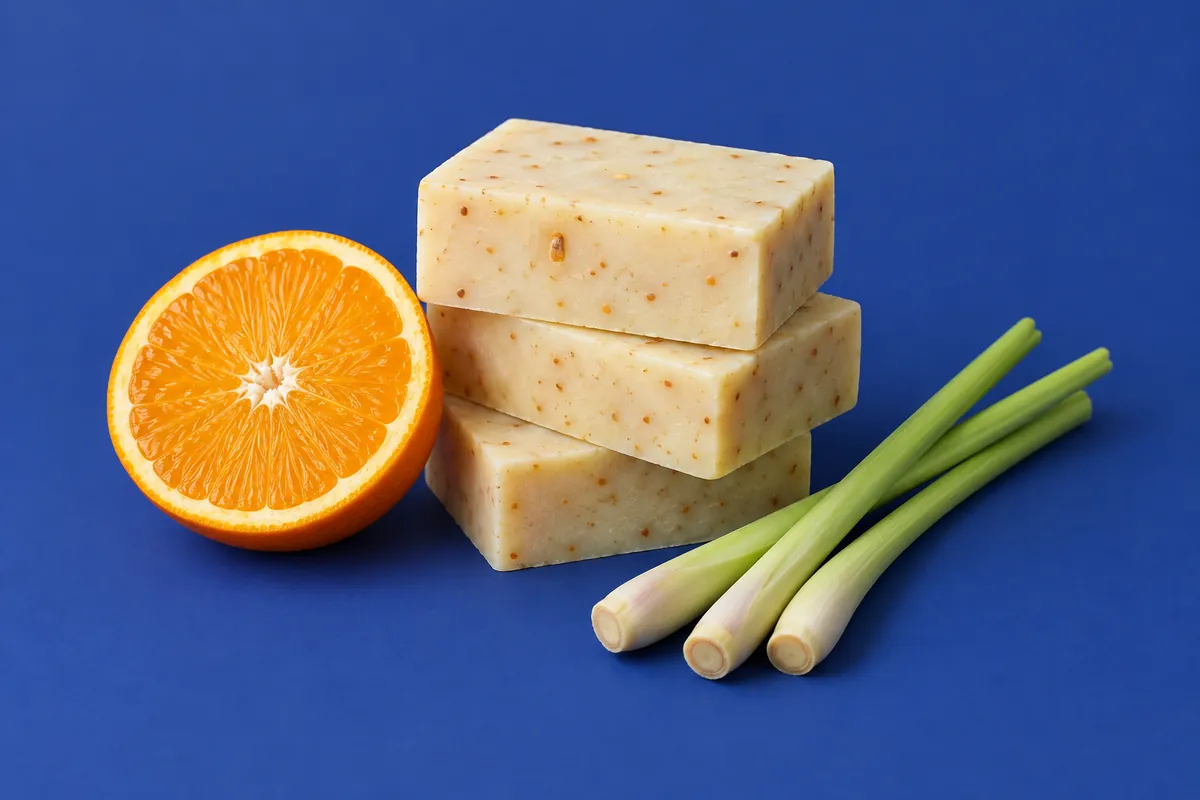
A hard, white, fast-lathering bar for the kitchen sink on the old lard, coconut and olive pattern, flecked with dried orange peel and scented with sweet orange and lemongrass. Simple to make and long-lasting.
- Skill
- Beginner
- Method
- Cold process
- Batch
- 1000 g of oils about 1469 g of batter
- Hands-on
- 1 hour
- Cure
- 4 weeks
- Gel phase
- Either way gel or not, both work
What you need
For 1000 g of oils, which fills a 1.5 litre loaf mould. Weigh everything, liquids included.
| Lard · 35.0 % | 350 g | 12.35 oz |
| Coconut Oil · 30.0 % | 300 g | 10.58 oz |
| Olive Oil · 30.0 % | 300 g | 10.58 oz |
| Castor Oil · 5.0 % | 50 g | 1.76 oz |
| Sodium hydroxide (NaOH) · the lye, 100 % pure | 143.6 g | 5.07 oz |
| Distilled water · for a 33 % lye solution | 291.5 g | 10.28 oz |
| Orange peel powder · about 2 teaspoons, stirred into 1 tbsp of the oils first, for specks | 4 g | 0.14 oz |
| Sweet orange essential oil · 2.0 % of the oils, at trace | 20 g | 0.71 oz |
| Lemongrass essential oil · 1.0 % of the oils, at trace | 10 g | 0.35 oz |
- Superfat
- 5 %
- Temperatures
- Lye solution and oils both at 35 to 40 °C (95 to 104 °F)
Method
-
Get ready
Put on goggles, gloves and long sleeves, open a window or turn on the extractor, weigh every ingredient and line the mould. -
Make the lye solution
Sprinkle 143.6 g of sodium hydroxide into 291.5 g of cold distilled water, never the water onto the lye, and stir until clear. Keep your face away from the fumes for the first minute, and leave it to cool where no one will knock it. -
Melt the fats
Melt the lard and coconut oil gently, stir in the olive and castor oils, and let them cool to 35 to 40 °C (95 to 104 °F). -
Wet the peel
Stir 4 g (about 2 teaspoons) of orange peel powder into a tablespoon of the melted oils so it goes into the batter without clumping. -
Combine
When the lye solution is also at 35 to 40 °C (95 to 104 °F), pour it into the oils down the shaft of the stick blender and blend in short bursts to light trace, like thin custard. -
Scent and speck it
Stir in the peel and then 20 g sweet orange and 10 g lemongrass essential oil by hand until evenly spread. -
Pour
Pour into the mould, tap it on the bench to release air, and smooth or texture the top. -
Cover lightly
Lay baking paper or a board over the mould but no towel, and leave it for a day. It will warm up and may gel, which is fine; wrapping it as well could overheat it and crack the top. -
Clean up with gloves on
Wipe the raw batter off the pot and tools with paper towels into the bin, not the sink, then wash them in hot soapy water. -
Unmould and cut
Unmould with gloves on after 24 to 48 hours, when the loaf is firm, and cut it into bars. -
Cure
Stand the bars on edge on a rack with air around them for four weeks, turning them now and then.
Tips
- Sweet orange and lemongrass aren't phototoxic. Cold-pressed lemon, lime, grapefruit, bitter orange and bergamot can be, which is why IFRA restricts their furocoumarins in leave-on products; rinse-off soap is exempt, but keep neat citrus oils off your skin while you measure them.
- Lemongrass is limited by its citral. At 1 % of the oils it uses under half of its IFRA category 9 allowance, so don't raise it much past 2 %.
- Plain sweet orange oil fades from cold process soap within weeks. A 5-fold or 10-fold orange lasts much longer.
- Use dried peel, not fresh zest, which holds water and can spoil; the specks darken to rust brown in the bar.
The oils
| Oil | Share |
|---|---|
| Lard (pure rendered pork fat) | 35.0 % |
| Coconut Oil | 30.0 % |
| Olive Oil (virgin / refined / olive oil) | 30.0 % |
| Castor Oil | 5.0 % |
How it is made
| Process | Cold process |
| Alkali | NaOH |
| Superfat | 5 % |
| Water | lye water at 33 % |
| Iodine value | 53 |
| INS | 159 |
Why make it
A bar for the kitchen sink, where hands get greasy and are washed many times a day. Lard makes it hard and slow to wear away on a wet ledge, and 30 % coconut gives a fast, big lather even in cold or hard water, cleansing 21 on our scale: more than a face bar, and about right for hands. The dried orange peel is there for specks, and sweet orange and lemongrass because people like a citrus smell by the sink. Kitchen lore credits citrus with cutting grease, but in a bar the soap does the cleaning and the scent is for pleasure. The caveats: citrus scents fade within weeks unless you use a folded oil, and lard makes it unsuitable for vegans.
Sources
- The Natural Soap Book · Storey Publishing, 1995
What tradition, makers' experience and research say about soaps like this, each labelled for what it is. It is not medical advice, and no soap treats a skin condition: if you have one, ask a doctor or pharmacist.
What the numbers say
- Lauric acid 14.7 %
- Myristic acid 6.3 %
- Palmitic acid 15.6 %
- Stearic acid 7.1 %
- Ricinoleic acid 4.4 %
- Oleic acid 38.9 %
- Linoleic acid 7.2 %
- Other 7.3 %
Saturated : unsaturated 47 : 53
Computed from the fatty acids of the fats above. The bands are what the craft has settled on, not chemistry — a bar outside one is not wrong.
From the guides
All guides
Scenting soap: essential oils and fragrance oils
How much essential or fragrance oil to use in soap, what ounces per pound mean in percent, the IFRA limits for common essential oils, and EU allergen labelling.
Herbs, flowers and infusions in soap
What dried herbs, petals, infused oils and herbal teas really do in soap: which survive lye, how to infuse an oil, and which claims a herbal soap can make.
Lard and tallow: soaping with animal fats
Why lard and tallow make hard, mild, creamy soap, how to render and store them at home, how beef, mutton and pork fat differ, and classic recipes.
Guides with this recipe
Where these proportions come from
Our own formulation on the old kitchen-soap pattern of lard, coconut and olive oil: lard for a hard, white bar that lasts at the sink, 30 % coconut oil for a quick, big lather, and a little castor oil to hold it, at a 5 % superfat.