Classic olive, coconut and palm bar
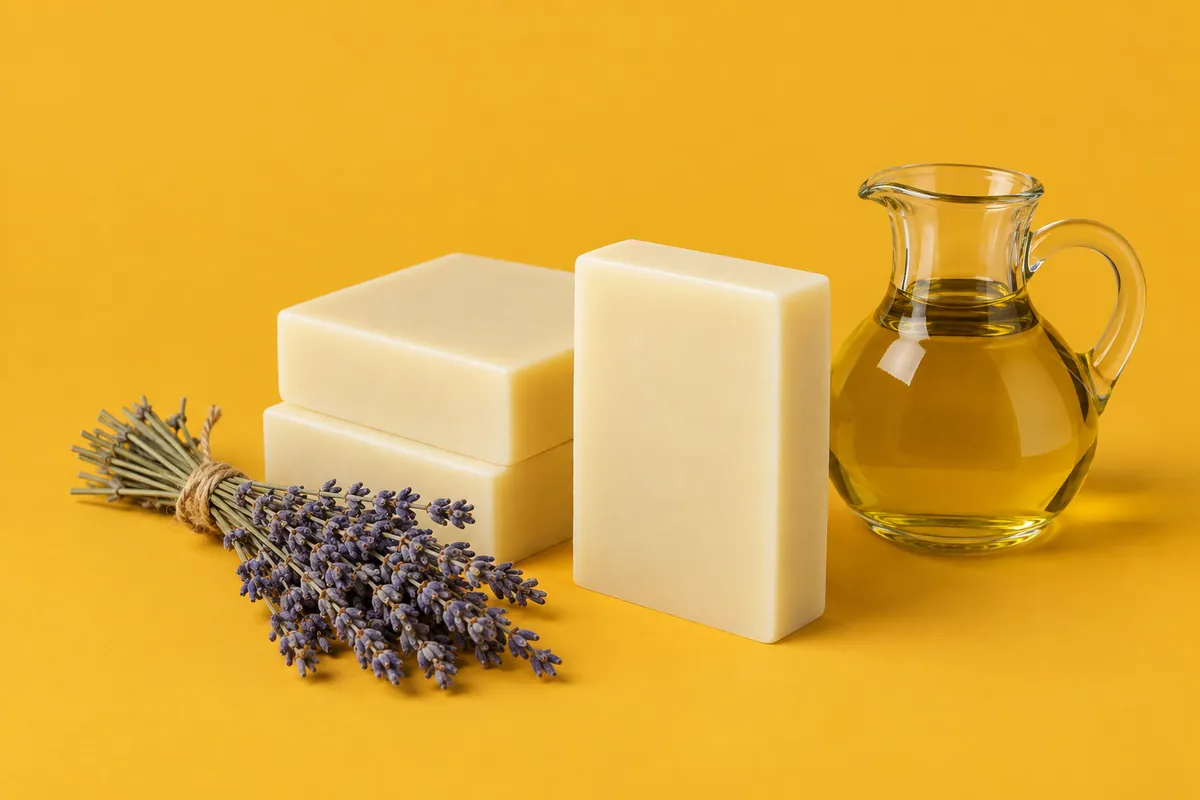
The olive, coconut and palm bar that so many soapmaking books teach first, with a little castor oil for a fuller lather and lavender essential oil. Hard, lathery and mild, it unmoulds cleanly after a day and is a good bar for learning to scent.
- Skill
- Beginner
- Method
- Cold process
- Batch
- 1000 g of oils about 1459 g of batter
- Hands-on
- 1 hour
- Cure
- 4 weeks
- Gel phase
- Yes insulate the mould
What you need
For 1000 g of oils, which fills a 1.5 litre loaf mould. Weigh everything, liquids included.
| Olive Oil · 40.0 % | 400 g | 14.11 oz |
| Palm Oil · 30.0 % | 300 g | 10.58 oz |
| Coconut Oil · 25.0 % | 250 g | 8.82 oz |
| Castor Oil · 5.0 % | 50 g | 1.76 oz |
| Sodium hydroxide (NaOH) · the lye, 100 % pure | 141.5 g | 4.99 oz |
| Distilled water · for a 33 % lye solution | 287.3 g | 10.13 oz |
| Lavender essential oil · 3.0 % of the oils, at trace | 30 g | 1.06 oz |
- Superfat
- 5 %
- Temperatures
- Oils and lye solution each between 35 and 43 °C (95 and 110 °F)
Method
-
Get ready
Put on splash goggles, nitrile gloves and long sleeves, open a window or turn on the extractor fan, and keep children and pets out of the room. Have the mould, a towel and every tool out before you open the lye. -
Melt and stir the palm oil
Melt the whole tub of palm oil and stir it well before you weigh any. It separates as it stands, and a scoop from the top is softer than one from the bottom. -
Weigh the oils and the lavender
Weigh 300 g palm oil and 250 g coconut oil into the pot, 400 g olive oil and 50 g castor oil into a jug, and 30 g lavender essential oil into a small glass or stainless steel cup. -
Make the lye solution
Weigh 287.3 g distilled water into a heat-safe jug and 141.5 g sodium hydroxide into a dry container. In a well-ventilated spot, pour the lye slowly into the water, never the water onto the lye, and stir until clear; leave it to cool, labelled and out of reach. -
Melt the hard oils
Melt the palm and coconut oils together on low heat, then pour in the olive and castor oils. -
Check the temperatures
Carry on when the oils are clear and both they and the lye solution are between 35 and 43 °C (95 and 110 °F). Any cooler and the palm starts to set, thickening the batter before it has really traced. -
Combine
Pour the lye solution into the oils down the shaft of the stick blender, tap the blender on the bottom of the pot to let trapped air out, and keep the blade submerged while it runs. -
Blend to light trace
Blend in bursts of a few seconds, stirring between them. Palm and coconut bring trace on quickly, often within two minutes: stop when a drizzle leaves a faint line on the surface. -
Stir in the lavender
Add the lavender essential oil and stir it through by hand with the spatula, then give the batter one short pulse to even it out. -
Pour and insulate
Pour into the mould, tap it on the worktop to raise air bubbles and cover it with a lid or board. Wrap it in a towel and leave it for 24 hours, so the whole loaf gels evenly and firms up sooner. -
Unmould and cut
Once the loaf has cooled and feels firm, usually after a day, unmould it with gloves on and cut it into bars about 2.5 cm (1 in) thick. -
Cure
Stand the bars on edge with air around them in a dry, airy room for four to six weeks, turning them every few days.
Tips
- Buy palm oil certified by the Roundtable on Sustainable Palm Oil (RSPO). To leave palm out, shea butter or lard can take its place, but each needs a different amount of lye: swap the oil in the calculator and weigh its figures.
- If the top starts to crack while it is wrapped, take the towel off: the loaf is running hot. Next time, soap nearer 35 °C (95 °F).
- Some of the lavender evaporates during the cure. Cure the bars in an airy room, then keep them in a closed box to hold on to the scent that is left.
The oils
| Oil | Share |
|---|---|
| Olive Oil (virgin / refined / olive oil) | 40.0 % |
| Palm Oil | 30.0 % |
| Coconut Oil | 25.0 % |
| Castor Oil | 5.0 % |
How it is made
| Process | Cold process |
| Alkali | NaOH |
| Superfat | 5 % |
| Water | lye water at 33 % |
| Iodine value | 56 |
| INS | 153 |
Why make it
This is the bar many soapmaking books teach first, and for good reason: olive oil for mildness, palm for hardness and coconut for lather, balanced at hardness 42, cleansing 17 and conditioning 55 on our scale. It traces reliably, unmoulds after a day and makes a hard, long-lasting everyday soap, which makes it a good recipe for learning to scent and to manage gel. Lavender is there for its smell, one of the best-loved in soap. The caveat is palm oil itself. Clearing forest for oil palm has cost Borneo and Sumatra large areas of wildlife habitat, yet the IUCN's review warns that switching to other oils could take more land, since palm gives far more oil per hectare. If you use it, buy RSPO-certified oil; if you would rather not, the palm-free guide shows how to replace it.
Sources
What tradition, makers' experience and research say about soaps like this, each labelled for what it is. It is not medical advice, and no soap treats a skin condition: if you have one, ask a doctor or pharmacist.
What the numbers say
- Lauric acid 12.4 %
- Myristic acid 5.1 %
- Palmitic acid 20.8 %
- Stearic acid 3.4 %
- Ricinoleic acid 4.4 %
- Oleic acid 41.7 %
- Linoleic acid 8.7 %
- Other 5.0 %
Saturated : unsaturated 45 : 55
Computed from the fatty acids of the fats above. The bands are what the craft has settled on, not chemistry — a bar outside one is not wrong.
From the guides
All guides
Scenting soap: essential oils and fragrance oils
How much essential or fragrance oil to use in soap, what ounces per pound mean in percent, the IFRA limits for common essential oils, and EU allergen labelling.
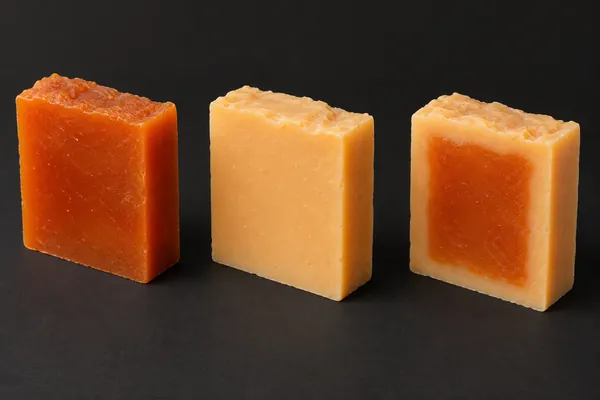
Gel phase: to insulate or keep it cool
What gel phase is, why a loaf turns dark and translucent, how gelled and ungelled bars differ, why partial gel is cosmetic, and how to cause or prevent it.
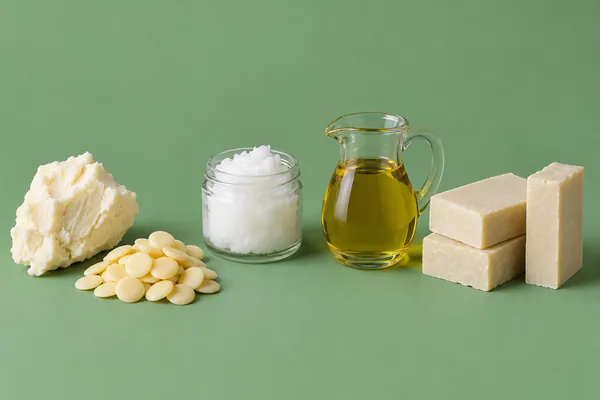
Palm-free soap: what takes palm oil's place
What palm oil does in a bar of soap, why makers drop it, and how lard, tallow, shea, cocoa, kokum or stearic acid take its place, with worked palm-free recipes.
Guides with this recipe
- Choosing the oils for your first soap
- Designing your own soap recipe: purpose, acids, oils
- Fatty acids and soap qualities: what the numbers mean
- Soda ash: why it forms and how to stop it
- The soaping oils: what each one brings to a bar
- Using a lye calculator: every number explained
- Your first cold process soap, step by step
Where these proportions come from
Adapted from the olive, palm and coconut bar that Letcavage and Harden and David Fisher both teach as their basic recipe, roughly a third of each oil with Fisher adding 5 % castor: we keep the castor and the palm at 30 %, and move 5 % from coconut to olive for a milder bar for everyday use.
Formulation adapted from The Complete Photo Guide to Soap Making by David Fisher (Creative Publishing International, 2018); Natural Soap Making by Elizabeth Letcavage and Melissa Harden (Stackpole Books, 2013). The method and notes are ours.