Goat milk and shea hot process bar
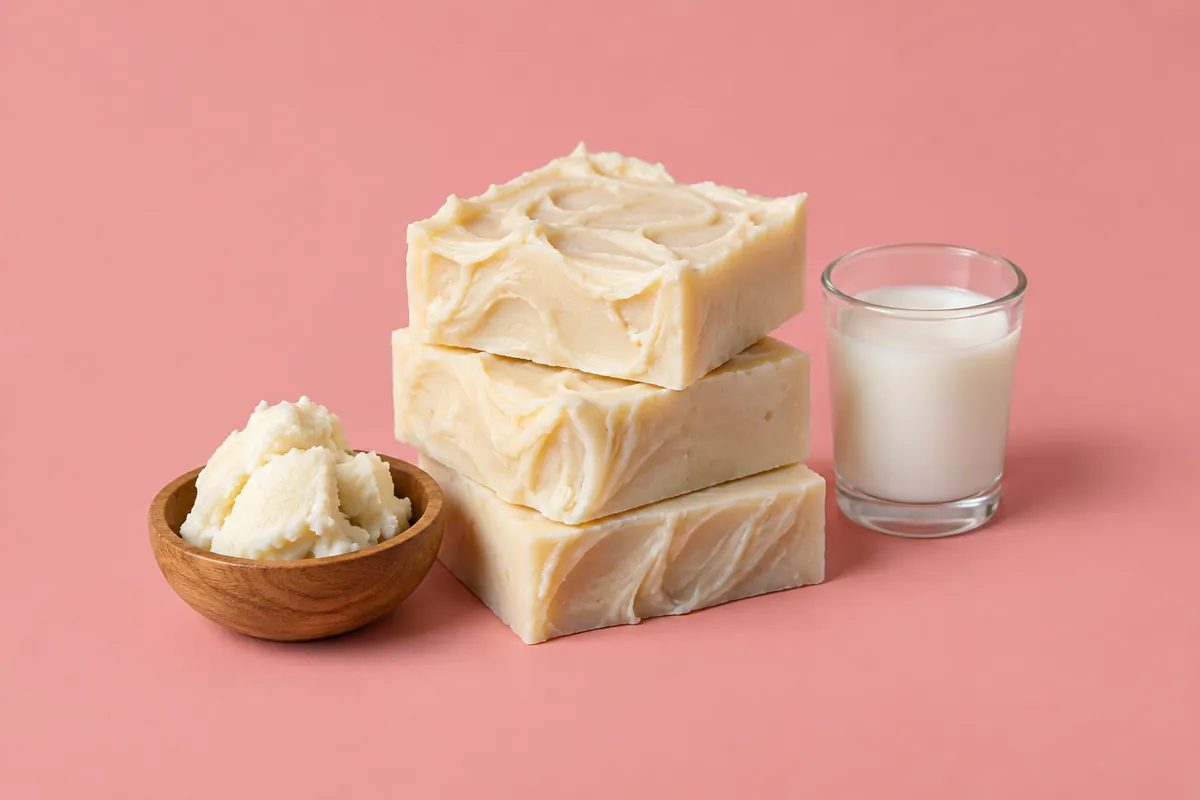
A hot process bar with a quarter shea butter, cooked in a slow cooker and then loosened with warm goat milk once the lye is spent. The milk never meets fresh lye, so the bars stay cream-coloured, and they can be cut the same day.
- Skill
- Intermediate
- Method
- Hot process
- Batch
- 1000 g of oils about 1551 g of batter
- Hands-on
- 1 h 40 min
- Cure
- 4 weeks
- Gel phase
- In the pot it gels as it cooks
What you need
For 1000 g of oils, which fills a 1.6 litre loaf mould. Weigh everything, liquids included.
| Olive Oil · 40.0 % | 400 g | 14.11 oz |
| Coconut Oil · 25.0 % | 250 g | 8.82 oz |
| Shea Butter · 25.0 % | 250 g | 8.82 oz |
| Cocoa Butter · 5.0 % | 50 g | 1.76 oz |
| Castor Oil · 5.0 % | 50 g | 1.76 oz |
| Sodium hydroxide (NaOH) · the lye, 100 % pure | 137.0 g | 4.83 oz |
| Distilled water · for a 33 % lye solution | 274.2 g | 9.67 oz |
| Goat milk · warmed to about 40 °C, stirred in after the cook | 110 g | 3.88 oz |
| Geranium essential oil · 2.0 % of the oils, after the cook | 20 g | 0.71 oz |
| Atlas cedarwood essential oil · 1.0 % of the oils, after the cook | 10 g | 0.35 oz |
- Superfat
- 6 %
- Temperatures
- Lye solution and oils below 77 °C (170 °F) when they meet, cooked on the slow cooker's low setting, scent in below 82 °C (180 °F)
Method
-
Get ready
Put on goggles, gloves and long sleeves, weigh every ingredient, keep children and pets out of the kitchen, and set the slow cooker to low so it warms up. -
Make the lye solution
Where the air moves, sprinkle the sodium hydroxide into the distilled water, never the water onto the lye, and stir until it clears. It gets very hot, so let it cool for a few minutes, until it is below 77 °C (170 °F). -
Melt the oils
Melt all the oils and butters together in the slow cooker. -
Blend to trace
Pour in the lye solution and stick blend until the batter is thick, like pudding, so it does not separate as it heats. -
Cook
Lay cling film over the pot, put the lid on and cook on low. Every 15 to 20 minutes, fold the glossy edges into the middle and stir down any foam. -
Cook until translucent
After about an hour the whole pot should look like petroleum jelly, glossy and a little stretchy, with no opaque patches left in the middle. -
Warm the milk
While the soap finishes, warm the goat milk to about 40 °C (104 °F). Cold milk makes hot soap seize around it. -
Add the milk
Turn off the heat and stir in the warm milk a little at a time until the soap is smooth, creamy and paler. -
Add the scent
Once the soap is below about 82 °C (180 °F), stir in the geranium and cedarwood essential oils quickly and thoroughly. -
Pack the mould
Spoon the soap into the mould, pressing it into the corners, bang the mould on the bench to knock out air pockets, and swoop the top with the back of a spoon. -
Unmould and cut
When it has cooled and firmed, usually within a few hours and certainly by the next morning, unmould it and cut it into bars. -
Cure
The bars are safe to use once set, but stand them on a rack with air around them for four to six weeks, so the extra water leaves and they harden and last.
Tips
- The milk goes in after the cook because by then the lye is used up, so there is no hot fresh lye to scorch its sugar. Milk cooked with the batter from the start comes out tan.
- The milk also loosens the cooked soap, doing the job that held-back water or yogurt does in other hot process recipes, so the soap fills the mould with fewer air pockets.
- If the soap climbs up the pot while it cooks, stir it down and turn the heat lower; fill the slow cooker no more than about half full.
The oils
| Oil | Share |
|---|---|
| Olive Oil (virgin / refined / olive oil) | 40.0 % |
| Coconut Oil | 25.0 % |
| Shea Butter | 25.0 % |
| Cocoa Butter (Theobroma Oil) | 5.0 % |
| Castor Oil | 5.0 % |
How it is made
| Process | Hot process |
| Alkali | NaOH |
| Superfat | 6 % |
| Water | 2.7:1 water to lye |
| Iodine value | 55 |
| INS | 149 |
Why make it
Two good reasons to make this one. A quarter shea butter gives a creamy, conditioning bar, 55 on our scale with a dense lather, and hot process lets the goat milk go in after the cook, when the lye is spent, so the bars stay cream rather than tan. Cooking soap is also the older way of making it at home, the kettle over the fire, and a cooked bar can be used as soon as it has set, though a month's cure makes it last longer (Fisher). Milk soaps have a long reputation among makers for feeling rich and less drying (Makela); the lye turns the milk's fat into soap, and there are no good trials of milk soap on skin, so that reputation rests on experience. Geranium and cedarwood are simply a scent people like.
Sources
- The Complete Photo Guide to Soap Making · Creative Publishing International, 2018
- Making Natural Milk Soap (excerpted from Milk-Based Soaps) · Storey Publishing, 1999
What tradition, makers' experience and research say about soaps like this, each labelled for what it is. It is not medical advice, and no soap treats a skin condition: if you have one, ask a doctor or pharmacist.
What the numbers say
- Lauric acid 12.3 %
- Myristic acid 4.7 %
- Palmitic acid 10.0 %
- Stearic acid 14.1 %
- Ricinoleic acid 4.4 %
- Oleic acid 43.3 %
- Linoleic acid 7.3 %
- Other 4.9 %
Saturated : unsaturated 45 : 55
Computed from the fatty acids of the fats above. The bands are what the craft has settled on, not chemistry — a bar outside one is not wrong.
From the guides
All guides
Hot process soap, step by step
Cook soap batter in a slow cooker until the lye is spent, then stir in the superfat oil, fragrance and colour. A full recipe with the calculator's numbers.
Milk soap: goat milk, freezing and keeping it pale
How to make goat milk soap without scorching it: frozen milk, lye added a spoonful at a time, a cool mould, and a full recipe worked through the calculator.

Scenting soap: essential oils and fragrance oils
How much essential or fragrance oil to use in soap, what ounces per pound mean in percent, the IFRA limits for common essential oils, and EU allergen labelling.
Guides with this recipe
Where these proportions come from
Our own olive, coconut and shea blend at 6 % superfat, cooked by Fisher's slow-cooker method with part of the water held back until after the cook. Here the held-back part is goat milk, so the milk never meets fresh lye and stays pale. The water is 2.7 times the lye, a little above his 2.5, so the cook itself still has twice the lye's weight in water.
Formulation adapted from The Complete Photo Guide to Soap Making by David Fisher (Creative Publishing International, 2018). The method and notes are ours.