Goat milk powder bar
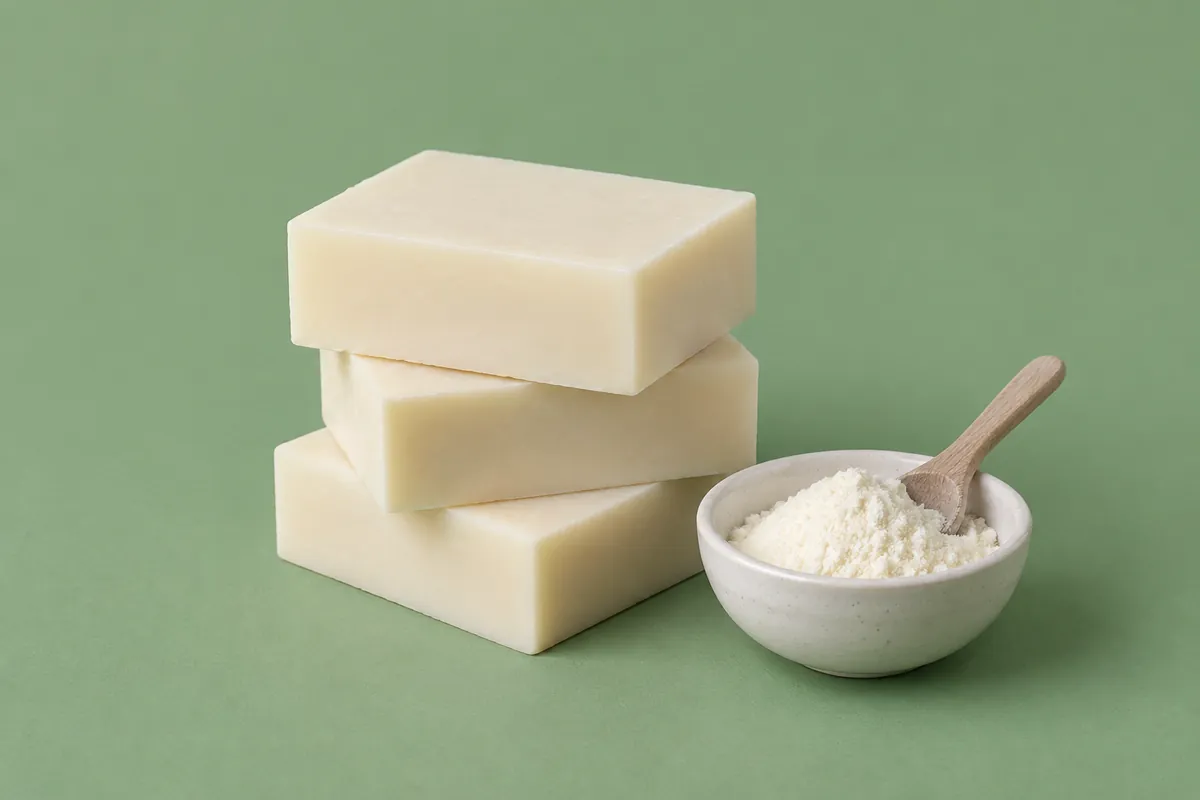
A firm tallow, olive and coconut bar with goat milk made from powder, stirred in as a paste at trace, and a clean peppermint scent. There is no freezing and no ice bath, because the lye goes into plain water.
- Skill
- Beginner
- Method
- Cold process
- Batch
- 1000 g of oils about 1458 g of batter
- Hands-on
- 45 min
- Cure
- 6 weeks
- Gel phase
- No keep it cool
What you need
For 1000 g of oils, which fills a 1.5 litre loaf mould. Weigh everything, liquids included.
| Edible Tallow · 35.0 % | 350 g | 12.35 oz |
| Olive Oil · 35.0 % | 350 g | 12.35 oz |
| Coconut Oil · 25.0 % | 250 g | 8.82 oz |
| Castor Oil · 5.0 % | 50 g | 1.76 oz |
| Sodium hydroxide (NaOH) · the lye, 100 % pure | 141.0 g | 4.97 oz |
| Distilled water · 246 g for a 36 % lye solution, 40 g set aside | 285.8 g | 10.08 oz |
| Goat milk powder · a little over 2 tbsp, whisked to a paste with 40 g of the recipe's water | 16 g | 0.56 oz |
| Peppermint essential oil · 1.5 % of the oils, at trace | 15 g | 0.53 oz |
- Superfat
- 5 %
- Temperatures
- Lye solution and oils at about 35 °C (95 °F)
Method
-
Get ready
Put on goggles, gloves and long sleeves, weigh the oils, lye, milk powder and peppermint oil, line the mould and clear a shelf in the fridge. -
Divide the water
Weigh 40 g of the distilled water into a small bowl for the milk, and the rest into a heat-safe jug for the lye. -
Make the lye solution
Where the air moves, sprinkle the sodium hydroxide into the water in the jug, never the water onto the lye, stir until it clears, and let it cool to about 35 °C (95 °F). -
Make the milk paste
Whisk the goat milk powder into the 40 g of water a spoonful at a time until it is smooth, like condensed milk, and leave it to stand. -
Melt the oils
Melt the tallow and coconut oil gently, stir in the olive and castor oils, and let them cool to about 35 °C (95 °F). -
Blend to light trace
Pour the lye solution into the oils through a sieve and stick blend in short bursts, stirring between them, until the batter looks like thin custard. -
Add the milk and peppermint
Stir the milk paste once more, pour it in with the peppermint essential oil, and stick blend for a few seconds until evenly mixed. -
Pour
Pour into the mould, tap it on the bench to release air and smooth the top. -
Keep it cool
Put the mould uncovered in the fridge for 24 hours. The milk is still milk, sugar and all, and browns if the loaf heats into gel. -
Unmould and cut
Let the loaf come back to room temperature, then unmould and cut it once firm, usually 24 to 48 hours after pouring. Tallow makes a hard bar that cuts cleanly. -
Cure
Stand the bars on a rack with air around them for six weeks, turning them now and then.
Tips
- Add the powder to the water a spoonful at a time and whisk each one in. Tipped in all at once it forms lumps that turn into specks in the bars.
- This is roughly half-strength milk, 16 g of powder for the recipe's 286 g of water. Fisher allows up to full-strength milk, but a lot of powder softens the bar, so start here.
- Opened milk powder goes stale within a couple of months, so use a fresh pack.
The oils
| Oil | Share |
|---|---|
| Edible Tallow (beef/mutton dripping) | 35.0 % |
| Olive Oil (virgin / refined / olive oil) | 35.0 % |
| Coconut Oil | 25.0 % |
| Castor Oil | 5.0 % |
How it is made
| Process | Cold process |
| Alkali | NaOH |
| Superfat | 5 % |
| Water | lye water at 33 % |
| Iodine value | 52 |
| INS | 156 |
Why make it
A firm, long-lasting milk soap for anyone who would rather not freeze milk. Tallow, the fat the soap trade built its curd and milled soaps on (Simmons and Appleton), gives a hard bar with a creamy, steady lather, 44 for hardness and 30 for creaminess on our scale, and olive and coconut round it out. The goat milk comes from powder stirred in at trace, so the lye goes into plain water and there is no ice bath. Makers choose milk soaps for a richer feel and value them for dry skin (Makela), a reputation that rests on experience rather than trials, and at roughly half-strength milk this bar carries less of it than a full milk soap. The peppermint is a clean scent; leave it out for fragrance-sensitive skin.
Sources
- The Handbook of Soap Manufacture · Scott, Greenwood & Son, 1908
- Making Natural Milk Soap (excerpted from Milk-Based Soaps) · Storey Publishing, 1999
What tradition, makers' experience and research say about soaps like this, each labelled for what it is. It is not medical advice, and no soap treats a skin condition: if you have one, ask a doctor or pharmacist.
What the numbers say
- Lauric acid 12.3 %
- Myristic acid 6.1 %
- Palmitic acid 15.9 %
- Stearic acid 9.7 %
- Ricinoleic acid 4.4 %
- Oleic acid 39.4 %
- Linoleic acid 6.2 %
- Other 6.0 %
Saturated : unsaturated 48 : 52
Computed from the fatty acids of the fats above. The bands are what the craft has settled on, not chemistry — a bar outside one is not wrong.
From the guides
All guides
Milk soap: goat milk, freezing and keeping it pale
How to make goat milk soap without scorching it: frozen milk, lye added a spoonful at a time, a cool mould, and a full recipe worked through the calculator.
Lard and tallow: soaping with animal fats
Why lard and tallow make hard, mild, creamy soap, how to render and store them at home, how beef, mutton and pork fat differ, and classic recipes.

Scenting soap: essential oils and fragrance oils
How much essential or fragrance oil to use in soap, what ounces per pound mean in percent, the IFRA limits for common essential oils, and EU allergen labelling.
Where these proportions come from
Our own tallow, olive and coconut bar with the goat milk bought as powder. The powder is handled the way Fisher describes, mixed to a slurry with water held back from the lye and stirred in at trace, here at about 2 tablespoons per cup of the recipe's water, roughly half-strength milk.
Formulation adapted from The Complete Photo Guide to Soap Making by David Fisher (Creative Publishing International, 2018). The method and notes are ours.