Natural colour sampler cubes
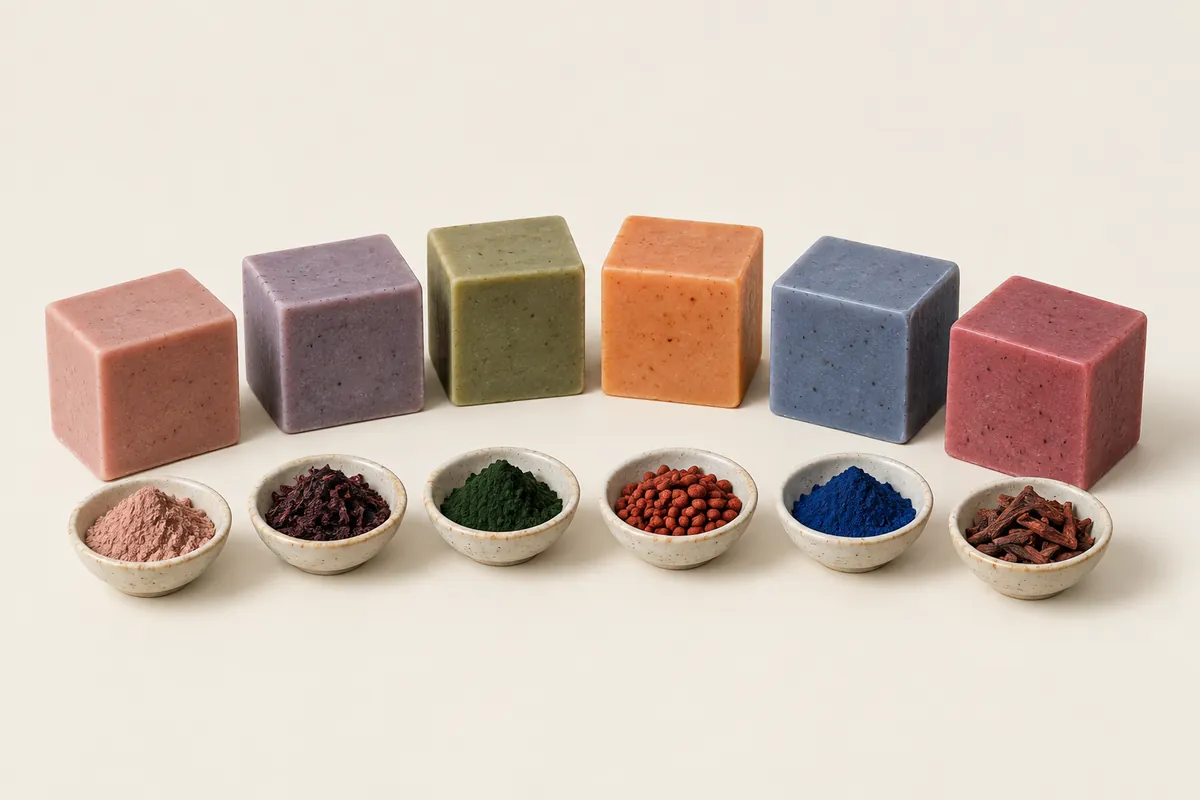
One palm-free batch split six ways and poured into cube moulds: rose clay, alkanet, spirulina, annatto, indigo and madder, two cubes of each. A way to see what natural colours really do in soap, side by side, and how well each one lasts.
- Skill
- Intermediate
- Method
- Cold process
- Batch
- 1000 g of oils about 1463 g of batter
- Hands-on
- 2 hours
- Cure
- 5 weeks
- Gel phase
- Yes insulate the mould
What you need
For 1000 g of oils, which fills silicone cube moulds holding about 1.5 litres in all: twelve cavities of about 125 ml. Weigh everything, liquids included.
| Olive Oil · 35.0 % | 350 g | 12.35 oz |
| Coconut Oil · 25.0 % | 250 g | 8.82 oz |
| Rice Bran Oil · 15.0 % | 150 g | 5.29 oz |
| Shea Butter · 15.0 % | 150 g | 5.29 oz |
| Avocado Oil · 5.0 % | 50 g | 1.76 oz |
| Castor Oil · 5.0 % | 50 g | 1.76 oz |
| Sodium hydroxide (NaOH) · the lye, 100 % pure | 138.7 g | 4.89 oz |
| Distilled water · 261 g for a 35 % lye solution, 15 g set aside | 276.3 g | 9.75 oz |
| Sodium lactate (60 % solution) · 2 tsp, stirred into the lye solution once it has cooled a little; helps the cubes let go of the silicone | 13.1 g | 0.46 oz |
| Annatto seed · 1.5 tsp, infused ahead in 40 g of extra olive oil and strained; 12 g of that oil colours the orange cubes as part of the recipe's olive oil | 3.1 g | 0.11 oz |
| Spirulina powder · 1 tsp, green cubes, dispersed in 12 g of the recipe's olive oil | 2.3 g | 0.08 oz |
| Alkanet root powder · purple cubes, about ¾ tsp dispersed in 12 g of the recipe's olive oil | 1.5 g | 0.05 oz |
| Indigo powder · 0.25 tsp, blue cubes, dispersed in 12 g of the recipe's olive oil | 0.4 g | 0.01 oz |
| Madder root powder · 1 tsp, red cubes, dispersed in 12 g of the recipe's olive oil | 2.1 g | 0.07 oz |
| Rose clay · 1 tsp, pink cubes, stirred into 15 g of the recipe's water | 3.2 g | 0.11 oz |
| Olive oil for the annatto infusion · extra to the recipe's; 12 g of the strained oil colours the orange cubes as part of the recipe's olive oil | 40 g | 1.41 oz |
| Isopropyl alcohol, 91 % or stronger, in a spray bottle · a light mist over the filled cavities against soda ash, well away from any flame | 30 ml | |
| Rosemary oil · 2.0 % of the oils, at trace | 20 g | 0.71 oz |
| Peppermint oil · 0.5 % of the oils, at trace | 5 g | 0.18 oz |
- Superfat
- 5 %
- Temperatures
- Oils and lye solution at 38 to 43 °C (100 to 110 °F), then a heating pad to push the cubes into gel
Method
-
Infuse the annatto ahead
A day or more before, put 1½ teaspoons of annatto seed and 40 g of olive oil, extra to the recipe's, in a jar and stand it in a pan of hot water on the lowest heat for about 4 hours. Keep the oil near 49 °C (120 °F) and below 54 °C (130 °F), checking with a thermometer, never over a direct flame or unattended, then strain it through fine cloth. -
Get ready
Put on goggles, gloves and long sleeves and open a window. Set the moulds on a board or tray you can lift without bending them, and set out six jugs and six small cups, each labelled with its colour. -
Fill the colour cups
Weigh 338 g of olive oil instead of 350 g, because 12 g of the annatto oil stands in for the rest; put that 12 g in the orange cup. Take 60 g from the 338 g and put 12 g in each of the other five cups. -
Stir in the colours
Stir 1 teaspoon of spirulina into the green cup, 1.5 g (about ¾ teaspoon) of alkanet root powder into the purple, ¼ teaspoon of indigo into the blue and 1 teaspoon of madder root into the red, until a smear on a white plate shows no grains. The pink cup stays plain oil. -
Mix the rose clay
Weigh the 276.3 g of water and take 15 g of it into a small cup. Stir the rose clay into it until smooth and set it by the pink cup; an hour ahead is better, so the clay wets right through. -
Make the lye solution
Where the air moves, pour the 138.7 g of sodium hydroxide slowly into the remaining 261.3 g of water, never the reverse, and stir until clear. When it has cooled a little, stir in the sodium lactate and leave it labelled and out of reach to cool to 38 to 43 °C (100 to 110 °F). -
Melt and scent the oils
Melt the coconut oil and shea butter gently, add the rest of the olive oil and the rice bran, avocado and castor oils, and let them cool to 38 to 43 °C (100 to 110 °F). Stir in the rosemary and peppermint oils. -
Blend to thin trace
Pour the lye solution in down the blender shaft, tap out trapped air, and blend in short pulses only until the batter is smooth and a drizzle stays visible on the surface for a few seconds. -
Split six ways
Weigh 227 g of batter into each jug, the last taking what is left, and whisk each colour cup into its jug until even. Do the pink last, its plain oil first and then the rose clay, because clay thickens batter. -
Fill the cavities
Pour each colour into two cavities, filling them to within about 3 mm of the top, and tap the board to bring up air. Scoop any leftover into a small tub. -
Push it into gel
Mist the tops lightly with isopropyl alcohol against soda ash, away from any flame, cover the moulds with a board and a towel, and lift them onto a heating pad on medium for 30 minutes, checking after 15 for cracked or bulging tops. Then switch it off and leave them wrapped on the pad overnight: cavities this small stay out of gel without the heat, and madder, alkanet and indigo need it. -
Unmould
After 2 to 3 days, press the cubes out from underneath with gloves on. If they cling, freeze the moulds for 2 to 4 hours and try again. -
Cure and compare
Stand the cubes with air around them for 5 weeks, turning them now and then. Keep one cube of each colour in a closed box and the other in daylight, and compare the two sets at the end.
Tips
- What to expect: rose clay stays a dusty pink; madder comes out rose red because it gelled; alkanet looks blue-grey at first and settles towards purple; spirulina starts bright and turns olive within a week or two; annatto stays a warm orange; indigo gives a soft denim blue. Faiola finds natural greens fade first, reds and oranges more slowly.
- Write each colourant and its dose on a slip of paper under its cubes. Plant colours vary from one lot to the next, and your notes are what let you repeat the shade you liked.
- Faiola deepens the green with comfrey leaf. We leave it out because comfrey contains pyrrolizidine alkaloids, which are mutagenic. If you sell soap, your safety assessor should also hear about the madder and the indigo; the natural colourants guide explains why.
- A dose of 1.5 g is hard to hit on a kitchen scale. A small scale that reads to 0.01 g costs little and makes every small colour dose repeatable.
The oils
| Oil | Share |
|---|---|
| Olive Oil (virgin / refined / olive oil) | 35.0 % |
| Coconut Oil | 25.0 % |
| Rice Bran Oil | 15.0 % |
| Shea Butter | 15.0 % |
| Avocado Oil | 5.0 % |
| Castor Oil | 5.0 % |
How it is made
| Process | Cold process |
| Alkali | NaOH |
| Superfat | 5 % |
| Water | lye water at 33 % |
| Iodine value | 63 |
| INS | 141 |
Why make it
This batch is a notebook in soap. Six natural colourants go into one base, so you can see side by side what each really does, how it shifts in the first weeks, and how fast it fades in daylight next to a twin kept in the dark. Several behave like pH indicators: alkanet's pigment turns blue in strong alkali (Malik et al.) and madder needs a gel to go red, so what you see in the jar is a poor guide. The base is a mild palm-free everyday bar, cleansing 17 and conditioning 59 on our scale, so every cube is a usable soap. Makers choose natural colour for its muted, earthy shades, not for anything it does to skin. If you plan to sell naturally coloured soap, go through each colourant with your safety assessor: madder carries a toxicology warning (Inoue et al.) and indigo has its own European safety opinion.
Sources
- Natural plant-derived compounds in food and cosmetics: a paradigm of shikonin and its derivatives · Malik S. et al., Materials 16, 2023
- Carcinogenic potential of alizarin and rubiadin, components of madder color, in a rat medium-term multi-organ bioassay · Inoue K. et al., Cancer Science 100, 2009
- Opinion on Indigofera tinctoria (SCCS/1615/20) · Scientific Committee on Consumer Safety, European Commission, 2020
What tradition, makers' experience and research say about soaps like this, each labelled for what it is. It is not medical advice, and no soap treats a skin condition: if you have one, ask a doctor or pharmacist.
What the numbers say
- Lauric acid 12.3 %
- Myristic acid 4.8 %
- Palmitic acid 11.2 %
- Stearic acid 8.6 %
- Ricinoleic acid 4.4 %
- Oleic acid 42.9 %
- Linoleic acid 11.3 %
- Other 5.3 %
Saturated : unsaturated 40 : 60
Computed from the fatty acids of the fats above. The bands are what the craft has settled on, not chemistry — a bar outside one is not wrong.
From the guides
All guides
Natural colourants: what herbs, clays and spices really do in soap
Clays, charcoal and plant colours in cold-process soap: doses per 500 g of oils, infused oil, powder or lye, and the colour each one actually turns.
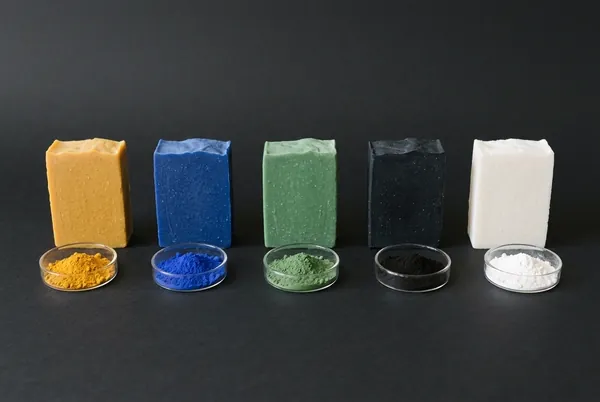
Colouring soap: micas, oxides, ultramarines and pigments
Which colourants survive cold-process soap, how much to use per 500 g of oils, how to disperse and split colour, and what the EU, UK and US rules ask.
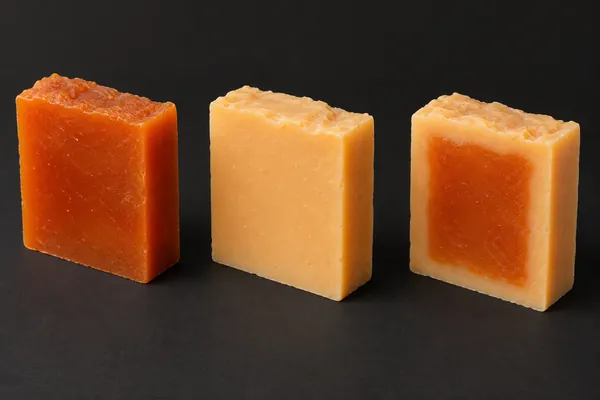
Gel phase: to insulate or keep it cool
What gel phase is, why a loaf turns dark and translucent, how gelled and ungelled bars differ, why partial gel is cosmetic, and how to cause or prevent it.
Where these proportions come from
Adapted from Anne-Marie Faiola's multicoloured cubes: one batch split into colours, poured one colour to a cavity and pushed into gel on a heating pad. We replace her palm oil and avocado butter with shea butter and avocado oil, widen her three colours to six, each near or below the 2 teaspoons per pound of soap of her colour chart, leave out her comfrey, and scent at 2.5 % of the oils rather than her 3.8 %.
Formulation adapted from Pure Soapmaking by Anne-Marie Faiola (Storey Publishing, 2016). The method and notes are ours.