Tomato and charcoal swirl bar
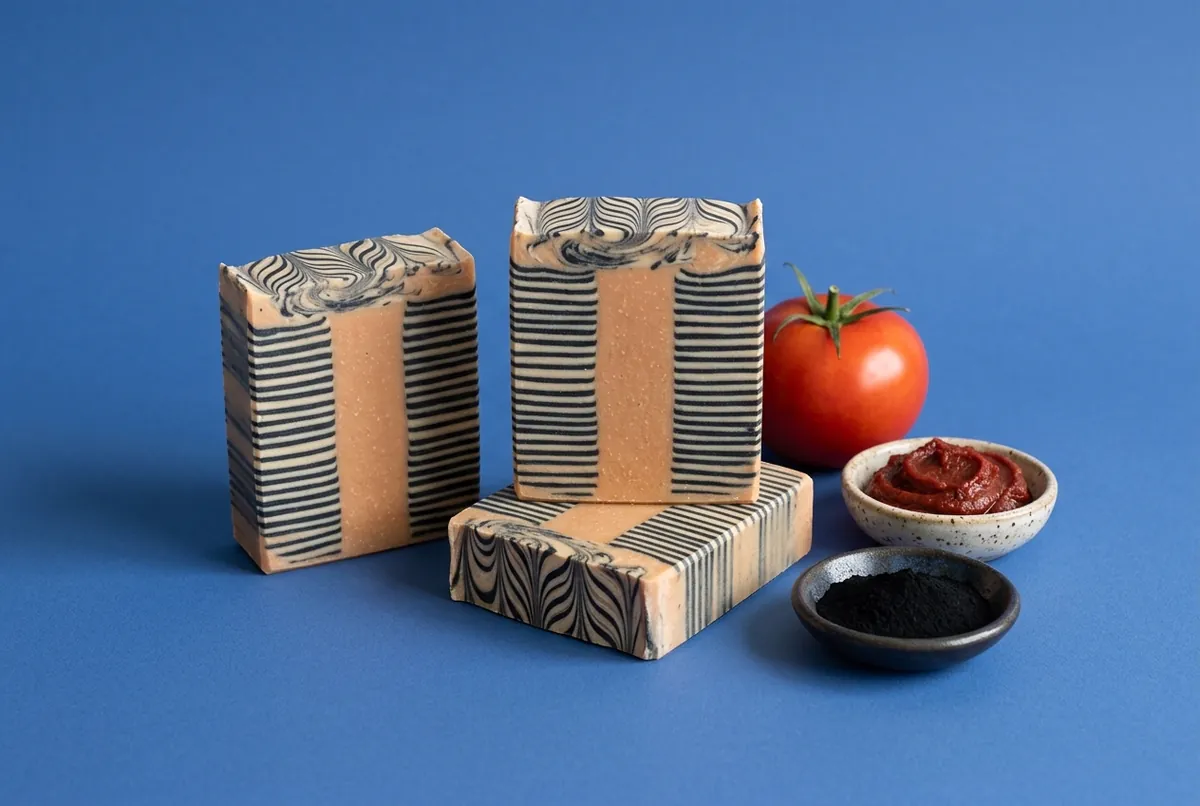
Black and cream stripes squeezed along the mould between two peach layers coloured with tomato paste, then dragged into a U-swirl across the top. A firm, palm-free bar with a clean peppermint and tea tree scent.
- Skill
- Intermediate
- Method
- Cold process
- Batch
- 900 g of oils about 1365 g of batter
- Hands-on
- 1 h 40 min
- Cure
- 6 weeks
- Gel phase
- No keep it cool
What you need
For 900 g of oils, which fills a 25 × 9 cm loaf mould filled 6 cm deep (about 1.4 litres). Weigh everything, liquids included.
| Coconut Oil · 30.0 % | 270 g | 9.52 oz |
| Olive-Pomace Oil · 30.0 % | 270 g | 9.52 oz |
| Rapeseed Oil - Low Erucic Acid · 25.0 % | 225 g | 7.94 oz |
| Mango Butter · 10.0 % | 90 g | 3.17 oz |
| Hazelnut Oil · 5.0 % | 45 g | 1.59 oz |
| Sodium hydroxide (NaOH) · the lye, 100 % pure | 127.7 g | 4.50 oz |
| Distilled water · for a 32 % lye solution | 268.6 g | 9.47 oz |
| Activated charcoal · 0.75 tsp, black portion only, dispersed in 10 g of the recipe's canola oil | 1.7 g | 0.06 oz |
| Tomato paste · tomato portion only; plain double-concentrated paste with no added herbs or garlic. About 29 g of it is water, counted in the recipe water, and its fruit acid uses a little lye, which the calculator adds | 40 g | 1.41 oz |
| Isopropyl alcohol (91 % or stronger), in a fine spray bottle · misted lightly over the top against soda ash; it evaporates. Flammable: keep it away from flames | 1 tbsp | |
| Peppermint oil · 1.5 % of the oils, at trace | 13.5 g | 0.48 oz |
| Tea tree oil · 1.5 % of the oils, at trace | 13.5 g | 0.48 oz |
- Superfat
- 5 %
- Temperatures
- Oils and lye solution at 35 to 40 °C (95 to 104 °F), warm enough to keep the mango butter melted
Method
-
Get ready
Put on goggles, gloves and long sleeves and open a window. Set the mould level, and set out three jugs labelled black, cream and tomato, two squeeze bottles of about 500 ml with their tips cut to about 5 mm, a spatula and a chopstick. -
Set out the jug oils
Weigh the 225 g of canola oil and take 30 g of it: 10 g into each jug. Stir the charcoal into the black jug's oil until smooth, and spoon the 40 g of tomato paste into the tomato jug beside its oil. -
Make the lye solution
Where the air moves, pour the 127.7 g of sodium hydroxide slowly into the 268.6 g of water, never the reverse, and stir until clear. The tomato paste brings about 29 g more water later, which the recipe counts in its 30 % solution; leave it labelled and out of reach to cool to 35 to 40 °C (95 to 104 °F). -
Melt and scent the oils
Melt the coconut oil and mango butter gently, add the olive pomace and hazelnut oils and the rest of the canola, and let them cool to 35 to 40 °C (95 to 104 °F). Stir in the peppermint and tea tree oils. -
Blend to thin trace
Pour the lye solution in down the blender shaft, tap out trapped air, and blend in short pulses only until the batter is smooth and a drizzle stays visible on the surface for a few seconds. -
Colour the jugs
Weigh 431 g of batter into each jug, the last taking what is left. Whisk the cream and the black until even, and give the tomato jug a few pulses with the blender until no streaks of paste remain. -
Fill the squeeze bottles
Pour the black and the cream batter into the two squeeze bottles and cap them. -
Squeeze the first stripes
Squeeze lines of black and cream side by side along the length of the mould, alternating the colours, until the bottom is covered about 1.5 cm deep. Tap the mould gently to settle them. -
Pour a tomato layer
Pour half the tomato batter slowly onto the back of a spatula held just above the stripes, moving along the mould so it spreads without breaking through. -
Repeat the stripes and tomato
Squeeze a second layer of black and cream lines about 1.5 cm deep, then pour the rest of the tomato over the spatula the same way. -
Finish with lines
Squeeze the remaining black and cream in alternating lines along the top until both bottles are empty. -
Swirl the top
Push the chopstick about 6 mm into one corner and, working down the length of the mould, drag it from side to side across the width in narrow U shapes, crossing the lines. -
Keep it cool
Leave the mould uncovered for 30 minutes, mist the top lightly with isopropyl alcohol against soda ash, away from any flame, then cover it and chill it overnight in a fridge kept apart from food. The paste's sugar adds heat, and a loaf that gels only in the middle shows a darker core through the cream stripes. -
Unmould and cut
Let the loaf come back to room temperature and unmould it with gloves on after 2 to 3 days, once firm. Lay it on one long side and cut bars about 2.5 cm (1 in) thick, wiping the knife between cuts. -
Cure in the dark
Stand the bars on edge with air between them for 6 weeks, turning them every few days, out of direct light.
Tips
- Expect peach to soft orange, not tomato red, and a colour that mellows towards tan over the months, faster in light. Faiola finds tomato's orange fades more slowly than natural greens, but it does fade.
- Buy plain tomato paste, sold in Britain as tomato purée in tubes or small tins, with no herbs, garlic or sugar added. Passata is too wet, and ketchup brings vinegar, sugar and spice.
- Charcoal smears across the cut faces at first. Leave the bars for about two days, then scrape a very thin layer off each face with the back of a knife and the lines come up crisp.
- Hazelnut is a tree nut, so name it on the label and keep the bar from anyone with a nut allergy, or replace it with more canola oil and run the recipe through the calculator again.
The oils
| Oil | Share |
|---|---|
| Coconut Oil | 30.0 % |
| Olive-Pomace Oil (refined / blended) | 30.0 % |
| Rapeseed Oil - Low Erucic Acid (Canola Oil) | 25.0 % |
| Mango Butter | 10.0 % |
| Hazelnut Oil | 5.0 % |
How it is made
| Process | Cold process |
| Alkali | NaOH |
| Superfat | 5 % |
| Water | lye water at 30 % |
| Iodine value | 65 |
| INS | 144 |
Why make it
A firm, palm-free everyday bar, cleansing 20 and conditioning 59 on our scale, made mostly for its looks: black and cream stripes between two peach layers, swirled across the top. The peach comes from tomato paste, a kitchen colour that fades towards tan over the months, though more slowly than plant greens, as Anne-Marie Faiola found. A tomato on the label appeals, but in soap it is colour rather than nourishment: whatever the paste carries is spread thin through the bar and rinsed away. The charcoal is simply the black. Peppermint and tea tree give a cool, clean scent. Hazelnut oil makes it a bar to label for nut allergies.
Sources
- Anne-Marie Faiola, Pure Soapmaking · Storey Publishing, 2016
What tradition, makers' experience and research say about soaps like this, each labelled for what it is. It is not medical advice, and no soap treats a skin condition: if you have one, ask a doctor or pharmacist.
What the numbers say
- Lauric acid 14.7 %
- Myristic acid 5.7 %
- Palmitic acid 8.9 %
- Stearic acid 6.5 %
- Oleic acid 46.3 %
- Linoleic acid 10.7 %
- α-Linolenic acid 2.4 %
- Other 6.7 %
Saturated : unsaturated 40 : 60
Computed from the fatty acids of the fats above. The bands are what the craft has settled on, not chemistry — a bar outside one is not wrong.
From the guides
All guides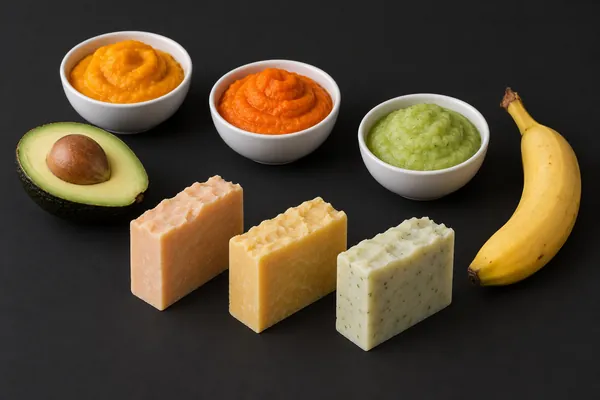
Fruit and vegetable purées in soap
How much pumpkin, carrot, cucumber, avocado or banana to put in soap, when to add it, why purées overheat and spoil, what each really adds, and a recipe.
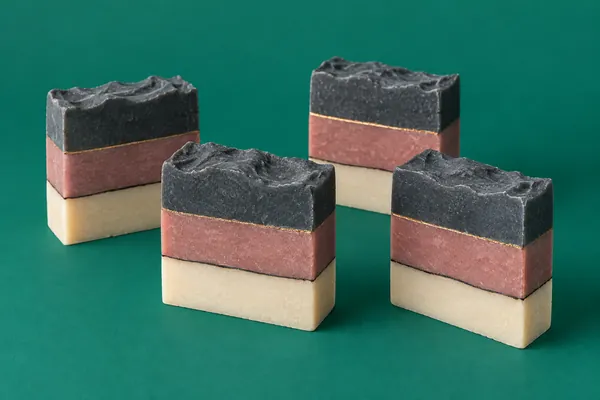
Layers, mica lines and pencil lines
Layered cold-process soap: batter thickness, pouring over a spatula, working out each layer from the mould, and pencil lines that don't split the bar.
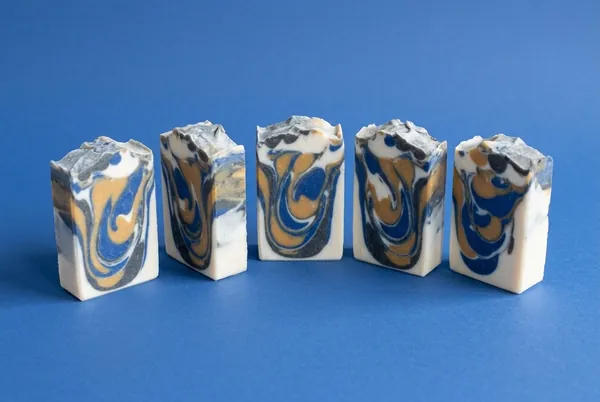
Swirl techniques: in the pot, drop, hanger, spoon and Taiwan
Seven cold-process swirls step by step, with the batter, recipe and temperatures that keep soap fluid, and why swirls turn muddy or lumpy.
Where these proportions come from
Adapted from Anne-Marie Faiola's layered tomato swirl bars: her palm-free oils, her tomato-paste layers between squeezed black and cream stripes, and her U-swirl. It is written at a 30 % lye solution with the water in the tomato paste counted as part of it, and the paste's fruit acid counted against the lye, and we cut her peppermint and tea tree from 4.3 % of the oils to 3 %.
Formulation adapted from Pure Soapmaking by Anne-Marie Faiola (Storey Publishing, 2016). The method and notes are ours.