In short
- Used frying oil is one or more of about a dozen oils and fats, and may carry fat from the food. Their published saponification values run from 180 to 203 mg KOH/g, so 1000 g of it takes anywhere from 128.3 to 144.7 g of sodium hydroxide to saponify completely.
- Enter it in the calculator as sunflower oil at a 10 % superfat: 122.5 g of sodium hydroxide per kilogram. Even at the bottom of the range that leaves 4.5 % of the oil unsaponified, where the usual 5 % would make a lye-heavy bar.
- Strain it, let it settle and weigh it in grams. Cleaning takes out crumbs and water, not the frying: in one study, washing with salt water more than halved the peroxide value but hardly moved the polar compounds.
- Three published fixed recipes run from about zero superfat to about 60 % more lye than the oil can use. Soap with that much spare lye still cleans, and it is harsh on skin.
- Make it for the laundry and the house. You cannot know what the oil took up from the food, and soap from fried oil carries its oxidation products with it.
On this page
Oil that has fried a few batches of chips is still fat, and lye still turns it into soap. Brazil’s health agency asks that used oil stay out of the public sewer, and soap is one way to use it up. The difficulty is that used oil comes without a label. You seldom know which oil it was, what frying did to it or what it took up from the food, and the lye depends on the first of those. This guide shows how far that uncertainty moves the lye, the superfat we use to cover it and why, how to clean the oil and what cleaning can and cannot do, a household bar with the calculator’s figures, and what some published fixed recipes put in the pot.
What used cooking oil is
Oils used for frying around the world include sunflower and high-oleic sunflower oil, soybean, rapeseed (canola), maize, groundnut, cottonseed and rice bran oil, olive oil, and palm oil, whose liquid fraction, palm olein, is particularly favoured for frying, as Abrante-Pascual and colleagues set out in their 2024 review. Spain’s national research council has tested olive-pomace oil as a frying oil beside sunflower oils (Holgado et al., 2021). Spain’s rules for frying allow edible fats as well as oils, so the jar can also hold an animal fat such as lard.
A jar filled over several fryings can hold more than one oil, and fryers get topped up with fresh oil between uses, a practice both Italy’s health ministry and Brazil’s health agency advise against. The food adds to the mix: frying moves fat both ways, and fatty foods such as salmon lose some of theirs into the oil (Abrante-Pascual et al.). So a jar of used oil seldom comes with a name, and the one number soapmaking needs from it, the saponification value, depends on the name.
What frying does to oil
Frying holds oil at 150 to 190 °C in air while water boils out of the food into it. Three kinds of change follow. Oxygen attacks the unsaturated fatty acid chains; damaged molecules join into pairs and longer chains, which thicken the oil; and steam splits some of the fat into free fatty acids and mono- and diglycerides (Abrante-Pascual et al.). Brazil’s health agency describes the same three reactions in household frying, and Italy’s health ministry lists what they look like: the oil darkens, thickens, foams more readily and smokes at a lower temperature. Volatile compounds, most of them aldehydes, give old oil its smell.
Food rules measure the damage as total polar compounds. The method passes the oil through a column of silica gel: the unchanged triglycerides wash through, and everything held back is counted as polar, from free fatty acids and partial glycerides to the products of heating, as Spain’s 1989 order for heated oils describes it. Fresh sunflower oil starts at about 4 % (Holgado et al.). That Spanish order requires oil used to fry food for the public to stay below 25 %, Italy’s health ministry passed on the same limit from the Istituto Superiore di Sanità in 1991, and most countries that regulate frying oil set theirs between 24 and 27 %. Brazil’s health agency, in its 2004 guidance, set no figure and went by the signs instead: foam and smoke during frying, a much darker oil and food, and an unfamiliar smell and taste.
How fast oil gets there depends on the oil and the frying. In a study at Spain’s national research council, chips fried at 175 °C in one-litre fryers took sunflower oil from about 4 % to 25 % polar compounds in nine fryings, and high-oleic sunflower oil in 17 or 18 (Holgado et al.). At 25 %, most of the polar share is still triglyceride of a kind: dimers and larger polymers make up 12 to 15 % of the oil and oxidised triglycerides 7 to 10 %, while the products of hydrolysis are a small part (Abrante-Pascual et al.). The acid value, which counts the free fatty acids, rises all the same. Refined oil is sold at 0.6 mg KOH/g or less (Codex); a sunflower oil collected after repeated frying for a Romanian study measured 3.82 mg KOH/g, at 38.5 % polar compounds (Glevitzky et al., 2026).
What that means for soap
The lye hardly changes. A free fatty acid takes the same lye it would have taken inside the fat, one hydroxide for one molecule of soap, and the saponification value counts free acids along with bound ones: ISO 3657 calls it a measure of “the free and esterified acids”. An acid value of 3.8 mg KOH/g is a small part of the 190 or so that the whole oil takes.
The oxidation comes with it. A research group in Brno made soap from oils before and after heating them. Soap from the heated oil held more malondialdehyde, a marker of oxidised fat: 2.33 µg/g against 1.94 for olive oil, and 4.10 against 3.43 for a rapeseed and palm blend (Antonić et al., 2020). In the group’s second study, with oils that fried chips until they reached 24 % polar material, the sunflower oil soaps held the most, up to 6.61 µg/g (Antonic et al., 2021). Frying also breaks down the oil’s own antioxidants, tocopherols among them (Abrante-Pascual et al.), and old, oxidised oil is a strong suspect when a bar spots and smells rancid, as the orange spots guide explains.
Otherwise it is much like any soap. In the second Brno study, soaps from oils fried up to 24 % polar material read pH 9.48 to 10.16 in a 1 % solution, held next to no free alkali and could not be clearly told apart from soaps of the same oils unheated. In the first, the soaps from heated oil smelled no different from the others. The Romanian soaps, made from their oil after cleaning, read pH 9.64 to 9.98 in a 10 % solution. A cured bar of any true soap reads about pH 9 to 10, as the soap pH guide explains.
How much lye: a range, not a number
The calculator’s saponification values, like the standards they come from, describe fresh oil, not oil that has been fried in. What can be pinned down is the value of each oil a used oil might have started as:
| Oil | Saponification value, mg KOH/g |
|---|---|
| Rice bran oil | 180–199 |
| Canola (low-erucic rapeseed) oil | 182–193 |
| Olive-pomace oil | 182–193 |
| High-oleic sunflower oil | 182–194 |
| Olive oil | 184–196 |
| Maize (corn) oil | 187–195 |
| Groundnut (peanut) oil | 187–196 |
| Sunflower oil | 188–194 |
| Soybean oil | 189–195 |
| Cottonseed oil | 189–198 |
| Lard | 192–203 |
| Palm olein | 194–202 |
| All of these | 180–203 |
| Mustard seed oil | 168–184 |
| High-erucic rapeseed oil | 168–181 |
From the Codex standards for named vegetable oils (CXS 210), olive oils (CXS 33) and animal fats (CXS 211), as the calculator uses them. The saponification chart has every other oil.
A mixed oil’s value lies inside the span of the oils in it, weighted by how much of each it holds. When you cannot say what went in, the honest answer is the whole span: 180 to 203 mg KOH/g. Two oils reach below it and are left out of it: mustard oil, and high-erucic rapeseed oil, which cannot be sold as food in the EU or UK, where vegetable oil for food may hold no more than 2 % erucic acid.
For 1000 g of oil, the span means this much sodium hydroxide:
| If the oil’s saponification value is | NaOH to saponify 1000 g completely | Superfat you get with 129.4 g (sunflower oil at 5 %) | Superfat you get with 122.5 g (sunflower oil at 10 %) |
|---|---|---|---|
| 180, the bottom of the span | 128.3 g | −0.8 % | 4.5 % |
| 182 | 129.7 g | 0.3 % | 5.5 % |
| 191, sunflower oil’s figure, at the middle of the span | 136.2 g | 5.0 % | 10.0 % |
| 203, the top of the span | 144.7 g | 10.6 % | 15.3 % |
| 168, mustard or high-erucic rapeseed oil at its lowest | 119.8 g | −8.0 % | −2.3 % |
From the calculator’s lye formula, NaOH = oil × SAP × 39.997 ÷ 56.106 ÷ 1000 × (1 − superfat ÷ 100), which the formula page sets out.
That is about ±6 % around sunflower oil’s figure, twice the ±3 % of a typical single oil, and an error in the saponification value lands directly on the superfat, as the SAP values guide explains. Weigh the lye for sunflower oil at the usual 5 % and an oil at the bottom of the span ends up lye-heavy.
Why we use 10 %
We calculate used oil as sunflower oil. The calculator’s figure for it, 191, sits in the middle of the span, which is 191.5, so it errs neither way. The question is then which superfat keeps even an oil at the bottom of the span clear of free lye.
The lye formula answers it. The lye you weigh at a superfat of s is exactly enough to saponify, completely, an oil whose value is 191 × (1 − s ÷ 100). An oil with a higher value is left with some superfat; an oil with a lower one is left with free lye. To keep that break-even value below 180, the superfat has to be at least 5.8 %. At 10 % it is 171.9, well below, and an oil at 180 keeps 4.5 % of itself unsaponified. Even in that worst case the bar keeps the margin of an everyday bar, with room left for the scale and for any water and crumbs that cleaning missed, which are weighed as oil and take no lye.
Why not more? Every extra point is oil left in the bar when the oil sits high in the span. At 10 %, an oil at 203 ends up at 15.3 %, soft but still a bar. At 15 % it would reach 20.0 %, the level above which the calculator warns of a soft bar, weak lather and a higher chance of rancidity.
A 10 % superfat is more free oil than a laundry bar made from known oils carries, which is 0 to 1 % (see the laundry soap guide). It is the price of not knowing the oil: a bar with oil to spare rather than lye to spare.
Make the used oil bar. 1000 g of cleaned used oil, entered as sunflower oil at a 10 % superfat, asks 122.5 g of sodium hydroxide and, at a 33 % lye solution, 248.8 g of water.
Open it in the calculatorWhat the range panel cannot know
Open that recipe and the calculator’s How well is this pinned down? panel puts the real superfat between 8.6 and 11.4 %. That band comes from sunflower oil’s own range, 188 to 194; the calculator has no way of knowing that your oil may be something else. For used oil, go by the span above.
If it may be mustard oil. Enter it as mustard seed oil and keep the 10 %: 112.9 g of sodium hydroxide per kilogram, which leaves 5.7 % at the bottom of mustard oil’s range.
Weigh it. A litre of frying oil weighs about 920 g: Codex puts sunflower and soybean oil at 0.918 to 0.925 times the density of water at 20 °C. The calculator works in grams. Measured out for a litre instead of a kilogram, the 122.5 g above would turn the 10 % into 2.2 % at sunflower oil’s figure, and into −3.8 % at the bottom of the span. A litre, weighed, takes 112.7 g.
Cleaning the oil
Used oil carries crumbs, batter and burnt bits, some water from the food, and whatever frying has made of the oil itself. The first two can be got out at home; the last cannot. The crumbs and water matter for the lye too: weighed with the oil, they take none of it, so weigh the oil once it is clean.
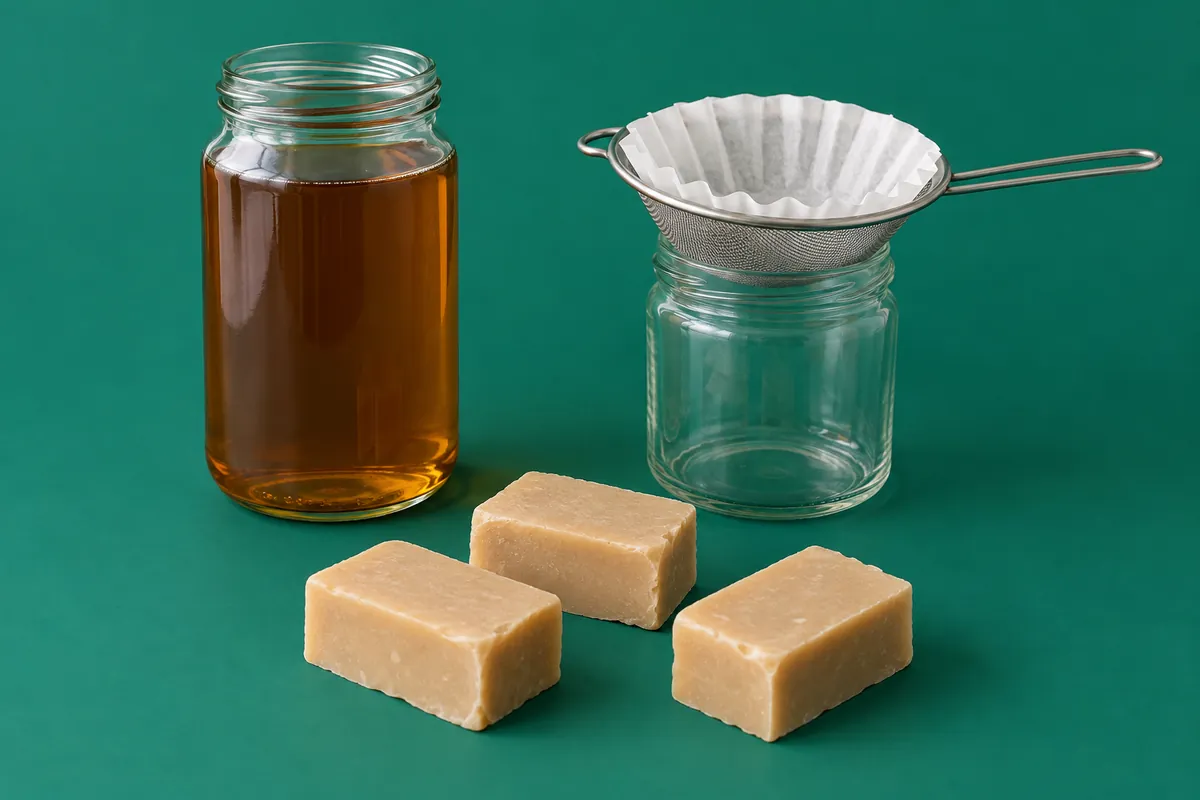
- Strain it once it is cool. Pour it through a fine sieve, then through cloth or a paper coffee filter, which takes out the crumbs, batter and burnt bits. The second Brno study and the Romanian one filtered their oil before making soap, and the Brazilian and Spanish recipes below strain it.
- Let it settle. Stand the strained oil in a tall jar with the lid on until it is clear. Oil is lighter than water, so water and fine sediment sink to the bottom, the same layering the lard and tallow guide shows when fat is rendered in water. Pour or ladle the clear oil off the top and leave the last layer behind.
- Wash it, if you like. Stir in an equal volume of warm water with 100 g of salt to the litre for about a quarter of an hour, let the layers separate, and take the oil off the top. Do it twice. This is the treatment Glevitzky and colleagues tested: a 10 % salt solution, equal volumes, 15 minutes at 60 °C.
- Let it clear, then weigh it. Take only clear oil, and weigh it in grams for the calculator.
The washing is optional because of what it does and does not do. In the Romanian study the two washes more than halved the peroxide value, a measure of the first products of oxidation, from 42.8 to 19.7 meq/kg. They moved the polar compounds only from 38.5 to 37.1 %, and the acid value from 3.82 to 3.76 mg KOH/g. Washing takes out what dissolves in water and some of the early oxidation products; it leaves nearly all of what frying made. The researchers finished by warming the washed oil to 90 °C to drive off the last of the water. We leave that step out and let the oil stand until it is clear instead. The little water that stays in is weighed as oil and takes no lye, and the 10 % superfat leaves room for it.
A household bar from used oil
| Bar | Oils | Superfat | Sodium hydroxide | Water |
|---|---|---|---|---|
| Used oil bar | 1000 g cleaned used oil, entered as sunflower oil | 10 % | 122.5 g | 248.8 g |
| Used oil and coconut bar | 800 g cleaned used oil, 200 g coconut oil | 10 % | 130.9 g | 265.9 g |
From the calculator: 1000 g of oils and a 33 % lye solution in each case.
The used oil bar is the oil on its own. Entered as sunflower oil it scores 11 for hardness and 0 for cleansing, softer on the calculator’s scale than castile, which scores 17 (see the fatty acids guide). Those figures describe fresh sunflower oil. A used oil with lard or palm olein in it makes a firmer bar: either on its own scores over 40 for hardness.
The used oil and coconut bar swaps a fifth of the used oil for fresh coconut oil, the proportion the Romanian group used, for a harder bar with more lather: hardness 25, cleansing 14. Worked across the frying-oil span and coconut oil’s own range, its 10 % superfat runs from 5.1 to 14.7 %.
Add coconut oil. 800 g of used oil, entered as sunflower oil, and 200 g of coconut oil at a 10 % superfat ask 130.9 g of sodium hydroxide and, at a 33 % lye solution, 265.9 g of water.
Open it in the calculatorMake either bar as you would any cold process soap; the first soap guide has the method step by step. Warm the cleaned oil just enough to melt any solid fat in it, mix the lye solution as the lye safety guide describes, and stick blend to trace. Then cure the bars: four to six weeks for most cold process soap, and longer for a soft one. Castile, harder than the plain used oil bar on the calculator’s scale, takes months. The curing guide shows how to tell by weighing a bar every few days: once its weight has all but stopped falling, it is as dry as your room will make it.
Published recipes with fixed amounts
Recipes for used-oil soap are often written in litres of oil and kilograms of caustic soda, with no calculation shown. Here are three, from a public research agency, a chemistry teaching journal and a town’s services company, worked through the calculator’s formula:
| Recipe | Oil | Sodium hydroxide | Enough for the oil | Superfat | Across the oil’s range |
|---|---|---|---|---|---|
| Embrapa Pantanal leaflet, liquid soap (Brazil, 2016) | 6 litres, about 5.5 kg | 990 g (1 kg at 99 %) | 751.6 g | −31.7 % | −39.8 to −23.9 % (180–203) |
| Química Nova na Escola, classroom bar (Brazil, 2021) | 1 litre, about 920 g | 200 g | 125.3 g | −59.7 % | −69.4 to −50.2 % (180–203) |
| Rivamadrid leaflet, bar (Spain, 2021) | 2 litres of olive oil, about 1.82 kg | 246 g | 246.9 g | 0.4 % | −2.9 to 3.4 % (184–196) |
“Enough for the oil” is the sodium hydroxide that saponifies it completely, at sunflower oil’s 191 for the seed oils and olive oil’s 190 for the olive oil. A litre of seed oil is taken as 920 g and a litre of olive oil as about 911 g, from the Codex densities.
The Brazilian recipes carry far more lye than their oil can use. Embrapa Pantanal, part of Brazil’s state agricultural research corporation, printed its recipe for a public workshop: 1 kg of 99 % caustic soda for 6 litres of strained used oil, with 5 litres of alcohol and 33 litres of water, bottled as 45 litres of liquid soap for cleaning the house. About 240 g of that sodium hydroxide has no oil to react with and stays in the soap as free alkali. Even if the oil were all lard, at the top of the span, it would be about 190 g.
The classroom bar comes from an article in Química Nova na Escola, the Brazilian Chemical Society’s journal on chemistry teaching: 200 g of caustic soda and 400 mL of water for a litre of used, filtered oil. The authors work out the excess themselves, as an exercise in finding the reagent in excess: 76.67 g of sodium hydroxide more than the oil uses. Our figure is 74.7 g, near 5 % of a fresh batch of about 1.5 kg. The East African standard for laundry soap allows 0.2 % free caustic alkali.
The Spanish recipe is the opposite case. Rivas-Vaciamadrid’s municipal services company prints 246 g of caustic soda for 2 litres of used olive oil. That comes out at about zero superfat, the setting of a laundry bar, and a little lye-heavy if the oil sits low in olive oil’s range (−2.9 % at 184) or was not olive oil at all (−5.2 % at 180).
Spare lye stays in the soap as free alkali. Soap like that still cleans, and for floors, tools and pans scrubbed with gloves on, that may be all it needs to do; on skin it is harsh. Keep it labelled, use it with gloves and keep it out of children’s reach. A calculated recipe with a margin makes the same cleaning soap without the spare lye.
The alcohol in Embrapa’s recipe changes none of this arithmetic, because it takes no lye. It dissolves oil and lye together, which is why the laboratory test for a saponification value is done in alcohol (see the SAP values guide), and in a bucket it helps them meet. It also makes the recipe a fire risk.
What the soap is for
Used-oil soap is a cleaning soap: for the laundry, rubbed into collars and cuffs as a stain bar or grated into the powder in the laundry soap guide, and for the house, on a brush for floors, tools and pans. We don’t make it for washing hands, face or body, for three reasons.
- You cannot know what is in it. Frying moves fat and other substances between the food and the oil, and a jar of used oil holds whatever was fried in it (Abrante-Pascual et al.).
- It carries the oil’s oxidation. The Brno group found more malondialdehyde, a marker of oxidised fat, in soap from heated oil than in soap from the same oil fresh (Antonić et al., 2020).
- It cannot be assessed. In the EU and UK a soap for skin is a cosmetic, and its safety report starts from the composition, characteristics and purity of every ingredient (Regulation 1223/2009, Annex I). A jar of used oil has none of them on record. The safety assessment guide explains the process.
For a lean laundry bar, one with no free oil to leave in the wash, use known oils: our laundry bar is tallow and coconut oil at 0 %.
Safety and testing
Test the cured bar as the soap pH guide describes, with phenolphthalein or a pH meter, and never on your tongue. A used-oil soap made to a calculated recipe should read like any other: the Brno soaps measured pH 9.48 to 10.16 in a 1 % solution, and the Romanian ones 9.64 to 9.98 in a 10 % one. A 1 % solution that reads 12 or more has free alkali in it.
Recipes to try
All recipesSources
- Standard for Named Vegetable Oils (CXS 210-1999) . Codex Alimentarius Commission (FAO/WHO) . Saponification values of sunflower (188–194), high-oleic sunflower (182–194), soya bean (189–195), low-erucic rapeseed (182–193), maize (187–195), arachis (187–196), cottonseed (189–198), palm olein (194–202), rice bran (180–199), mustardseed (168–184), rapeseed (168–181) and coconut oil (248–265); relative density at 20 °C of sunflower oil 0.918–0.923 and soya bean oil 0.919–0.925; acid value of refined oils at most 0.6 mg KOH/g.
- Standard for Olive Oils and Olive Pomace Oils (CXS 33-1981) . Codex Alimentarius Commission (FAO/WHO) , 2015. Saponification value 184–196 for olive oils and 182–193 for olive-pomace oils; relative density 0.910–0.916 at 20 °C.
- Standard for Named Animal Fats (CXS 211-1999), 2015 print . Codex Alimentarius Commission (FAO/WHO) , 2015. Lard: saponification value 192–203 mg KOH/g.
- ISO 3657:2023 Animal and vegetable fats and oils: Determination of saponification value . International Organization for Standardization , 2023. The saponification value is a measure of the free and esterified acids.
- Vegetable oils and their use for frying: a review of their compositional differences and degradation . Abrante-Pascual S. et al., Foods 13(24):4186 , 2024. Oils used for frying worldwide, palm olein particularly favoured; frying at 150–190 °C with oxygen and water from the food; thermoxidation, polymerisation and, to a lesser extent, hydrolysis; darker, thicker, foaming oil; tocopherols degraded; food lipids pass into the oil, fatty fish losing fat to it; at 25 % polar compounds, dimers and oligomers 12–15 % and oxidised triglycerides 7–10 % of the oil, hydrolysis products of little quantitative significance; aldehydes the main volatiles.
- Performance of olive-pomace oils in discontinuous and continuous frying. Comparative behavior with sunflower oils and high-oleic sunflower oils . Holgado F. et al. (CSIC), Foods 10(12):3081 , 2021. Chips fried at 175 °C in one-litre fryers: sunflower oils rose from 4.0–4.1 % to 25 % polar compounds at the 9th frying, high-oleic sunflower oils at the 17th–18th; most countries that regulate frying oil set 24–27 % polar compounds.
- Orden de 26 de enero de 1989 por la que se aprueba la Norma de Calidad para los Aceites y Grasas Calentados (BOE-A-1989-2265) . Boletín Oficial del Estado, Spain , 1989. Article 5: edible oils and edible fats for frying baths; article 6.3: polar components below 25 % in oil used to fry food for the public; annex: polar compounds, including mono- and diglycerides, free fatty acids and products formed by heating, separated from unaltered triglycerides on a silica column.
- Circolare 11 gennaio 1991, n. 1: Oli e grassi impiegati per friggere alimenti . Ministero della Sanità, Italy , 1991. Frying oil darkens, thickens, foams more and smokes at a lower temperature; the Istituto Superiore di Sanità recommends at most 25 g/100 g of polar compounds; used oil not to be topped up with fresh oil.
- Informe Técnico nº 11, de 5 de outubro de 2004: utilização e descarte de óleos e gorduras utilizados para fritura . Agência Nacional de Vigilância Sanitária (Anvisa), Brazil , 2004. Oxidation, hydrolysis and polymerisation in household frying; discard at foam and smoke, marked darkening of oil and food, and an uncharacteristic smell and taste; do not top up with new oil; used oil not to go into the public sewer. Proposed limits of 25 % polar compounds and 0.9 % free fatty acids were not adopted.
- Physicochemical characterization of home-made soap from waste-used frying oils . Antonić B. et al., Processes 8(10):1219 , 2020. Olive oil and a rapeseed and palm blend heated three times to 200 °C; malondialdehyde in the soaps rose from 1.94 to 2.33 µg/g (olive) and from 3.43 to 4.10 µg/g (rapeseed and palm); no noticeable difference in odour.
- Reused plant fried oil: a case study with home-made soaps . Antonic B. et al., Processes 9(3):529 , 2021. Rapeseed, sunflower and palm oils frying chips at about 175 °C, sampled up to 24 % total polar material and filtered; soaps pH 9.48–10.16 in 1 % solution, total alkali 0.00–0.03 %, not clearly distinguishable from soaps of unheated oil; malondialdehyde highest in the sunflower oil soaps, up to 6.61 µg/g.
- Resource recovery from waste cooking oil through cold-process saponification for sustainable solid soap production . Glevitzky M. et al., Sustainability 18(18):9558 , 2026. Sunflower oil collected after repeated frying and filtered: 38.5 % polar compounds, acid value 3.82 mg KOH/g, peroxide value 42.8 meq/kg. Two washes with 10 % salt solution (equal volumes, 15 min, 60 °C), then 90 °C: 37.1 %, 3.76 and 19.7. Soaps of 80 % purified oil and 20 % coconut oil, pH 9.64–9.98 in 10 % solution.
- Oficina para fabricação de sabão líquido caseiro . Agostinho Carlos Catella and Fábio Galvani, Embrapa Pantanal , 2016. Leaflet for a public workshop: 6 litres of used cooking oil strained through a sieve, 1 kg of 99 % caustic soda, 5 litres of 92.8 % or fuel alcohol and 33 litres of water, bottled as 45 litres of liquid soap for household cleaning; the oil and alcohol are poured into the soda solution.
- Uma visão multi e interdisciplinar a partir da prática de saponificação . Borges R. et al., Química Nova na Escola 43(3):305–314 , 2021. Classroom soap from 1000 mL of used, filtered oil, 200 g of NaOH and 400 mL of water; the article's own stoichiometry puts the excess at 76.67 g of NaOH.
- ¿Cómo hacer tu propio jabón casero? . Rivamadrid, Empresa Municipal de Servicios de Rivas-Vaciamadrid , 2021. 2 litres of used olive oil strained through a sieve, cloth or coffee filter, 2 litres of water and 246 g of caustic soda.
- EAS 31:2011 Laundry soap: Specification . East African Community , 2011. Free caustic alkali at most 0.2 % as NaOH, for both grades of laundry soap.
- Commission Regulation (EU) 2019/1870 on maximum levels of erucic acid . legislation.gov.uk (retained in UK law) , 2019. No more than 20 g/kg erucic acid in vegetable oils sold as food.
- Regulation (EC) No 1223/2009 on cosmetic products: Article 2 and Annex I . legislation.gov.uk . A product applied to the body mainly to clean it is a cosmetic; the safety report's Part A covers the composition of the product and the characteristics and purity of its substances and mixtures.
- NIOSH Pocket Guide to Chemical Hazards: Ethyl alcohol . US National Institute for Occupational Safety and Health . Flash point 55 °F (13 °C).