In short
- Melt-and-pour base is finished soap with glycerin, sorbitol and solvents added so it melts. The lye was used up before you bought it.
- Melt it in short bursts and keep it below about 71 °C (160 °F). Hotter, it boils, scorches and turns leathery.
- Scent it at 1 to 3 % of the finished soap and never above your fragrance's IFRA limit for category 9. Colour it with micas, oxides and pigments.
- A mist of rubbing alcohol pops surface bubbles and helps layers stick. It is flammable, so keep it away from flames.
- The glycerin pulls water from the air, which is why bars sweat. Wrap them in cling film as soon as they are hard.
On this page
Melt and pour is the quickest way to a bar of soap you made yourself. You buy a block of base, melt it, add colour and scent, and pour it into a mould; an hour later you can unmould it and use it. The base is real soap, made from oils and lye by its manufacturer, so there is no lye to weigh and nothing to cure. The skill lies in the temperature, in a little arithmetic, and in knowing what a base will and will not carry.
What is in the base
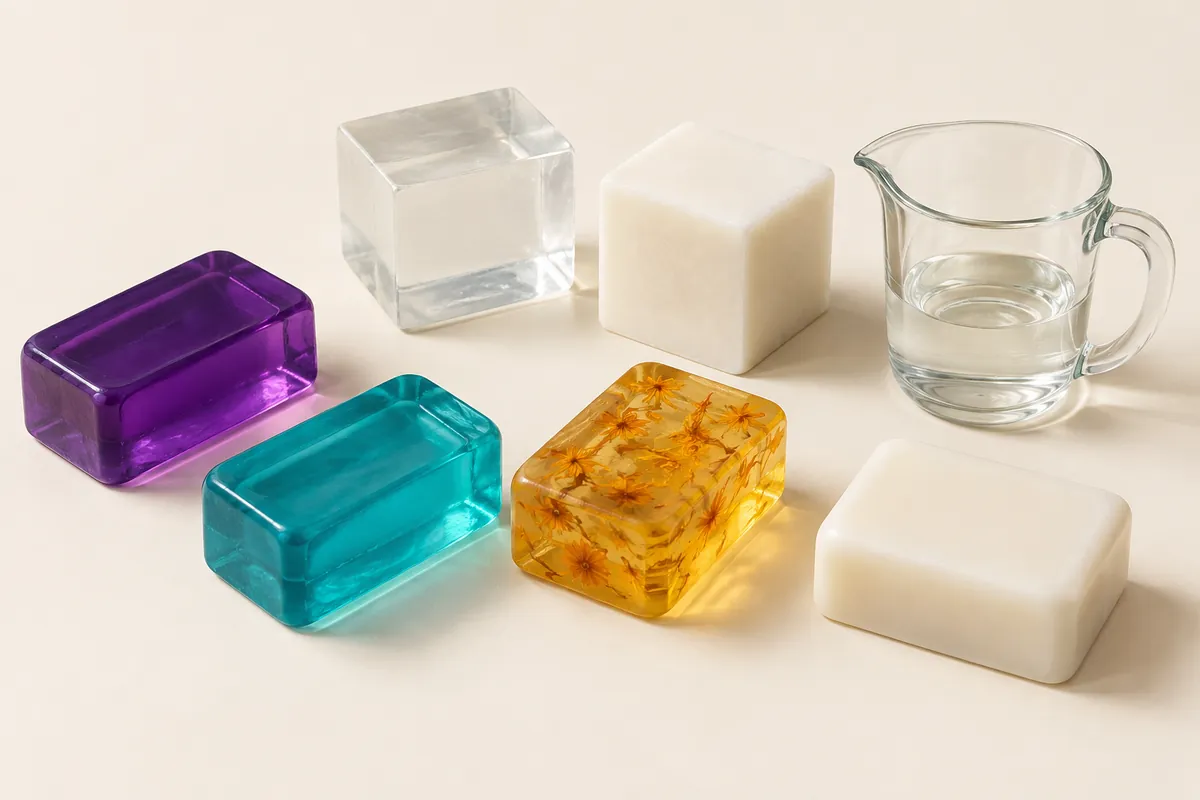
A melt-and-pour base starts as ordinary soap: oils saponified with sodium hydroxide. Its label shows this in one of two ways, either as what went into the pot (water, coconut oil, sodium hydroxide) or as the soaps those became (sodium laurate, sodium stearate). What makes it different is what the maker adds afterwards so that it melts cleanly and sets glossy:
- Glycerin and sorbitol, which make a clear base clear.
- Propylene glycol, a solvent that helps it melt.
- Often sodium laureth sulfate or sodium lauryl sulfate, synthetic detergents that boost the lather.
- Titanium dioxide in white bases, for opacity.
On that foundation, suppliers sell a family of bases.
| Base | What it is | Use it for |
|---|---|---|
| Clear | Transparent; glycerin and sorbitol keep it clear | Deep colours, embeds, botanicals you want to see |
| White | Titanium dioxide added | Pastel colours and opaque bars |
| Goat milk, shea, aloe and others | The ingredient is already in the formula | The easy way to get a luxury ingredient into the bar |
| Suspension | Thicker | Holding exfoliants and botanicals evenly |
| Low-sweat | Less glycerin | Humid rooms, and embeds in cold process soap |
| Detergent-free | No synthetic surfactants | Makers who want soap and nothing else |
The common kinds of base, after Fisher (2018). Your own base’s data sheet gives its melting point and how much fragrance it takes.
Because the saponification is already done, a melt-and-pour bar is ready as soon as it has set, with no cure.
Melting without scorching
Cut the base into small, even cubes so it melts evenly. Melt it in one of two ways:
- In the microwave, in a heatproof jug, in bursts of 30 to 45 seconds, stirring between each one. This is the method most makers use.
- Over a pan of barely simmering water, in a heatproof jug or bowl. It is slower, and easy to watch.
Do not put the base in a pan directly on the hob: the bottom scorches before the top melts.
Most bases start to melt at about 49 to 54 °C (120 to 130 °F) and pour best between 54 and 60 °C (130 and 140 °F). Above about 71 °C (160 °F) they start to boil and burn, and a scorched base goes thick, gloppy and leathery. Every remelt also drives off some of the base’s water, so base that has been reheated too many times turns stiff in the jug, and old, overheated or often remelted base can discolour, turn sticky or smell (Grosso). Cover the jug with cling film (plastic wrap) between heatings.
A probe thermometer is worth having. An infrared thermometer reads only the surface, which is the part that cools first.
Melted base is hot enough to scald, and it clings to skin like hot wax. Pour carefully, and keep children back from the jug while it is hot, even though there is no lye in it.
How much base to melt
Filling a mould by guesswork leaves you short or with a jug of leftovers, and fragrance worked out on the wrong total ends up stronger or weaker than you meant. The melt-and-pour calculator does these sums. You tell it:
- What the mould holds. Fill it with water and weigh the water: a gram of water is a millilitre. For a mould with several cavities, measure them all together. The calculator turns millilitres into grams with the density of the base, 1.06 g/mL unless you change it. Most glycerin bases weigh 1.03 to 1.10 g per millilitre, and weighing one cavity filled with your own base replaces the guess. Grosso’s rough rule is that 2 cups (473 ml) of water in the mould means about a pound of soap; at the calculator’s density it is 501 g.
- Or the bars you want, as a number of bars and a weight for each.
- What goes in, each as a percentage of the finished soap: fragrance, oil or butter, dry additions such as clay or exfoliant, and colour.
- Extra for the jug, 5 % unless you change it, for what clings to the jug and the spoon.
It counts the fragrance as a share of the finished soap, because that is how IFRA states its limits and how your fragrance supplier’s certificate reads. It shows the same fragrance as a share of the base too, since many recipes count it that way. And it warns when fragrance or added oil goes above 3 % of the soap, or dry additions above 5 %. Those are the working limits most makers use rather than measured thresholds, but past them bases tend to sweat, soften or lose their lather.
Six bars of 100 g. With 2 % fragrance and 5 % extra for the jug, the calculator says to melt 617.4 g of base and weigh out 12 g of fragrance.
Open the calculatorThe basic pour
- Cut and weigh the base. Cut small, even cubes and weigh out what the calculator gives you.
- Melt it slowly. Heat in short bursts, stirring between them, until only a few small pieces are left; they melt as you stir. Do not let it boil.
- Stir in the colour. Stir gently, so you do not beat in air.
- Add the fragrance. When the base has cooled to about 55 °C (130 °F), stir it in. The base may turn cloudy for a moment; keep stirring for 20 to 30 seconds and it clears.
- Pour. If the base has thickened in the jug, warm it for a few seconds first.
- Mist the surface. A light spray of rubbing alcohol pops the bubbles that rise to the top.
- Let it set, then unmould. Most bars are hard in about an hour. If a block still feels warm when it comes out, let it finish cooling whole: cut it early and the liquid centre runs out, leaving a hollow bar (Grosso).
- Wrap it. Wrap each bar in cling film as soon as it is hard (see sweating, below).
The fridge sets the soap faster, but a bar that comes out cold collects condensation like a glass of iced water, so let bars set at room temperature when you can.
Scent
Melt and pour takes 1 to 3 % fragrance by weight of the finished soap. Three per cent, about 14 g for a 454 g (1 lb) batch, is a common place to start; strong scents need less, and your base’s data sheet may give a maximum of its own. The fragrance sets a ceiling too. Its IFRA certificate states the most it may be used at in category 9, the category for rinse-off soap, and you stay under that figure even when it is below 3 %.
Use fragrance oils sold for soap, with a certificate that covers category 9, or essential oils within their limits. Fragrances with vanilla in them turn the soap brown over time, even in melt and pour. The fragrance and allergen check works out your load against the certificate, and the scenting guide covers choosing and blending.
Colour
Melt and pour takes the same colourants as other soaps. Micas, oxides, ultramarines and pigments give colour that stays where you put it; oxides and clays mix in without specks if you stir them into a little glycerin first. Water-soluble dyes give the clear, stained-glass look, but they migrate: in layers or embeds, the colour bleeds into its neighbours over time, and most food colourings fade in light (Grosso).
A clear base shows colour as deep, glassy tones, and a white base turns the same colour pastel. Colourants that change colour in the strongly alkaline batter of cold process usually hold in melt and pour, because the base is finished soap with no free lye left in it. The colouring guide has the rates.
Bubbles, layers and the alcohol spray
A light mist of rubbing alcohol (isopropyl alcohol) on freshly poured soap pops the bubbles on the surface. The same mist helps layers stick. To pour a second layer, wait until the first has a firm skin but is still warm, mist it with alcohol, and pour the next layer at about 52 to 57 °C (125 to 135 °F). Hotter than that and it melts into the layer below. Pour before the skin has formed, or skip the alcohol, and the layers can come apart later.
Use the same brand of base for every layer. Bases harden and shrink at different rates, and layers of different brands are more likely to come apart.
Embeds and whipped soap
Because it is clear and sets quickly, melt and pour is the easiest soap to build with. Shreds, curls and chunks of coloured soap can be set in a clear bar: mist them with alcohol before the overpour so it bonds, and pour at the cool end of the range so they keep their edges. To know how much base to melt for the overpour, subtract the weight of the embeds from what the finished bars should weigh; in the calculator, enter the bars at that lighter weight. An object set into a full mould tends to float up, so Grosso embeds in two stages: pour the mould half full and let a skin form, mist the object with alcohol and set it through the skin, then, once that layer has set, mist again and fill.
Melt-and-pour pieces also go into cold process soap. Use a low-sweat base for them, and keep the cold process loaf from gelling, since the heat of gel can melt the pieces. The embeds guide goes further.
Whipped melt and pour makes frosting for soap cupcakes and piped decorations. Melt 113 g (4 oz) of white base with 30 mL (2 tablespoons) of real liquid soap, not washing-up liquid, to about 65 °C (150 °F), then whip it with an electric mixer in a tall jug. It foams up, settles, and then thickens. The thickening comes from cooling, not from the whipping, so a batch that sets too stiff can be warmed for a few seconds and whipped again.
What the base will not take
A base is formulated to melt, set and lather in a particular balance, and there is little room in it for extras.
Oils and butters. A spoonful of oil is generous in cold process soap. In melt and pour, more than about 3 % makes the bar soft, sticky and slow to lather. If you want shea butter or goat milk in the bar, buy a base that already has it.
Fresh ingredients. Fresh fruit and vegetable purees, fresh milk, and fresh herbs and flowers can grow mould inside the bar. Use botanicals only when they are completely dry.
Anything you could brew into a tea, such as coffee grounds, mint leaves and many petals, will bleed colour into the soap around it. Brewing them first and drying them again takes most of the colour out.
Heavy additions. Exfoliants and dried botanicals sink in a runny base. Keep stirring until the base cools to about 40 to 43 °C (105 to 110 °F) and starts to thicken before you pour, or use a suspension base.
Why the bars sweat
Leave a melt-and-pour bar unwrapped on a humid day and it soon wears a coat of tiny beads of liquid. This is glycerin dew. Glycerin is hygroscopic: it pulls water from the air, and a base rich in glycerin collects that water on its surface. It does no harm, but it looks poor, makes the bar sticky and spoils paper labels.
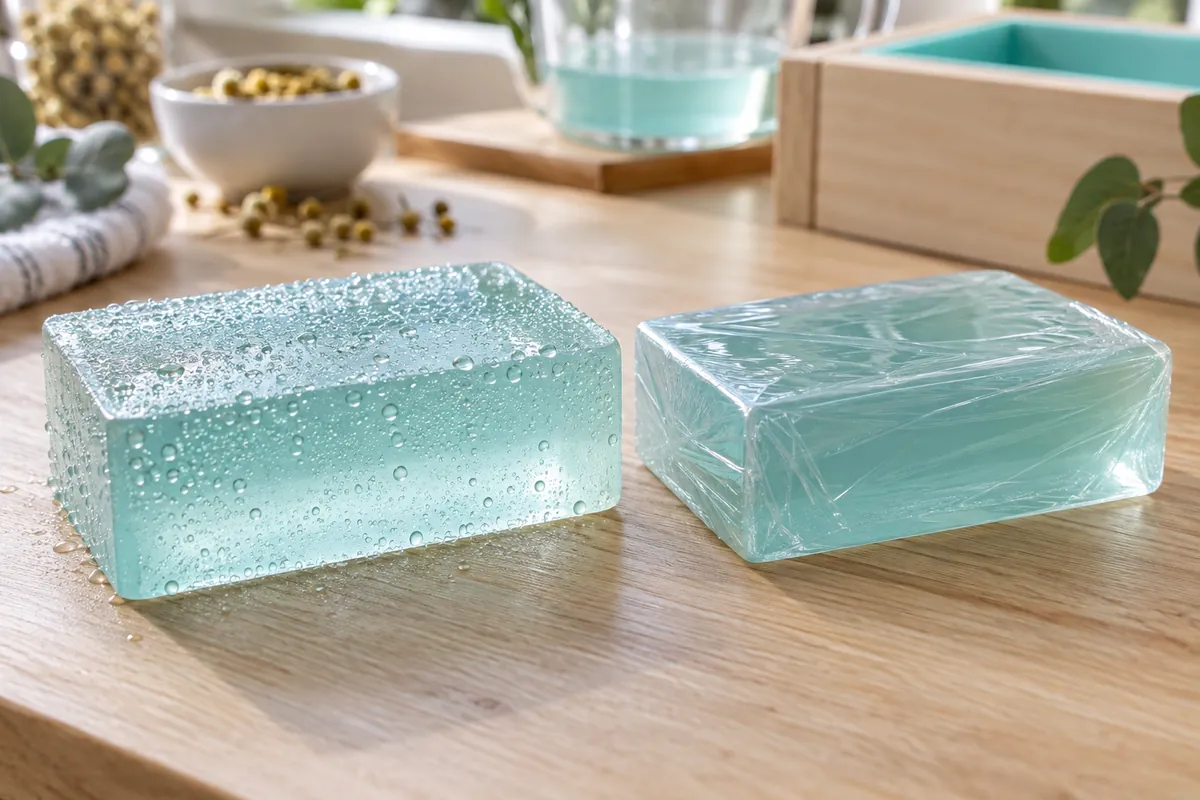 Glycerin dew. The unwrapped bar has pulled water from the air; the wrapped one has not.
Wrap each bar in cling film as soon as it has hardened, and store the bars somewhere dry. A low-sweat base, with less glycerin, sweats less. Wiping the dew off works for a while, but it comes back.
If you sell it
The base you bought is an ingredient: its ingredient list goes on your label along with everything you added. There is one catch in the United States. The FDA treats a product as soap only when most of it is fatty-acid salts and those salts do the cleaning. A base whose lather comes partly from synthetic detergents such as sodium laureth sulfate does not meet that definition, and the FDA regulates cleansers like that as cosmetics. In the EU, fragrance allergens have to be named in the ingredient list once they pass 0.01 % of a rinse-off product; the allergen check works that out from your supplier’s declaration, and the labelling guide covers the rest.
When you want to go further than a base allows, the next step is rebatching, which remelts soap you made yourself, or your first cold process batch.
Sources
- The Complete Photo Guide to Soap Making . David Fisher, Creative Publishing International , 2018. Base types and ingredients; melting in 30 to 45 second bursts; bases melt at 49 to 54.5 °C, pour best at 54.5 to 60 °C and boil and burn above 71 °C; fragrance at about 3 % of the base, added at about 55 °C; layering and overpour temperatures; whipped soap; troubleshooting (mould in fresh additives, bleeding botanicals, sweating).
- Soap Crafting . Anne-Marie Faiola, Storey Publishing , 2013. A low-sweat base for melt-and-pour pieces embedded in cold process soap, and keeping that soap from gelling so the pieces do not melt.
- The Everything Soapmaking Book, 3rd edition . Alicia Grosso, Adams Media , 2013. 2 cups of water in the mould for about a pound of soap; old, overheated or remelted base discolouring; a warm block's liquid centre; food colourings fading; embedding in two stages.
- Guidance for the use of IFRA Standards, 51st Amendment . International Fragrance Association (IFRA) , 2023. Limits are maximum concentrations in the finished product; category 9 covers rinse-off soap. The fragrance supplier issues the certificate.
- NIOSH Pocket Guide to Chemical Hazards: Isopropyl alcohol . US National Institute for Occupational Safety and Health . Flash point 53 °F (12 °C); Class IB flammable liquid; synonyms include rubbing alcohol.
- Glycerol (CID 753) . PubChem, US National Library of Medicine . Physical description: a clear, colourless, hygroscopic syrupy liquid.
- Is It a Cosmetic, a Drug, or Both? (Or Is It Soap?) . US Food and Drug Administration , 2024. A product is regulated as soap only if most of it is alkali salts of fatty acids and its cleaning comes from them; cleansers built on synthetic detergents are cosmetics.
- Commission Regulation (EU) 2023/1545, amending Annex III to Regulation (EC) No 1223/2009 . Official Journal of the European Union , 2023. Fragrance allergens must be named in the ingredient list above 0.01 % in rinse-off products.