In short
- Aleppo soap is olive oil with laurel berry oil, the fat of bay laurel fruit. It is not the essential oil distilled from the leaves.
- The percentage on a bar is the laurel share of the oils, from under 5 % to 40 % and more. Nothing checks it, and the price climbs with it.
- Laurel oil's measured saponification value, about 197 to 201, sits below what its fatty acids imply, because the oil carries volatile aroma compounds that make no soap.
- Cauldron soap is cooked with lye to spare and washed; cold process keeps whatever lye goes in. At home, give olive soaps a real superfat of 4 to 5 %.
- Olive soaps need a long cure: Aleppo soap is dried for six to nine months.
On this page
Aleppo soap is two things at once: a formulation, olive oil with laurel berry oil, and a process, a cauldron cook that no kitchen can copy. The formulation is easy to make at home. The process is what made the traditional soap safe at superfats a cold process maker should not use, and that is the part most recipes leave out. This guide covers both, along with Aleppo’s two olive-oil cousins, the soaps of Nablus and Marseille.
What Aleppo soap is
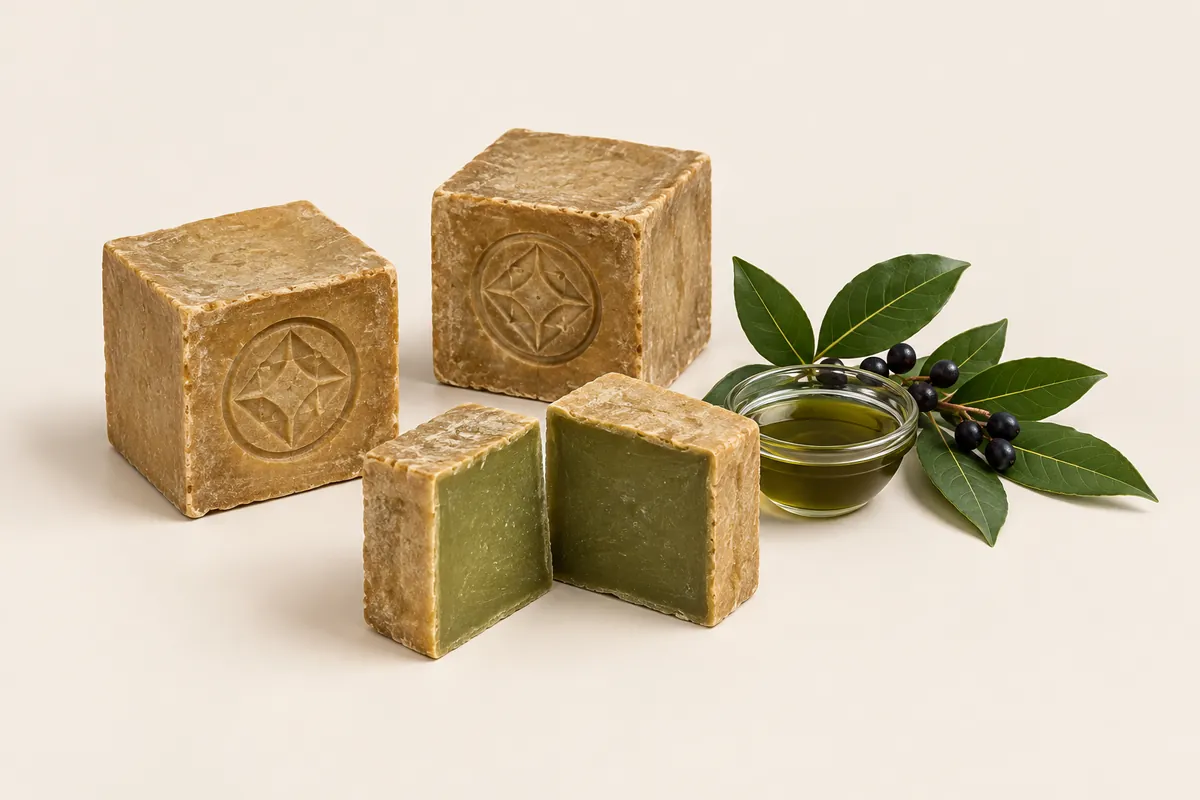
In Arabic it is often called ghar soap, after the laurel. UNESCO added the “Craftsmanship of Aleppo Ghar soap” to its Representative List of intangible heritage in December 2024. Put together from its description and from reporting inside the soap works, the method runs like this. Lye, olive oil and laurel oil are cooked together in large cauldrons over two days or more; makers differ on when the laurel goes in, some at the start, some a day later or at the end of the cook. The paste is washed with salted water, poured across the floor of the soap works and left to set. Craftsmen in large wooden shoes walk across the slab and cut it into cubes with a rake, each cube is stamped with the family’s seal, and the cubes are stacked in open towers so that air reaches every side. There they dry for six to nine months. The outside turns ochre while the inside stays olive green, which is why a cut Aleppo bar is two colours.
Its history is real but shorter than the labels say. Marketing often gives Aleppo soap two or three thousand years; what the record shows is soap-making “much practised” in Sarmin, in the Aleppo province, where Ibn Battuta found a brick soap made for export to Damascus and Cairo in the fourteenth century, and soap made “at Aleppo, but the greatest part at Edlib”, with ashes brought in from the desert, in Alexander Russell’s natural history of 1756.
The war nearly ended it. Aleppo’s soap works stopped around 2012, and many makers moved to Damascus, Tartous or across the border to Gaziantep, Nizip and Mersin in Turkey; by 2024, AFP reported that of about 100 factories in the city only some 10 remained. Much Aleppo soap is now made in exile, in Turkey above all.
Nablus and Marseille, the cousins
Nablus soap is olive oil soap with no laurel at all. Beshara Doumani’s history of Jabal Nablus describes the traditional process: olive oil and water cooked with qilw, the ash of barilla plants gathered and burned by Bedouin east of the Jordan, and with lime, for about eight days; poured onto the floor, cut, stamped, and stacked in tall, hollow cones called tananir to dry for three months to a year. Industrial caustic soda replaced qilw from the 1860s. Soap from Nablus was “exported to all lands, and to the Islands of the Mediterranean” by the time the geographer al-Dimashqi wrote, before 1327. UNESCO listed the Nablus tradition in December 2024 too. Our Nablus recipe is simply olive oil, like a castile.
Savon de Marseille was defined by law. An edict of 1688, under Louis XIV, allowed Marseille’s soap works only pure olive oil, with no animal fat. The traditional process is a cauldron cook finished with sea salt, which carries the glycerin-rich, salty lye down and away from the soap. The famous stamp does not describe the recipe: “72 %” is, in the makers’ own words, 72 % vegetable oils and 28 % moisture in the finished bar. Two applications for a French geographical indication, filed in 2015, have both been rejected. Our 72 % recipe is the common modern cold process reading, olive oil with coconut and palm, and an homage rather than the same soap.
Laurel berry oil
Laurel berry oil is the fat of the fruit of the bay laurel, Laurus nobilis, the tree whose leaves go into the stockpot. It is not bay laurel essential oil, which is steam-distilled from the leaves and makes no soap, and not West Indian bay, a different plant sold under the same English name. The berries are 24 to 30 % fat. Traditionally they are boiled in water until the oil rises and is skimmed off; the oil can also be pressed. It is dark green, strongly herbal and buttery in a cool room, melting at about 32 to 36 °C.
Its fatty acids are why it is there. Olive oil is mostly oleic acid, which makes a mild soap with a small lather. Laurel fruit oil adds lauric acid, the lathering acid of coconut oil, alongside oleic, linoleic and palmitic acid. The share of lauric acid varies widely: from 12.7 to 31.2 % across the trees of one Turkish province (Ayanoğlu and others, 2018), 27.7 % in Tunisian berries (Marzouki and others, 2008), 30 % in a laboratory sample analysed by Castilho and others (2005), and 54.2 % in an older Turkish study they cite. Where and when the fruit was picked matters. Our laurel berry oil page carries the Turkish band, and the calculator works from its mean, 19.4 %, so for a high-lauric oil it will under-read the lather.
Its saponification value, and why it sits low
Laurel oil is not all fat. The German pharmacopoeia of 1910 described it as a green, salve-like mixture of fat and essential oil, and Lewkowitsch’s 1909 handbook notes that crude laurel oils carry varying amounts of volatile oil. The volatile part is mostly aroma compounds such as ocimene and cineole, which make no soap. So a gram of laurel oil takes less lye than a gram of pure fat with the same fatty acids would.
The measurements bear this out. Lewkowitsch collected saponification values for laurel oil from six sources, and all fell between 197 and 201 mg KOH/g except one author’s range that ran up to 210; a 1980 patent gives 198 to 199. Worked out from the fatty acids in our database alone, the oil should take about 209. The calculator uses the measured 198.5. Had it used the fatty acids instead, a bar with 20 % laurel would get 1.5 g more lye per kilo of oils, and a 4 % superfat would really be about 2.9 %. The volatile part does not disappear: it goes into the bar as scent and colour, on top of the superfat you set. Because the oil varies so much from one origin to another, a saponification value on your supplier’s certificate of analysis beats any table, and the calculator will take a lot’s own value in place of ours.
How much laurel: 5 % to 40 % and more
The percentage printed on an Aleppo bar is the laurel share of the oils: a “30 %” bar is 30 % laurel oil and 70 % olive oil. Bars are sold at anything from under 5 % to 40 %, and an IPGRI study of the Syrian trade recorded 10 to 60 %. The more laurel, the higher the price: in 2018 France 24 found bars with more than 20 % selling for 8 to 12 euros, and reported that nothing strictly controls the real percentage.
Laurel is the scarce ingredient; IPGRI found that about 80 % of the laurel oil Aleppo used was imported from Turkey. The same study says more laurel needs more soda and hotter cooking. The soda, at least, barely changes: laurel oil’s saponification value is close to olive oil’s, so the laurel share hardly moves the lye:
| Laurel share | Sodium hydroxide for 1000 g of oils | Cleansing | Hardness | Iodine value |
|---|---|---|---|---|
| 0 % (all olive) | 130.0 g | 0 | 17 | 85 |
| 5 % | 130.3 g | 1 | 18 | 84 |
| 12 % | 130.7 g | 2 | 19 | 83 |
| 20 % | 131.2 g | 4 | 21 | 82 |
| 30 % | 131.8 g | 6 | 23 | 81 |
| 40 % | 132.4 g | 8 | 25 | 80 |
Olive oil with laurel berry oil at a 4 % superfat, from our calculator. The quality numbers use the typical value in our laurel band, so a high-lauric oil would score higher on cleansing. They are a craft convention in any case, and they call every olive soap too soft.
What the laurel changes most is the scent and the colour, and at higher shares the lather. With a laurel oil at 54 % lauric acid, a 40 % bar would carry more lauric acid than a bar made with 40 % coconut oil, and lather accordingly.
Cauldron soap and cold process soap
What separates a traditional olive soap from yours is what happens to the lye. In a cauldron, the soap is cooked with lye to spare and the maker judges when it is done. Then the spent lye is drained off and the soap is washed: with salted water in Aleppo, as New Lines describes, and with sea salt in Marseille. The washing carries away the excess alkali along with the glycerin. That is how the old soaps could be made to a fine balance without a calculator.
A cold process maker has none of those checks. Whatever goes into the mould stays in the bar, including any lye the oils did not need, so the only protection is the superfat. A low superfat leaves little room for the uncertainty in the oils’ own saponification values. At 2 or 3 %, the kind of low figure that suits a washed cauldron soap, an all-olive Nablus soap could fall to −1.2 % and a Marseille 72 % to −0.4 % if the oils sit at the bottom of their published ranges: bars that could carry free alkali. Our recipe pages keep a real margin instead:
| Recipe | Superfat | Worst case across the published SAP ranges |
|---|---|---|
| Nablus, all olive | 5 % | 1.9 % |
| Savon de Marseille, 72 % | 5 % | 1.6 % |
| Aleppo, 20 % laurel | 4 % | 1.5 % |
From our calculator, at the superfat on each recipe page. The superfat guide explains the uncertainty band.
The recipe: Aleppo-style soap in cold process
This is our Aleppo recipe, 20 % laurel, for 1000 g of oils. It makes 1397.6 g of soap, about twelve bars of 115 g, which lose a good deal of weight over the long cure.
| Ingredient | Grams | Ounces |
|---|---|---|
| Olive oil | 800 | 28.22 |
| Laurel berry oil | 200 | 7.05 |
| Sodium hydroxide (100 %) | 131.2 | 4.63 |
| Water | 266.4 | 9.40 |
4 % superfat, a 33 % lye solution. Across the published saponification ranges the superfat sits between 1.5 and 6.4 %. Hardness 21, cleansing 4, conditioning 78.
Try other laurel shares. At 20 % laurel, 1000 g of oils take 131.2 g of sodium hydroxide; at 40 % they take 132.4 g.
Open it in the calculatorThe old full-water figure, 380 g for this batch, makes a 25.7 % solution. It traces more slowly, shrinks more as it cures, and sits close to the strength at which Kevin Dunn’s olive oil soap separated in the mould, which is why the recipe uses 33 %.
Make it as any cold process soap, from the first batch guide, with the olive soap’s habits from the castile guide. Warm the laurel oil gently until it melts and stir it into the olive oil. Expect a slow trace and blend in bursts. Leave the loaf in the mould for at least 48 hours, as Corley Barto does with her olive oil bars, and longer if it is still soft. The laurel brings its own scent, so it needs no fragrance.
The long cure
Aleppo soap is dried for six to nine months before it is sold, and some is kept for years; a Reuters report in 2010 gave six months to three years. Nablus soap took three months to a year. Your cold process version needs the same patience: give it at least six months, somewhere cool and airy, and it keeps improving for longer. The curing guide explains how to follow the water loss by weighing a bar now and then.
Recipes to try
All recipesSources
- Craftsmanship of Aleppo Ghar soap (Representative List, decision 19.COM 7.B.10) . UNESCO Intangible Cultural Heritage , 2024.
- Tradition of Nabulsi soap making in Palestine (decision 19.COM 7.B.8) . UNESCO Intangible Cultural Heritage , 2024.
- The Laurel tree in Syria . A. Giuliani, International Plant Genetic Resources Institute (IPGRI) , 2005. Laurel oil at 10 to 60 % of the oils; most of Aleppo's laurel oil imported from Turkey; soap stored at least six months.
- The Resilient Artisans Keeping Aleppo Soap Alive . Stefania D'Ignoti, New Lines Magazine , 2025.
- Aleppo soap: Balsam from a war zone . Mey Dudin, Qantara.de , 2017.
- UNESCO grants heritage status to Aleppo soap as Syria war flares . AFP, via Al-Monitor , 2024.
- Modern threat to Syria's ancient Aleppo soap industry . Reuters (archived copy) , 2010.
- À Alep, avec l'accalmie, les affaires des savonniers reprennent . France 24 , 2018.
- Palestine under the Moslems . Guy Le Strange, Palestine Exploration Fund , 1890. Translations of al-Muqaddasi, al-Dimashqi and Ibn Battuta on soap from Palestine, Nablus and the Aleppo province.
- The Natural History of Aleppo . Alexander Russell , 1756.
- Rediscovering Palestine: Merchants and Peasants in Jabal Nablus, 1700–1900 . Beshara Doumani, University of California Press , 1995. Nablus soap: qilw and lime, an eight-day cook, drying in tananir for three months to a year.
- Savon de Marseille: cahier des charges (UPSM) and application status IG 15-003 . Institut national de la propriété industrielle (INPI) . The 1688 edict, the cauldron process with sea salt; both geographical indication applications rejected.
- FAQ: savon de Marseille and savon d'Alep . Marius Fabre (manufacturer) . The maker's explanation of the 72 % stamp: 72 % vegetable oils, 28 % moisture.
- Chemical Technology and Analysis of Oils, Fats and Waxes, 4th edition, volume 2 . J. Lewkowitsch, Macmillan , 1909. pp. 414–417, laurel oil: berries 24 to 30 % fat, pressed or boiled; saponification values 197.5 to 200.9 (one 197 to 210); melting point 32 to 36 °C.
- Promising bay laurel (Laurus nobilis L.) genotypes for fruit production . Ayanoğlu F., Kaya D.A. and Koçer O., International Journal of Chemistry and Technology 2(2):161–167 , 2018. Berries of laurel genotypes from Hatay, Turkey: lauric acid 12.74 to 31.19 %, mean 19.35 %.
- Extraction and Separation of Volatile and Fixed Oils from Berries of Laurus nobilis L. by Supercritical CO2 . Marzouki H. et al., Molecules 13(8):1702–1711 , 2008.
- Characterization of laurel fruit oil from Madeira Island, Portugal . Castilho P.C. et al., Journal of the American Oil Chemists' Society 82(12):863–868 , 2005. Madeiran laurel oil, from a related laurel, with a Laurus nobilis sample for comparison; cites Turkish laurel fat at 54.2 % lauric acid.
- US Patent 4,235,889: Therapeutic agent for the external treatment of psoriasis, tinea and eczemas . Walter Evers, United States Patent and Trademark Office , 1980. Saponification value 198 to 199 and iodine value 68 to 80 for laurel oil.
- Deutsches Arzneibuch, 5th edition: Oleum Lauri . German Pharmacopoeia , 1910. Laurel oil described as a green, salve-like mixture of fat and essential oil pressed from the berries.
- Regulation (EC) No 1223/2009 on cosmetic products, Annex II, entry 359 . European Union; retained in UK law . Prohibited: oil from the seeds of Laurus nobilis L.
- The Natural Soap Chef . Heidi Corley Barto, Ulysses Press , 2012. Olive oil bars left 48 hours before unmoulding.