Palm-free classic bar
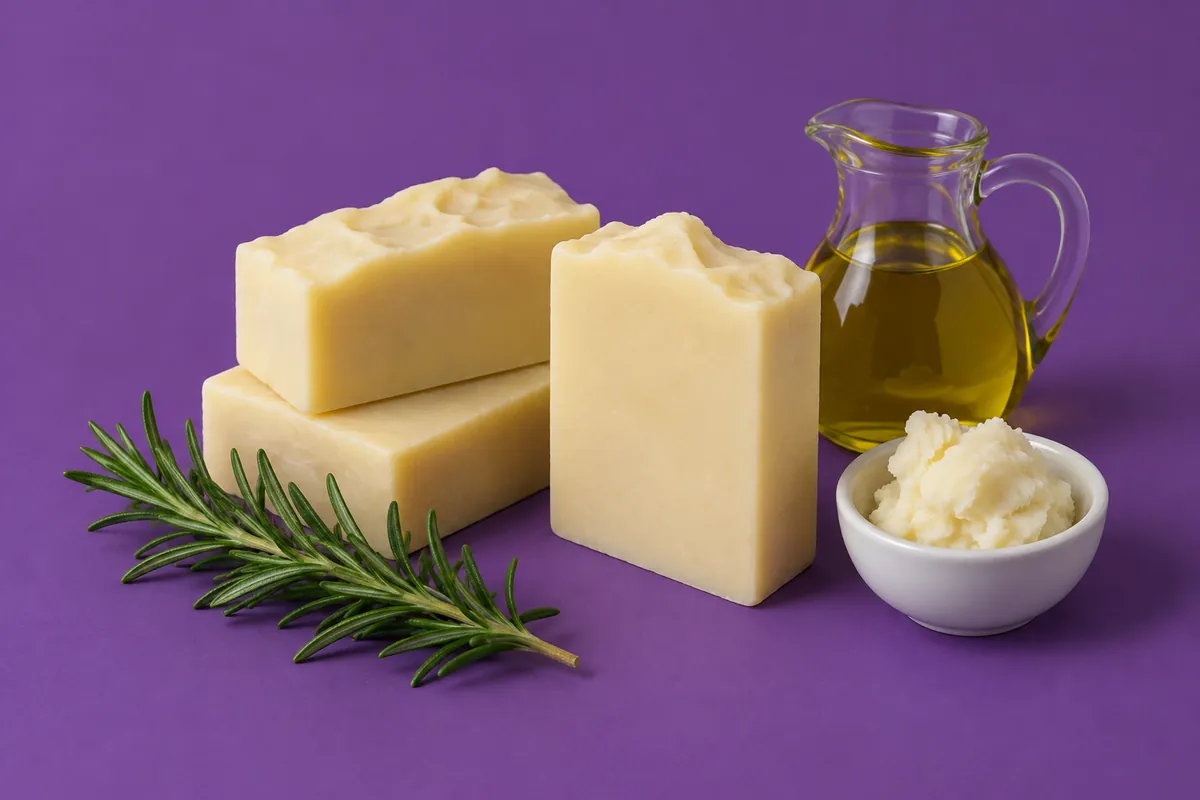
Our everyday bar without palm oil: olive, coconut and castor oils, with shea butter doing the hardening palm would have done and high-oleic sunflower oil for a bar that keeps. Scented softly with lavender and rosemary.
- Skill
- Beginner
- Method
- Cold process
- Batch
- 1000 g of oils about 1459 g of batter
- Hands-on
- 1 hour
- Cure
- 5 weeks
- Gel phase
- Either way gel or not, both work
What you need
For 1000 g of oils, which fills a 1.5 litre loaf mould. Weigh everything, liquids included.
| Olive Oil · 40.0 % | 400 g | 14.11 oz |
| Coconut Oil · 25.0 % | 250 g | 8.82 oz |
| Shea Butter · 20.0 % | 200 g | 7.05 oz |
| Castor Oil · 5.0 % | 50 g | 1.76 oz |
| Sunflowerseed Oil - High Oleic Acid · 10.0 % | 100 g | 3.53 oz |
| Sodium hydroxide (NaOH) · the lye, 100 % pure | 138.5 g | 4.88 oz |
| Distilled water · for a 33 % lye solution | 275.2 g | 9.71 oz |
| Sodium lactate (60 % solution) · stirred into the lye solution once it has cleared, for a firmer loaf | 15 g | 0.53 oz |
| Lavender oil · 2.0 % of the oils, at trace | 20 g | 0.71 oz |
| Rosemary oil · 1.0 % of the oils, at trace | 10 g | 0.35 oz |
- Superfat
- 5 %
- Temperatures
- Oils and lye solution each between 32 and 43 °C (90 and 110 °F)
Method
-
Get ready
Put on splash goggles, nitrile gloves and long sleeves, open a window or turn on the extractor fan, and keep children and pets out of the room. Set out a 1.5 litre loaf mould, level, where it can stay for two days. -
Weigh the oils
Weigh 250 g coconut oil and 200 g shea butter into the pot, and 400 g olive oil, 100 g high-oleic sunflower oil and 50 g castor oil into a jug. -
Weigh the rest
Weigh 275.2 g distilled water into a heat-safe lye jug and 138.5 g sodium hydroxide into a small, dry container. Weigh 15 g sodium lactate into a cup, and 20 g lavender oil and 10 g rosemary oil into a small glass. -
Make the lye solution
By an open window, pour the sodium hydroxide slowly into the water, never the water onto the lye, and stir until it runs clear, keeping your face away from the vapour. Stir in the sodium lactate, then leave the jug to cool, labelled and out of reach. -
Melt the solid oils
Melt the coconut oil and shea butter on the lowest heat until just clear, then pour in the olive, sunflower and castor oils, which bring the temperature down. -
Check the temperatures
Go ahead when the oils are clear and both they and the lye solution read between 32 and 43 °C (90 and 110 °F); the two need not match. -
Blend to light trace
Pour the lye solution into the oils down the shaft of the stick blender, then pulse for a few seconds and stir, over and over. With half its oils liquid the batter takes a few minutes to thicken, so keep going until a drizzle leaves a faint line on the surface. -
Add the essential oils
Pour in the lavender and rosemary oils, stir them in with the blender switched off, then give two or three short pulses to spread them through the batter. -
Pour and cover
Pour into the mould, tap it firmly on the worktop to raise air bubbles, and cover it with a lid or board and a folded towel for a day. A warm loaf firms up sooner; if the top starts to crack, take the towel off. -
Clean up with your gloves on
Wipe the raw batter off the pot and tools with paper towels into the bin, then wash everything in hot soapy water. -
Unmould and cut
After 24 to 48 hours, when the loaf is firm to a pressed finger and has pulled away from the sides, unmould it with gloves on and cut it into bars about 2.5 cm (1 in) thick. If it still feels soft, give it another day. -
Cure for four to six weeks
Stand the bars on edge in a dry, airy place out of the sun, a finger's width apart, and turn them every few days. They are ready after four weeks, and harder and milder after six.
Tips
- For a swirl, which needs the batter to stay fluid for longer, set the calculator's water to a 30 % lye concentration. The lye stays the same; the batter thickens more slowly, and the loaf wants an extra day in the mould.
- The sodium lactate is optional. Leave it out and the bar is the same soap; just give the loaf an extra day in the mould before you unmould it.
- Refined shea butter makes a whiter bar with no smell of its own; unrefined shea smells faintly nutty. Either works, and the calculator treats them the same.
- For a first batch, our first-batch palm-free bar is simpler still, with no additions and no scent. Our vegan hard bar takes its hardness from cocoa butter instead of shea, and our classic olive, coconut and palm bar is the palm version of this soap.
The oils
| Oil | Share |
|---|---|
| Olive Oil (virgin / refined / olive oil) | 40.0 % |
| Coconut Oil | 25.0 % |
| Shea Butter | 20.0 % |
| Castor Oil | 5.0 % |
| Sunflowerseed Oil - High Oleic Acid | 10.0 % |
How it is made
| Process | Cold process |
| Alkali | NaOH |
| Superfat | 5 % |
| Water | lye water at 33 % |
| Iodine value | 59 |
| INS | 145 |
Why make it
This is our everyday bar for makers who would rather not use palm oil. Shea butter takes palm's place for hardness, and the bar sits in the middle of every range on our scale, hardness 37, cleansing 17 and conditioning 60: a mild, creamy bar for hands and body that most skin gets on with. High-oleic sunflower oil carries far less linoleic acid than the ordinary kind (Codex), so it is less likely to go rancid over a long cure. People leave palm out because oil palm expansion has driven deforestation in parts of tropical Asia and Latin America and threatens many species there (IUCN). The IUCN also notes that palm gives up to nine times more oil per hectare than other oil crops, so replacing it can move the damage rather than end it. A palm-free bar is a reasonable choice, not a guaranteed good one.
Sources
- Palm oil and biodiversity (issues brief), drawing on Oil palm and biodiversity: a situation analysis by the IUCN Oil Palm Task Force · International Union for Conservation of Nature (IUCN), 2018
- Standard for Named Vegetable Oils (CXS 210-1999) · Codex Alimentarius Commission (FAO/WHO)
What tradition, makers' experience and research say about soaps like this, each labelled for what it is. It is not medical advice, and no soap treats a skin condition: if you have one, ask a doctor or pharmacist.
What the numbers say
- Lauric acid 12.3 %
- Myristic acid 4.7 %
- Palmitic acid 8.9 %
- Stearic acid 10.8 %
- Ricinoleic acid 4.4 %
- Oleic acid 47.4 %
- Linoleic acid 7.8 %
- Other 5.1 %
Saturated : unsaturated 40 : 60
Computed from the fatty acids of the fats above. The bands are what the craft has settled on, not chemistry — a bar outside one is not wrong.
Try it differently
9 variationsThe same soap with one thing moved. Each opens in the calculator ready to change again.
- Kokum Butter instead of Shea Butter
- Cocoa Butter (Theobroma Oil) instead of Shea Butter
- Mango Butter instead of Shea Butter
- Sal Butter instead of Shea Butter
- 8 % superfat
- Kokum Butter instead of Shea Butter and 8 % superfat
- Cocoa Butter (Theobroma Oil) instead of Shea Butter and 8 % superfat
- Mango Butter instead of Shea Butter and 8 % superfat
- Sal Butter instead of Shea Butter and 8 % superfat
From the guides
All guides
Palm-free soap: what takes palm oil's place
What palm oil does in a bar of soap, why makers drop it, and how lard, tallow, shea, cocoa, kokum or stearic acid take its place, with worked palm-free recipes.
Your first cold process soap, step by step
A complete first batch of cold process soap: one simple recipe with exact lye and water for 500 g and 1 kg of oils, and every step from goggles to cure.
Scenting soap: essential oils and fragrance oils
How much essential or fragrance oil to use in soap, what ounces per pound mean in percent, the IFRA limits for common essential oils, and EU allergen labelling.
Guides with this recipe
- Colouring soap: micas, oxides, ultramarines and pigments
- Dreaded orange spots (DOS) and rancid soap
- Embeds, textured tops and piping
- Fatty acids and soap qualities: what the numbers mean
- Hot process soap, step by step
- Layers, mica lines and pencil lines
- Natural colourants: what herbs, clays and spices really do in soap
- Soap moulds: choosing one and sizing a recipe to fit
- Swirl techniques: in the pot, drop, hanger, spoon and Taiwan
- The soaping oils: what each one brings to a bar
Where these proportions come from
Our own formulation: the olive, coconut and castor of a classic everyday bar, with the hardness palm oil would have given taken from 20 % shea butter instead, and 10 % high-oleic sunflower oil, which keeps better than ordinary sunflower. Sodium lactate at Faiola's teaspoon per pound of oils helps the softer palm-free loaf firm up and leave the mould sooner.