In short
- The 25er is 25 % each of olive, rapeseed, coconut and palm oil: half liquid oils, half solid fats. German books, courses and makers start beginners on it because it is balanced and easy to work.
- German sources set the superfat anywhere from 6 to 10 %. We use 8 %: 136.7 g of sodium hydroxide and 277.5 g of water for 1000 g of oils, and even if all four oils saponify low, 4.6 % stays unsaponified.
- Rapeseed oil sold as food is the low-erucic kind, which the calculator calls canola oil. The high-erucic entry asks 6.9 % less lye per gram; picked by mistake, it turns the 25er's 8 % into 9.4 %.
- Rapeseed brings linolenic acid, the quickest of the soap acids to go rancid: the 25er sits at 14.4 % linoleic and linolenic acid together. Buy the oil fresh and keep the bars cool and dark.
- Palmin is coconut fat, not palm. For a palm-free 25er, put 15 % shea butter and 10 % cocoa butter in palm's place: nearly the same bar, at 134.6 g of sodium hydroxide.
- Cure the bars for four to six weeks.
On this page
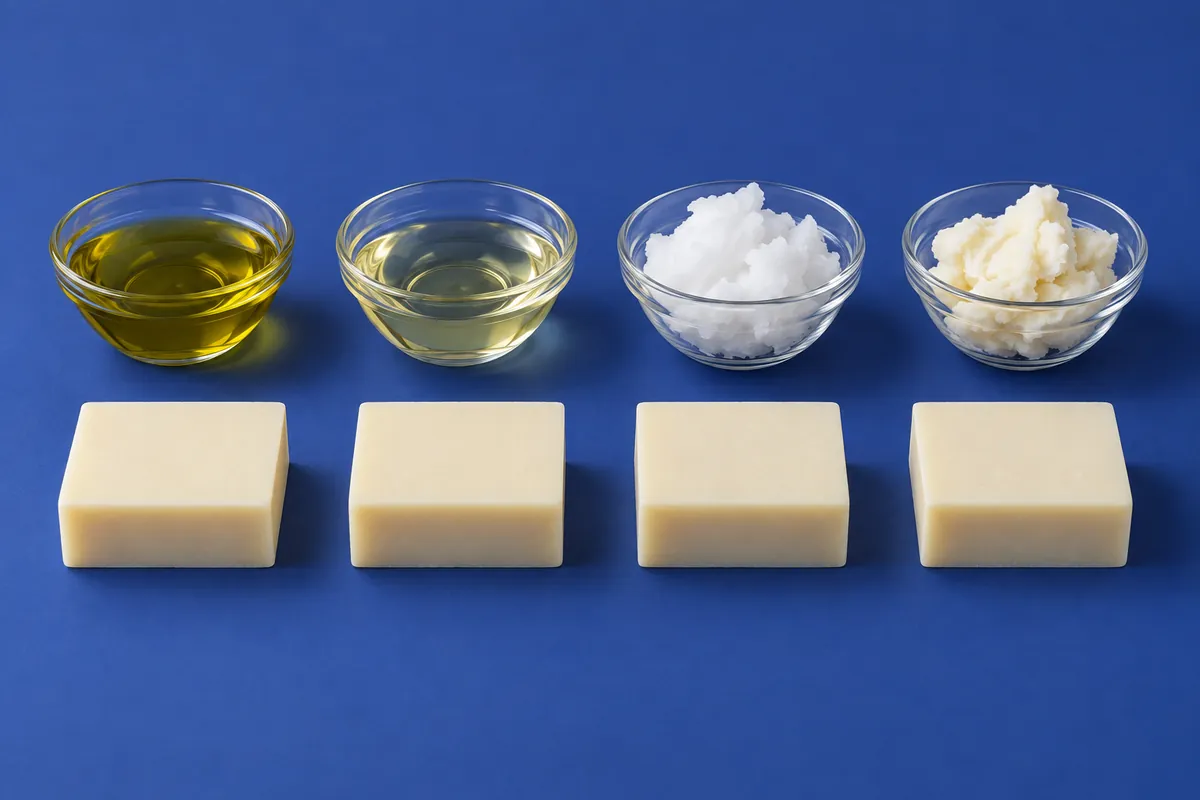
Ask in a German soap shop, course or book what to make first, and the answer is often the 25er-Rezept, the “25 recipe”: 25 % olive oil, 25 % rapeseed oil, 25 % coconut oil and 25 % palm oil. Petra Neumann’s Seife sieden makes it the basic recipe of the book and calls it “a real beginner’s recipe”. This guide sets out what each oil does in it, the superfat German sources use and the one we use, the lye and water from our calculator, which rapeseed oil to enter, and how to make it without palm.
What the 25er is
The name is the recipe: four oils at 25 % each, so a kilogram of oils is 250 g of each and a half-kilo batch 125 g of each. Half of it is solid fat (coconut and palm) and half liquid oil (olive and rapeseed), and German makers credit that split for its good behaviour. The Austrian soapmaker Barbara Freyberger calls the result “not too soft and not too firm”, with a batter that neither stays runny for long nor sets too fast. Neumann recommends it because it can be worked over a wide range of temperatures, which leaves a beginner time to learn the steps.
Each oil is there for its fatty acids, which the fatty acids guide explains in full:
| Oil | Main fatty acids | What it brings to the bar |
|---|---|---|
| Olive oil | oleic 55–83 % | Mildness and a slow, creamy lather; soft until the bar has cured |
| Rapeseed oil | oleic 51–70 %, linoleic 15–30 %, linolenic 5–14 % | Mildness, much as olive oil; its linolenic acid is the part of the soap that goes rancid first |
| Coconut oil | lauric 45–53 %, myristic 17–21 % | Cleansing and a quick, big-bubbled lather; firmness |
| Palm oil | palmitic 39–48 %, oleic 36–44 % | Hardness, a bar that wears slowly, and a stable, creamy lather |
Fatty-acid ranges from the Codex standards, as on each oil’s page.
Equal parts work because none of the four goes past the share makers usually give it. Faiola keeps palm oil to 25 % of the oils and canola to 35 %, and says some people find coconut oil drying above 25 %. The four together land inside all seven of the usual quality bands, as the table further down shows.
Buying the fats
Neumann notes that most of the basic soap fats come from the supermarket, the 25er’s four among them: coconut fat, palm fat sold as a frying fat, olive oil and rapeseed oil. Two of those need a closer look.
Palmin is coconut fat. Despite the name, it is 100 % coconut fat, made from the flesh of the coconut (Palmin), and it goes in the coconut quarter. Palmin soft is a different product: it also contains palm oil and sunflower oil (Palmin), which is why German makers say to use Palmin but not Palmin soft (Kreativseifen). Put Palmin in palm’s place and you have a different soap, half coconut oil, and the 25er’s 136.7 g of sodium hydroxide leaves 13.9 % of the oils unsaponified instead of 8 %.
A frying-fat bar is usually a blend. The bars sold as vegetable frying fat (Fettstange) are usually palm oil blended with other fats (Kreativseifen); Biskin Reines Pflanzenfett, for one, is made from palm and coconut fat (Biskin). The calculator can only use the fats you enter, and coconut oil takes about 29 % more lye per gram than palm oil. Entered as palm oil, a blend with coconut fat in it gets less lye than it can use and ends up with more superfat than you set; one with a liquid oil in it gets a little more lye than it needs. Palm oil sold as palm oil takes the guesswork out.
The superfat
The superfat, Überfettung in German, is the share of the oils left unsaponified on purpose: the lye you weigh is a few percent short of what the oils could use (see the superfat guide). German sources agree on the oils and differ on this:
| Source | Superfat | Water for 500 g of oils | Cure |
|---|---|---|---|
| Kreativseifen, a soapmaker’s blog | at least 6 %; the author uses 11 % | 150–165 g (30–33 %) | 4–8 weeks |
| LandFrauen course handout, Althütte | 8 % | 168 g | 3–8 weeks |
| Seifenmagie workshop, for a first soap | 8–10 % | not given | 4–6 weeks |
| Utopia.de | about 10 % | about a third of the oils | about 4 weeks |
| Neumann, Seife sieden: a palm-free first soap, with lard | 10 % | 168 g (33 %) | 4–6 weeks |
The calculator’s How well is this pinned down? panel shows what each choice buys. It takes the published saponification range of every oil and works out what the lye you weighed amounts to if your oils sit at either end:
| Superfat | Sodium hydroxide for 1000 g of oils | Water, 33 % lye solution | If every oil sits at the bottom of its range | If every oil sits at the top |
|---|---|---|---|---|
| 5 %, the calculator’s default | 141.1 g | 286.5 g | 1.5 % | 8.2 % |
| 8 % | 136.7 g | 277.5 g | 4.6 % | 11.1 % |
| 10 % | 133.7 g | 271.4 g | 6.7 % | 13.1 % |
From the calculator. Taking every oil at the same end of its range at once is a bound, not a likely case. Palm oil’s range, 190 to 209 mg KOH/g, is the widest of the four.
Why we use 8 %
At 5 % the 25er is sound on paper. Even if all four oils saponify at the bottom of their ranges, 1.5 % of the oil stays unsaponified. That is a thin margin for a first batch: a scale that reads to the gram can be a gram out, and a gram is 1.4 % of the 70.6 g of sodium hydroxide a 500 g batch needs at 5 %.
At 8 % the worst case keeps 4.6 %, close to the 5 % the default promises on paper, with room left for the scale. The palm-free version further down keeps at least 5.2 % at the same setting. And 8 % is still inside the 3 to 8 % that Faiola gives as the common range. It is the figure in the LandFrauen handout, too, and our lye agrees with theirs: 68.3 g of sodium hydroxide for 125 g of each oil, against their 68.24 g.
10 % makes good soap as well, a little softer, with more free oil. We stop short of it because of the rapeseed oil. The oil a superfat leaves behind is not a fair sample of the recipe: in Kevin Dunn’s tests the leftover fat held 22 % oleic acid where the blend held 7 %, and 17 to 19 % linoleic where the blend held 9 %, which he put down to unsaturated oils reacting with lye more slowly. In the 25er the unsaturated oils are the olive and the rapeseed oil, and rapeseed carries linolenic acid, the quickest of the soap acids to go rancid. In Dunn’s orange spot tests a 10 % lye discount did not bring the orange on any sooner, but it did make it deeper.
The recipe
| Ingredient | 1000 g of oils | 500 g of oils |
|---|---|---|
| Olive oil | 250 g | 125 g |
| Rapeseed oil (canola oil in the calculator) | 250 g | 125 g |
| Coconut oil | 250 g | 125 g |
| Palm oil | 250 g | 125 g |
| Sodium hydroxide | 136.7 g | 68.3 g |
| Water | 277.5 g | 138.7 g |
8 % superfat and a 33 % lye solution, from the calculator. The full batch weighs 1414.1 g before any scent, the half batch 707.1 g.
German recipes measure the water as about a third of the weight of the oils: 168 g for 500 g in the LandFrauen handout and in Neumann’s first soaps. With this lye that is a 29 % solution, against the 33 % our calculator starts at. Both work; the difference is how much water the bars have to lose as they cure, which the water guide sets out.
Make the 25er. 1000 g of oils at an 8 % superfat ask 136.7 g of sodium hydroxide and, at a 33 % lye solution, 277.5 g of water.
Open it in the calculatorWhat the numbers say about the bar
| Figure | The 25er | Usual band |
|---|---|---|
| Hardness | 38 | 29–54 |
| Cleansing | 17 | 12–22 |
| Conditioning | 59 | 44–69 |
| Bubbly lather | 17 | 14–46 |
| Creamy lather | 21 | 16–48 |
| Iodine value | 65 | 41–70 |
| INS | 143 | 136–165 |
From the calculator; the superfat does not change them. The bands are a convention hobby calculators share, not a measurement.
Every figure sits inside its band. Set beside the classic three-oil bar of 40 % olive, 30 % coconut and 30 % palm oil, our everyday bar, the 25er is softer (38 against 45 for hardness), cleanses a little less (17 against 21) and conditions more (59 against 51). Its iodine value is higher, 65 against 52: that is the rapeseed oil’s double bonds, which make a milder, softer soap and one that keeps less well.
Which rapeseed oil
Rapeseed oil comes in two kinds with different lye figures, and the calculator lists them apart. For rapeseed oil bought as food, choose canola oil (on our German pages, Rapsöl).
Rapeseed can carry over 50 % erucic acid in its fatty acids, and breeding has brought it below 2 % (BfR). Erucic acid was bred out of rapeseed in 1974, and in 1986 and 1987 double-low (00) varieties, low in glucosinolates as well, took over; apart from a few erucic varieties, only 00 rapeseed is grown today (UFOP). The 00 varieties grown for food usually hold less than 0.5 % erucic acid, and official German checks of 984 rapeseed oils found 0.26 % on average (BfR). EU law allows at most 20 g of erucic acid per kilogram, 2 %, in vegetable oils and fats sold as food, rapeseed oil among them (Regulation (EU) 2023/915). The same kind of rapeseed is sold as canola in Canada, where the name was coined: to earn it, the oil must hold less than 2 % erucic acid (Canola Council of Canada).
That is the oil our canola oil describes, from the Codex standard for low-erucic rapeseed oil: 182 to 193 mg KOH/g. The calculator’s rapeseed oil is the high-erucic kind, with more than 2 % and up to 60 % erucic acid, at 168 to 181 mg KOH/g; varieties like it are now grown only for the chemical industry, not for food (KErn). Erucic acid is a 22-carbon chain, longer than the 18-carbon acids that make up most of the food oil, so a gram of high-erucic oil holds fewer molecules and takes less lye (see the SAP values guide).
| Chosen in the calculator | Saponification value, mg KOH/g | 1000 g of that oil alone | The 25er, 1000 g of oils |
|---|---|---|---|
| Canola oil: rapeseed oil sold as food | 182–193 | 123.0 g | 136.7 g |
| Rapeseed oil, high-erucic | 168–181 | 114.4 g | 134.5 g |
Sodium hydroxide at an 8 % superfat, from the calculator.
Gram for gram, the food oil takes 7.4 % more lye. In the 25er, where rapeseed is a quarter of the oils, the gap is 2.2 g, and the easy mistake, picking rapeseed oil by its name, runs the safe way: supermarket oil entered as the high-erucic kind gets 134.5 g, which turns the 8 % into 9.4 %. The other way round, a high-erucic oil entered as canola would end up at 6.5 %.
Linolenic acid, and keeping the bars
Rapeseed oil is 5 to 14 % linolenic acid, the fatty acid with three double bonds and the quickest of the common soap acids to oxidise (see the orange spots guide). In a comparison of cold-pressed low-erucic rapeseed oils with virgin olive oils, the rapeseed oils oxidised more easily, in part because of their higher share of polyunsaturated fatty acids (Koski et al., 2002). In the 25er, the rapeseed oil brings the recipe to 11.8 % linoleic and 2.6 % linolenic acid: 14.4 % together, just under the 15 % that Classic Bells gives as a rule of thumb, while saying the rule has no strong scientific basis. Olive oil’s linoleic acid varies from 3.5 to 21 %, so a real batch can land either side of the line.
That is a reason for care, not alarm. What helps is what the orange spots guide sets out for any soap with polyunsaturated oil in it: fresh oil, distilled water, plastic or stainless steel tools, and bars cured and stored cool, dark and airy, never on bare metal. If you like, add tetrasodium EDTA to the water and rosemary extract to the fresh oils, 0.1 % of the oils each, the doses Kevin Dunn tested; the antioxidants and chelators guide explains both.
Refined, cold-pressed or high-oleic
Refined oils are mostly colourless or pale yellow, and cold-pressed oils often an intense yellow or green (Verbraucherzentrale). Refined or cold-pressed, rapeseed oil sold as food is low-erucic and takes the same lye. Cold-pressed oil keeps for less time: about nine to twelve months in a closed bottle and two months once opened, against up to two years and six to eight months for refined oil (Verbraucherzentrale). Buy either in amounts you will use soon.
High-oleic rapeseed oil comes from HOLL varieties, with more than 75 % oleic and less than 5 % linolenic acid (LELF Brandenburg), and is sold for long high-temperature use in the food industry, catering and fast food (UFOP). If you can get it, the calculator lists it as high-oleic canola oil. In the 25er it brings linoleic and linolenic acid together down from 14.4 % to 10.7 %, for 137.2 g of sodium hydroxide at 8 %. Faiola prefers high-oleic canola for the same reason: it goes rancid less quickly.
Without palm
Palm oil is the one fat in the 25er that many German recipes now offer a way around, and the reason is land. The UN Food and Agriculture Organization’s remote-sensing survey found that the expansion of oil palm caused 7 % of all deforestation worldwide between 2000 and 2018, and on Borneo at least half of all deforestation between 2005 and 2015 was related to oil palm (IUCN). The same IUCN brief warns that simply switching to other oil crops is no solution, because oil palm yields up to nine times more oil per unit of land than the other major oil crops. Germany’s agriculture ministry takes the same view: at about 3.5 to 4 tonnes of oil per hectare, oil palm is the highest-yielding oil crop, and replacing its oil with coconut or soya would only shift the problems, or could make them worse (BMLEH).
Certification is the other route. The Roundtable on Sustainable Palm Oil (RSPO) certifies palm oil through four supply chain models: Identity Preserved and Segregated oil is certified oil kept separate from ordinary palm oil, Mass Balance oil is mixed with ordinary oil along the chain, and credits pay certified growers without the oil itself reaching you. In Germany, the Forum Nachhaltiges Palmöl brings industry, associations, NGOs and two federal ministries together on the question; in 2019, the year of the most recent study the ministry cites, just under 60 % of the palm oil used in Germany outside the energy sector was certified (BMLEH). The IUCN found certified palm oil only marginally better than uncertified oil at preventing deforestation so far. Some makers buy certified palm oil and others leave it out; the rest of this section is for the second group, and the palm-free guide goes further into what palm does and what replaces it.
Here are the fats German sources put in palm’s place, worked through in the 25er itself:
| In place of the palm | Hardness | Cleansing | Conditioning | Creamy lather | Iodine value | Linoleic and linolenic | Sodium hydroxide |
|---|---|---|---|---|---|---|---|
| Palm oil 25 % (the 25er) | 38 | 17 | 59 | 21 | 65 | 14.4 % | 136.7 g |
| Shea butter 15 %, cocoa butter 10 % | 39 | 17 | 58 | 22 | 64 | 13.0 % | 134.6 g |
| Shea butter 25 % | 37 | 17 | 59 | 20 | 65 | 13.2 % | 134.0 g |
| Cocoa butter 25 % | 41 | 17 | 56 | 24 | 61 | 12.7 % | 135.6 g |
| Lard 25 % | 36 | 17 | 60 | 19 | 67 | 14.1 % | 136.3 g |
| Coconut oil 30 %, cocoa butter and shea butter 10 % each | 40 | 20 | 56 | 20 | 62 | 12.8 % | 137.0 g |
| Olive oil 50 % | 30 | 17 | 66 | 13 | 73 | 14.9 % | 135.1 g |
1000 g of oils at an 8 % superfat, from the calculator. Rapeseed oil stays at 25 % in every row, and olive and coconut oil at 25 % unless the row says otherwise.
Every hard fat puts the bar back within a few points of the 25er’s hardness, and each needs its own lye. Olive oil alone in palm’s place is the exception.
The swap we recommend: shea and cocoa butter
A lab worksheet from the University of Bremen gives exactly this recipe: 25 % each of olive, rapeseed and coconut oil, with 15 % shea butter and 10 % cocoa butter in palm’s place. Freyberger uses the same two butters at 10 % each with a little more coconut oil. On the numbers it is as close to the original as any: hardness 39 against 38, creamy lather 22 against 21, with less linoleic and linolenic acid. It keeps cocoa butter below the 15 % above which Faiola finds it can make a bar crack, and it keeps shea butter, the fat with the widest lye figure, to 15 %.
What changes is where the hardness comes from. Palm brings palmitic acid; the two butters replace much of it with stearic acid, whose soap is the hardest and slowest to dissolve of the common soap acids (see the fatty acids guide). Shea also carries 2.4 to 11.6 % unsaponifiable matter, which stays in the bar as it is (Akihisa et al., 2010).
Unrefined shea is the one fat here whose lye figure varies widely. The Codex standard for unrefined shea butter allows saponification values from 160 to 195 mg KOH/g, because it covers butters with up to 19 % unsaponifiable matter; butters that have been measured fall between 179.3 and 190, and the calculator uses 183. At 15 % shea and an 8 % superfat that hardly matters: even a butter at 160 would leave 6.4 % of the oils unsaponified.
Make the palm-free 25er. 250 g each of olive, rapeseed and coconut oil with 150 g of shea butter and 100 g of cocoa butter, at an 8 % superfat, ask 134.6 g of sodium hydroxide and, at a 33 % lye solution, 273.3 g of water. For 500 g of oils, 67.3 g and 136.7 g.
Open it in the calculatorThe other swaps
Shea butter alone at 25 % barely moves the figures (hardness 37) and means one butter to buy. Utopia recommends shea in palm’s place but at 10 to 15 %, with the olive oil raised to make up the rest; at 15 % shea and 35 % olive oil the bar scores 34 for hardness, softer than the 25er.
Cocoa butter alone at 25 % makes the hardest bar in the table and the creamiest lather, but it is well above the 15 % at which Faiola finds it can crack a bar. Kasper gives palm’s share to two-thirds cocoa butter and one-third olive oil, which puts cocoa butter at 16.7 % and scores 37.
Lard (Schweineschmalz) takes palm’s place in one of Neumann’s palm-free first soaps. In the 25er it makes a bar a touch softer than palm, 36 for hardness, for 136.3 g of sodium hydroxide. It is not vegan.
More coconut with both butters, Freyberger’s version, gives a quicker, bigger lather: cleansing 20 at a hardness of 40. The coconut oil is then 30 % of the recipe, past the 25 % at which Faiola says some people find it drying.
Olive oil alone in palm’s place makes the softest bar in the table: hardness 30, creamy lather 13, below its band, and an iodine value of 73, above its band. Kasper finds such soaps milder, with less lather, and says they do best with about two weeks’ more cure.
Margarine turns up in German recipes too. Kasper allows a one-for-one swap only with the lye recalculated, and prefers blends for larger amounts, because margarine carries water and varies from brand to brand. Our calculator has no margarine entry: a fat whose make-up changes with the brand has no single lye figure to give it.
Whatever you choose, recalculate. Put shea and cocoa butter in palm’s place and keep the 25er’s 136.7 g of sodium hydroxide, and the 8 % superfat falls to 6.6 %.
Making it
The method is the ordinary cold process one. The first soap guide takes you through it step by step, and handling lye safely comes before it. A few points belong to the 25er:
- Two of the four fats are solid. Melt the coconut and palm oil gently, then stir in the olive and rapeseed oil, which cools the mix. Palm oil separates in its tub as it stands, so melt and stir the whole tub before you weigh any (Faiola).
- Combine between about 32 and 43 °C. The oils and the lye solution should both be in that window when they meet (Watson); they need not match. The 25er is forgiving here, which is why Neumann starts beginners on it.
- Blend to light trace, as the first soap guide describes; the trace guide shows what to look for.
- Unmould and cut after a day or two, once the loaf is firm.
- Cure the bars on edge with air all round, out of the sun, and turn them now and then. German sources most often give four to six weeks (Seifenmagie; Neumann; University of Bremen), some three to eight (LandFrauen) or four to eight (Kreativseifen). The curing guide shows how to tell when the bars are done by weighing one.
Keep the cured bars cool and dark and use the oldest first: the rapeseed oil is the part of this soap that ages first.
Recipes to try
All recipesSources
- Seife sieden: Grundlagen, Techniken und Rezepte . Petra Neumann, Verlag Eugen Ulmer, 2nd edition , 2023. From the publisher's sample pages: the basic recipe (Grundrezept) is the 25er-Rezept, 'ein echtes Anfängerrezept' because it can be worked over a wide range of temperatures and leaves a beginner time to learn the steps; coconut fat, palm fat (a frying-fat bar), olive and rapeseed oil from the supermarket; palm-free first soaps at a 10 % lye discount with 168 g of water (33 %) for 500 g of fats, one of them with lard in place of palm, cured 4–6 weeks.
- Naturseife, das reine Vergnügen . Claudia Kasper, Freya Verlag , 2020. p. 12, replacing palm oil: palm mainly gives firmness and a stable lather; any hard fat can take its share, in blends such as two-thirds cocoa butter and one-third olive oil; olive oil alone makes a milder soap with less lather that wants about two weeks' more cure; margarine only with the NaOH recalculated, and blends preferred for large amounts because of margarine's water content and varying make-up.
- Das 25er Rezept zum Seifensieden . Barbara Freyberger, Seifensieder (Austria) , 2023. A popular beginner's recipe named for its 4 × 25 %: coconut fat, palm fat, olive oil and rapeseed oil. Half solid fats and half liquid oils, 'nicht zu weich und auch nicht zu fest', with a batter that neither stays runny too long nor sets too fast. Palm-free variant: 30 % coconut fat, 10 % cocoa butter, 10 % shea butter, 25 % rapeseed oil, 25 % olive oil.
- Seife sieden für den Hausgebrauch: 25er Seifenrezept mit 8 % Überfettung . Simone Schif, talk handout for LandFrauen Althütte . A recipe for beginners: 125 g each of rapeseed, olive and coconut oil and palm fat, 168 g of demineralised water and 68.24 g of NaOH, at an 8 % superfat; bars cured 3–8 weeks somewhere airy and dry.
- Seife sieden für Anfänger: Anleitungen & Checklisten . Jasmin Jonietz, Seifenmagie , 2020. The 25er, 25 % each of four oils, as a typical beginner's recipe; 8 to 10 % superfat recommended for a first soap; the soap is cured after 4–6 weeks.
- Seifenherstellung; Rezeptvorschläge . Kreativseifen (soapmaker's blog) , 2023. The 25er recommended for beginners, half solid fats and half liquid oils; coconut oil as Palmin, but not Palmin Soft; supermarket frying-fat bars are usually palm oil blended with other fats; superfat at least 6 %, the author always uses 11 %; water 30–33 % at first; cure 4–8 weeks.
- Seife selber machen: Anleitung mit natürlichen Zutaten . Svenja Dirksen, Utopia.de , 2024. The 25er-Rezept, four ingredients in equal parts, as a common recipe suitable for beginners; superfat usually about 10 %; water about a third of the total; cure about four weeks; shea butter recommended in place of palm, at 10–15 % with more olive oil.
- Körperseife (worksheet) . Gro Harlem Brundtland Labor, Universität Bremen . Recipe variant: 25 % olive, 25 % rapeseed and 25 % coconut oil with 15 % shea butter and 10 % cocoa butter; water 33 % of the fats; lye discount to taste; soap ready after about 4–6 weeks.
- Palmin Kokosfett . Peter Kölln GmbH & Co. KGaA . 'Das Original aus 100% Kokosfett', made from the flesh of the coconut.
- Palmin soft . Peter Kölln GmbH & Co. KGaA . Contains RSPO-certified palm oil and sunflower oil as well as coconut fat.
- Biskin Reines Pflanzenfett . Peter Kölln GmbH & Co. KGaA . A frying fat made from palm and coconut fat.
- Standard for Named Vegetable Oils (CXS 210-1999) . Codex Alimentarius Commission (FAO/WHO) . Saponification values of low-erucic rapeseed oil (182–193 mg KOH/g), rapeseed oil (168–181), palm oil (190–209) and coconut oil (248–265); fatty acids of low-erucic rapeseed oil (oleic 51–70 %, linoleic 15–30 %, linolenic 5–14 %, erucic at most 2 %), rapeseed oil (erucic above 2 and up to 60 %), coconut and palm oil.
- Standard for Olive Oils and Olive Pomace Oils (CXS 33-1981) . Codex Alimentarius Commission (FAO/WHO) , 2015. Olive oil: saponification value 184–196 mg KOH/g; oleic acid 55–83 %, linoleic 3.5–21 %.
- Regional Standard for Unrefined Shea Butter (CXS 325R-2017), amended 2022 . Codex Alimentarius Commission (FAO/WHO) , 2022. Saponification value 160–195 mg KOH/g and unsaponifiable matter 1–19 %.
- Triterpene alcohol and fatty acid composition of shea nuts from seven African countries . Akihisa T. et al., Journal of Oleo Science 59(7) , 2010. Shea butter's stearic acid, 27.7–55.7 %, and its unsaponifiable matter, 2.4–11.6 %.
- Commission Regulation (EU) 2023/915 on maximum levels for certain contaminants in food, Annex I, point 2.1 . Official Journal of the European Union, L 119 , 2023. Erucic acid, including erucic acid bound in fat: at most 20.0 g/kg in vegetable oils and fats placed on the market for the final consumer or for use as an ingredient in food (50.0 g/kg for camelina, mustard and borage oil). Repeals Regulation (EC) No 1881/2006.
- Raps – mehr als nur Öl . Union zur Förderung von Oel- und Proteinpflanzen (UFOP) . Erucic acid bred out of rapeseed in 1974; in 1986 and 1987 the single-low varieties were replaced by double-low (00) rapeseed, also low in glucosinolates; apart from a few exceptions (erucic rape), only 00 rapeseed is grown today.
- Säuglingsnahrung: Gesundheitliche Risiken durch Erucasäure nicht zu erwarten (Stellungnahme Nr. 017/2021) . Bundesinstitut für Risikobewertung (BfR) , 2021. Rapeseed can carry over 50 % erucic acid, bred down to below 2 %; the 00 varieties grown for food usually hold less than 0.5 % (low erucic acid rapeseed, canola); official German data on 984 rapeseed oils: mean 0.26 %, median 0.2 %.
- About canola . Canola Council of Canada . To earn the name canola, the oil must contain less than 2 % erucic acid and the solid part less than 30 micromoles of glucosinolates per gram; the name is a contraction of Canada and ola.
- Bayerische pflanzliche Speiseöle: Heimischer Reichtum – Flüssiges Gold . Kompetenzzentrum für Ernährung (KErn) at the Bayerische Landesanstalt für Landwirtschaft , 2020. Varieties high in erucic acid are now grown only for the chemical oil industry, not for food.
- Oxidative stability and minor constituents of virgin olive oil and cold-pressed rapeseed oil . Koski A. et al., European Food Research and Technology 214:294–298 , 2002. Three cold-pressed low-erucic rapeseed oils oxidised more easily than three virgin olive oils, in part because of their higher contents of polyunsaturated fatty acids.
- Speiseöle: welche eignen sich für was? . Verbraucherzentrale , 2026. Refined oils mostly colourless or pale yellow, cold-pressed oils often intensely yellow or green; cold-pressed oils keep about nine to twelve months in a closed bottle and should be used within two months of opening, refined oils up to two years closed and six to eight months open; oils kept dark and cool.
- Pflanzenzüchtung . Union zur Förderung von Oel- und Proteinpflanzen (UFOP) . HOLL rapeseed, high oleic and low linolenic, gives an oil that stands up to long high-temperature use, for the food industry, catering and fast food.
- Sortenratgeber Winterraps 2025/26 . Landesamt für Ländliche Entwicklung, Landwirtschaft und Flurneuordnung Brandenburg (LELF) , 2026. HOLL varieties, with more than 75 % oleic and less than 5 % linolenic acid, are available for contract growing.
- The Dreaded Orange Spot . Kevin M. Dunn, The Handcrafted Soapmaker (Handcrafted Soapmakers Guild) , 2005/2006. Olive oil soap aged at 60 °C in oxygen: at a 10 % lye discount it ended more orange than at 0 %, but both turned at about 75 hours; additives tested at 0.1 % of the oil weight, rosemary extract and EDTA among them.
- Superfatting and the Lye Discount . Kevin M. Dunn, The Handcrafted SoapMaker, issue 2007-2 , 2007. Unsaponified oil extracted from finished soaps held 22 % oleic acid where the blend held 7 %, and 17–19 % linoleic where the blend held 9 %; Dunn supposed the unsaturated oils react with lye more slowly.
- Rancidity and DOS . DeeAnna Rouse, Classic Bells . Rule of thumb: keep linoleic and linolenic acid together at or below 15 %; 'There is not a strong scientific basis for this rule of thumb, but it does seem to work.'
- Soap Crafting . Anne-Marie Faiola, Storey Publishing , 2013. Palm oil up to 25 % and canola up to 35 % of the oils; some people find coconut oil drying above 25 %; cocoa butter above about 15 % can make a bar crack; 3 to 8 % the common superfat range.
- Pure Soapmaking . Anne-Marie Faiola, Storey Publishing , 2016. Palm oil's fractions separate, so melt and stir the whole tub before weighing; canola preferably high-oleic, which goes rancid less quickly.
- Smart Soapmaking . Anne L. Watson, Shepard Publications , 2013. Oils and lye solution combined between about 32 and 43 °C (90–110 °F); the two need not match.
- FRA 2020 Remote Sensing Survey (FAO Forestry Paper 186) . Food and Agriculture Organization of the United Nations , 2022. During 2000–2018, the expansion of oil palm cultivation alone caused 7 percent of all deforestation worldwide.
- Palm oil and biodiversity (issues brief) . International Union for Conservation of Nature (IUCN) , 2018. On Borneo, at least 50 % of all deforestation between 2005 and 2015 was related to oil palm; oil palm produces up to nine times more oil per unit area than other major oil crops, and a simple shift to other oil crops may lead to further biodiversity loss.
- Saying 'no' to palm oil would likely displace, not halt biodiversity loss . International Union for Conservation of Nature (IUCN), press release , 2018. Certified palm oil has so far proven only marginally better at preventing deforestation than its non-certified equivalent.
- RSPO supply chains: certification models . Roundtable on Sustainable Palm Oil (RSPO) . Identity Preserved and Segregated oil is kept separate from ordinary palm oil throughout the supply chain; Mass Balance oil is mixed with it; RSPO Credits are bought from certified growers.
- Nachhaltig zertifiziertes Palmöl in Deutschland: Forum Nachhaltiges Palmöl . Bundesministerium für Landwirtschaft, Ernährung und Heimat (BMLEH) , 2025. FONAP brings together the palm-oil-processing industry, associations, NGOs and the federal ministries BMLEH and BMZ; in 2019 just under 60 % of the palm oil used in Germany outside the energy sector was certified (83 % with it); oil palm yields about 3.5–4 t of oil per hectare, the most of any oil crop; replacing palm oil with coconut or soya would only shift the problems, or could make them worse.